Exploring the Meaning of Titlos in Greek
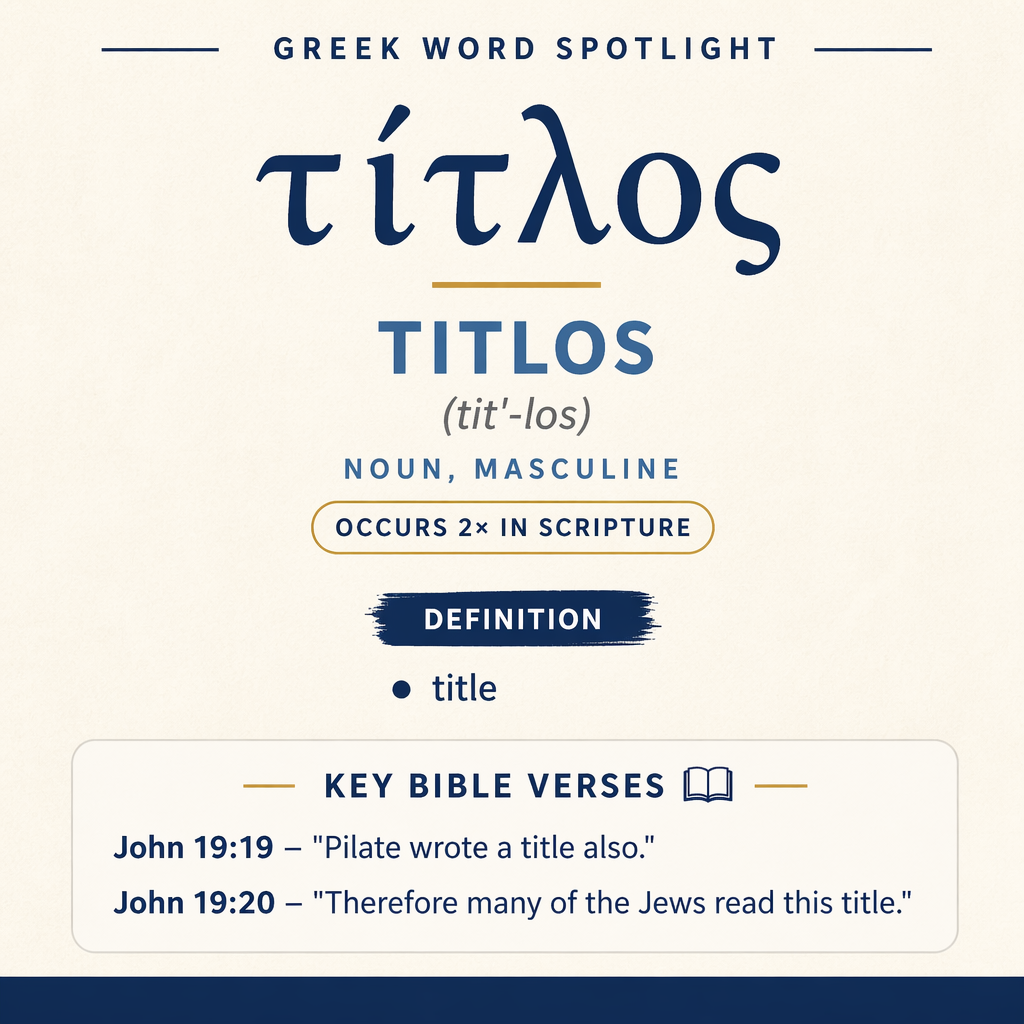
τίτλος means “title” and appears twice in Scripture, in John 19:19–20.
Gospel Occurrences
It occurs in John 19:19 and John 19:20. In both verses it refers to what Pilate wrote and placed on the cross.
Learn More →Inscription Content
John 19:19 records the written title: “JESUS OF NAZARETH, THE KING OF THE JEWS.” John 19:20 notes that many Jews read this title.
Learn More →τίτλος denotes a “title” and appears in the crucifixion narrative in John 19:19–20. In these two verses it refers to the written notice associated with Jesus’ cross, read publicly and presented in multiple languages.
Occurrences
John 19:19 — “Pilate wrote a title also, and put it on the cross. There was written, “JESUS OF NAZARETH, THE KING OF THE JEWS.””
Here τίτλος is something Pilate deliberately produces (“wrote”) and then physically affixes (“put it on the cross”). The verse describes the title as a written item whose content is not left vague: it is explicitly quoted as “JESUS OF NAZARETH, THE KING OF THE JEWS.” In this scene, then, the “title” functions as an identifying inscription tied to the crucifixion itself—attached to the cross and defining, in written words, who is being crucified and how he is being publicly designated. Because the writing is presented as Pilate’s act, the title also carries an official, authorized character within the narrative: it is not a private label but a public notice placed at the site of execution.
The structure of the verse makes the title both an object (something written and placed) and a message (the quoted wording). The narrative emphasis falls on its visibility and fixity: it is not merely spoken but “written,” and not merely written but “put…on the cross,” making the title part of what onlookers would encounter at the crucifixion.
John 19:20 — “Therefore many of the Jews read this title, for the place where Jesus was crucified was near the city; and it was written in Hebrew, in Latin, and in Greek.”
This second occurrence keeps the reference concrete: it is “this title,” pointing back to the same written notice just described. The verse highlights its reception—“many of the Jews read this title”—and explains why it gained readers: “the place where Jesus was crucified was near the city.” τίτλος here is not only an inscription that exists; it is an inscription that is actually read by many, functioning in the open as a readable public statement. The title’s placement and the location of the crucifixion combine to make it broadly accessible.
The verse also underscores the title’s multilingual form: “it was written in Hebrew, in Latin, and in Greek.” The “title” is thus presented as written communication designed to be understood across language boundaries. Within the narrative, τίτλος carries the idea of a visible, written designation made widely intelligible through its linguistic presentation; it is not hidden or coded, but displayed and rendered in multiple languages for the surrounding public.

Sense and Usage
Across John 19:19–20, τίτλος is a written designation attached to the crucifixion setting, serving as a public identifier. The passages treat the “title” as more than a general heading or name: it is a concrete posted notice that belongs to a particular place (“on the cross”) and a particular moment (the crucifixion near the city), and it is meant to be read. The first verse foregrounds production and placement—Pilate writes it and puts it on the cross—while the second verse foregrounds circulation and comprehension—many read it, and it is written in three languages.
The narrative also clarifies what a “title” does in context. It presents a fixed wording that labels the person being executed with a formal identification: “JESUS OF NAZARETH, THE KING OF THE JEWS.” Because the wording is framed as something “written,” τίτλος operates as a stable, repeatable statement—able to be read by multiple observers rather than depending on oral report. This stability is reinforced by the way John 19:20 explains the scale of its readership: proximity to the city results in many readers, so the title becomes part of the public experience of the crucifixion site.
John’s description also links τίτλος to multilingual written form. The same “title” is said to be “written in Hebrew, in Latin, and in Greek,” which portrays the inscription as intentionally presented for broader understanding in a setting where different languages are relevant. The emphasis is not simply that the title exists, but that it is legible to diverse readers. In these verses, then, τίτλος is a title in the most literal sense: a posted written designation intended to be seen and read by the public.
Finally, the two verses together show τίtλος operating at two connected levels: (1) as a physical object associated with the cross, and (2) as a communicative act whose content is the quoted designation and whose reach is widened by location and language. The word gathers both dimensions into a single reference: a “title” is what is posted, and what is posted is a readable message that identifies the one crucified.
Imagery
In John 19:19–20, τίτλος evokes the stark imagery of writing displayed at an execution site: a posted inscription fixed to the cross and exposed to view. The narrative’s focus on reading and on the three languages places the title in the open air of a public place “near the city,” where many pass by and take in the written designation as part of what the crucifixion presents to the world.
Sources: Lexical data from Strong’s Exhaustive Concordance and the Translators Brief Lexicon of Extended Strongs for Greek (STEPBible, CC BY). Occurrence data from the Translators Amalgamated Greek New Testament (STEPBible, CC BY). Scripture quotations from the World English Bible (public domain).