Exploring the Meaning of Theoreo in Greek
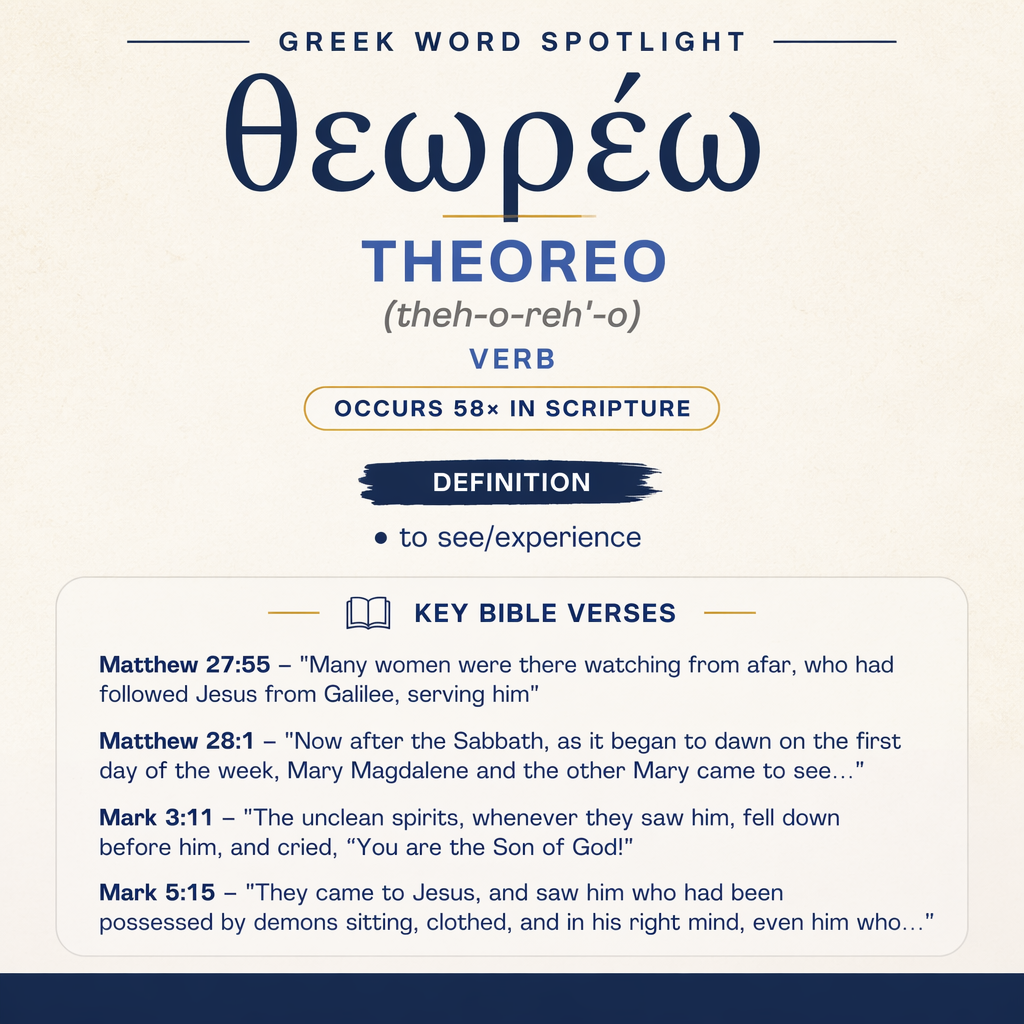
θεωρέω (Theoreo) means “to see/experience” and occurs 58 times in Scripture, including Matthew 27:55; 28:1 and Mark 3:11; 5:15,38; 12:41; 15:40,47.
Core Meaning
θεωρέω means “to see/experience.” In the listed passages it describes observing people, events, and places.
Learn More →Gospel Scenes
In Matthew and Mark, it is used for watching from afar and coming to see (Matthew 27:55; 28:1; Mark 15:40). It also describes seeing Jesus, an uproar, and how people gave offerings (Mark 3:11; 5:15,38; 12:41).
Learn More →Witnessing Events
The word appears in contexts of direct witnessing, including seeing where Jesus was laid (Mark 15:47). It is also used when unclean spirits saw Jesus and cried out (Mark 3:11).
Learn More →θεωρέω expresses seeing as an event of witness or experience, where what is seen has force to shape response. In the passages below it is used for observers at the crucifixion and burial, visitors at the tomb, crowds and spirits reacting to Jesus, and scenes where Jesus himself sees what is happening.
Occurrences
“Many women were there watching from afar, who had followed Jesus from Galilee, serving him.” (Matthew 27:55)
Here θεωρέω frames the women’s role at a distance: they are not participants in the action but steady witnesses to it. The scene ties their watching to their prior following and serving, so the seeing is part of a sustained relationship to Jesus rather than a momentary glance.

“Now after the Sabbath, as it began to dawn on the first day of the week, Mary Magdalene and the other Mary came to see the tomb.” (Matthew 28:1)
In this early-morning approach, the verb presents the visit as an intended encounter with the tomb. The motion (“came”) is oriented toward an experience of what is now the case there, setting up seeing as purposeful contact with the physical site.
“The unclean spirits, whenever they saw him, fell down before him, and cried, “You are the Son of God!”” (Mark 3:11)
θεωρέω links sight to immediate reaction: the spirits’ seeing triggers bodily submission (“fell down”) and a spoken outcry. The repeated circumstance (“whenever”) portrays this seeing as a recurring experience that reliably produces the same response in their presence.
“They came to Jesus, and saw him who had been possessed by demons sitting, clothed, and in his right mind, even him who had the legion; and they were afraid.” (Mark 5:15)
The verb highlights what the onlookers register: the formerly possessed man’s posture, clothing, and restored state. Their fear is connected to what they have seen; the experience of the change is itself unsettling, not merely the report of it.
“He came to the synagogue ruler’s house, and he saw an uproar, weeping, and great wailing.” (Mark 5:38)
Here seeing extends to a charged scene: “an uproar, weeping, and great wailing.” θεωρέω presents Jesus’ arrival as immediately met by an environment that can be apprehended and taken in, where the visible and audible commotion forms the experience.
“Jesus sat down opposite the treasury, and saw how the multitude cast money into the treasury. Many who were rich cast in much.” (Mark 12:41)
In this setting, the verb emphasizes observation of manner (“how”) rather than only outcome. Jesus’ seated position “opposite the treasury” suggests deliberate watching, and the seeing is detailed enough to distinguish patterns within the crowd’s giving.
“There were also women watching from afar, among whom were both Mary Magdalene, and Mary the mother of James the less and of Joses, and Salome;” (Mark 15:40)
As in Matthew’s crucifixion scene, θεωρέω marks sustained witness “from afar.” The naming of the women anchors the act of seeing in identifiable observers, stressing that the watching is not anonymous but carried by specific people present at the event.
“Mary Magdalene and Mary, the mother of Joses, saw where he was laid.” (Mark 15:47)
The verb focuses on the location: they “saw where he was laid.” Seeing functions here as fixing the place in memory, an experienced knowledge of the burial site gained through direct witness.
“for it was very big. Looking up, they saw that the stone was rolled back.” (Mark 16:4)
θεωρέω conveys a fresh discovery made by lifting the eyes: the women’s “looking up” leads to seeing a new state of affairs, “that the stone was rolled back.” The seeing is presented as recognition of a changed physical condition at the tomb.
“He said to them, “I saw Satan having fallen like lightning from heaven.” (Luke 10:18)
Here the verb is used in a first-person statement of experienced sight. The content is narrated as a seen event—“having fallen like lightning from heaven”—so the force of the saying rests on witnessed experience rather than inference.
“Or perhaps, when he has laid a foundation, and is not able to finish, everyone who sees begins to mock him,” (Luke 14:29)
In this cautionary picture, seeing is public observation that leads to social response. The onlookers’ experience of an unfinished building project becomes the basis for ridicule; θεωρέω therefore carries the idea of exposure to view and the consequences that follow.
““As for these things which you see, the days will come, in which there will not be left here one stone on another that will not be thrown down.”” (Luke 21:6)
The verb anchors Jesus’ pronouncement in the disciples’ present visual experience: “these things which you see.” Their immediate sight of impressive structures becomes the reference point for a future reversal, making present perception the backdrop for a warning about what will happen.

Sense and Usage
Across these passages, θεωρέω consistently presents seeing as more than bare noticing; it is seeing that counts as an experience with interpretive weight. The crucifixion scenes show watching “from afar” (Matthew 27:55; Mark 15:40), where the verb supports the idea of sustained witness—remaining present, attentive, and able to testify to what unfolded. That same witnessing function tightens in the burial notice, where the women “saw where he was laid” (Mark 15:47): the experience of seeing secures the place as known.
Several uses display the immediacy of reaction tied to what is seen. The unclean spirits, “whenever they saw him,” respond with falling down and crying out (Mark 3:11); and the townspeople who see the restored man “were afraid” (Mark 5:15). In both, the seeing is portrayed as encounter—contact with a reality that provokes response. Mark 5:38 similarly places Jesus in a situation where what he sees is a scene saturated with grief, “weeping, and great wailing,” and the verb helps depict the intensity of the moment as something met directly upon arrival.
θεωρέω can also present careful, discerning observation. When Jesus “saw how the multitude cast money into the treasury” (Mark 12:41), the focus is not simply that gifts were given but how giving happened, enough to note that “many who were rich cast in much.” In Mark 16:4 the verb carries the sense of discovery: “Looking up, they saw that the stone was rolled back.” The experience of seeing here is a realization of a changed condition, encountered by perception.
Luke’s occurrences widen the range of what is experienced through seeing. Luke 10:18 is an “I saw” statement where the experienced sight is expressed with vivid comparison (“like lightning”), reinforcing the claim’s force as something personally witnessed. Luke 14:29 presents seeing as a public experience that invites judgment; what people observe becomes grounds for mockery. Luke 21:6 uses present sight as the starting point for interpreting time: “these things which you see” are contrasted with coming days of destruction. In these varied scenes, seeing is consistently portrayed as experiential contact that produces knowledge, reaction, or evaluation.
Imagery
The passages repeatedly pair θεωρέω with distance and viewpoint: women “watching from afar” at the cross, observers positioned “opposite the treasury,” visitors “looking up” at the tomb. Whether the scene is grief-stricken uproar (Mark 5:38), public scrutiny of an unfinished foundation (Luke 14:29), or present admiration of visible stones soon to be thrown down (Luke 21:6), the verb’s imagery is of sight that places the observer in relation to an event and makes that event consequential for what follows.
Sources: Lexical data from Strong’s Exhaustive Concordance and the Translators Brief Lexicon of Extended Strongs for Greek (STEPBible, CC BY). Occurrence data from the Translators Amalgamated Greek New Testament (STEPBible, CC BY). Scripture quotations from the World English Bible (public domain).