Exploring the Meaning of Themelios in Greek
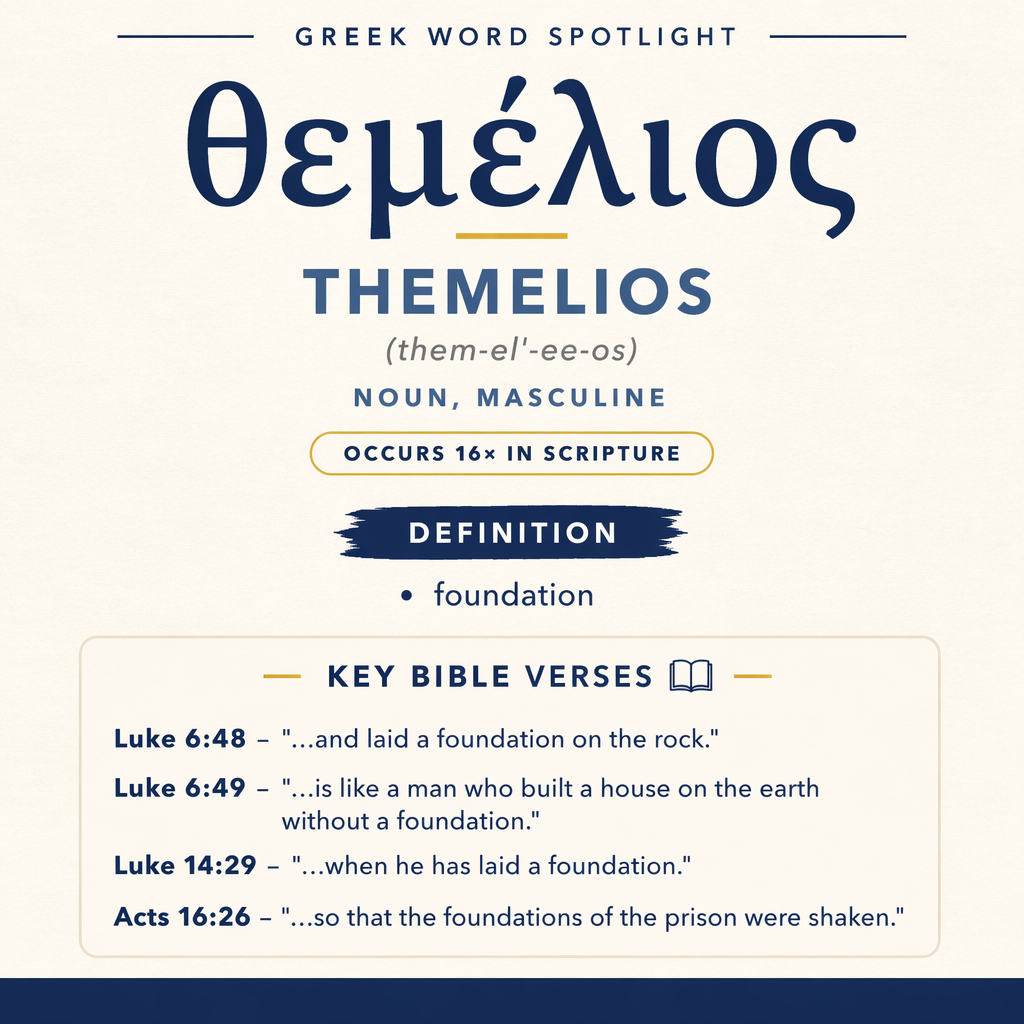
θεμέλιος (Themelios) means “foundation” and occurs 16 times in Scripture, including Luke 6:48–49, Luke 14:29, Acts 16:26, Romans 15:20, and 1 Corinthians 3:10–12.
Core Meaning
θεμέλιος means “foundation.” It can describe what a house or building rests upon.
Learn More →Narrative Scenes
In Luke 6:48–49 it contrasts building with a foundation on rock versus without a foundation. In Acts 16:26, the foundations of the prison are shaken by an earthquake.
Learn More →Paul’s Teaching
In Romans 15:20 Paul speaks of not building on another’s foundation. In 1 Corinthians 3:10–12 he describes laying a foundation and building upon it.
Learn More →θεμέλιος names a foundation: the base laid down so that what is built can stand, be finished, and endure strain. In the passages where it appears, the word moves between literal building work and extended uses drawn from the same building image.
Occurrences
“He is like a man building a house, who dug and went deep, and laid a foundation on the rock. When a flood arose, the stream broke against that house, and could not shake it, because it was founded on the rock.” (Luke 6:48)
Here θεμέλιος is the decisive act of construction that precedes the house itself: the builder “dug and went deep” and “laid a foundation on the rock.” The foundation is shown to matter when external pressure comes (“a flood arose”), because the house resists shaking. The scene ties foundation to depth of preparation and stability under assault.
“But he who hears, and doesn’t do, is like a man who built a house on the earth without a foundation, against which the stream broke, and immediately it fell, and the ruin of that house was great.” (Luke 6:49)
θεμέλιος is absent by design: building “without a foundation” produces immediate collapse when the stream strikes. The word’s contribution is sharpened by contrast—foundation is the hidden element that determines whether the visible structure survives. The verse frames the foundation as a practical necessity, not an optional enhancement.
“Or perhaps, when he has laid a foundation, and is not able to finish, everyone who sees begins to mock him,” (Luke 14:29)
In this brief picture, θεμέλιος marks the point at which a project has undeniably begun: the foundation is already laid, yet the work remains incomplete. Because the foundation is visible evidence of intent, failure to finish becomes public and invites mockery. The word thus carries the idea of an initial, irreversible stage that commits a builder to completion.
“Suddenly there was a great earthquake, so that the foundations of the prison were shaken; and immediately all the doors were opened, and everyone’s bonds were loosened.” (Acts 16:26)
Here the plural “foundations of the prison” depicts the building’s base as something that can be physically shaken by an earthquake. The narrative places θεμέλιος at the deepest, most stable part of the structure; when even that is moved, the whole prison is affected (“all the doors were opened”). Foundation functions as the ultimate structural reference point: if it shifts, everything above it responds.
“yes, making it my aim to preach the Good News, not where Christ was already named, that I might not build on another’s foundation.” (Romans 15:20)
θεμέλιος is used figuratively for a prior base of work on which further work could be done—something already laid by “another.” The language of “build on” keeps the construction image intact: the foundation belongs to an earlier labor, and the speaker’s aim is to avoid entering a place where that base is already established.
“According to the grace of God which was given to me, as a wise master builder I laid a foundation, and another builds on it. But let each man be careful how he builds on it.” (1 Corinthians 3:10)
This verse uses θεμέλιος for the first stage of a communal building project: one person “laid a foundation,” and “another builds on it.” The warning turns on sequence and responsibility: once a foundation exists, later work is measured by how it is built “on it.” The word therefore anchors an ongoing process in which later labor depends on what has already been set down.
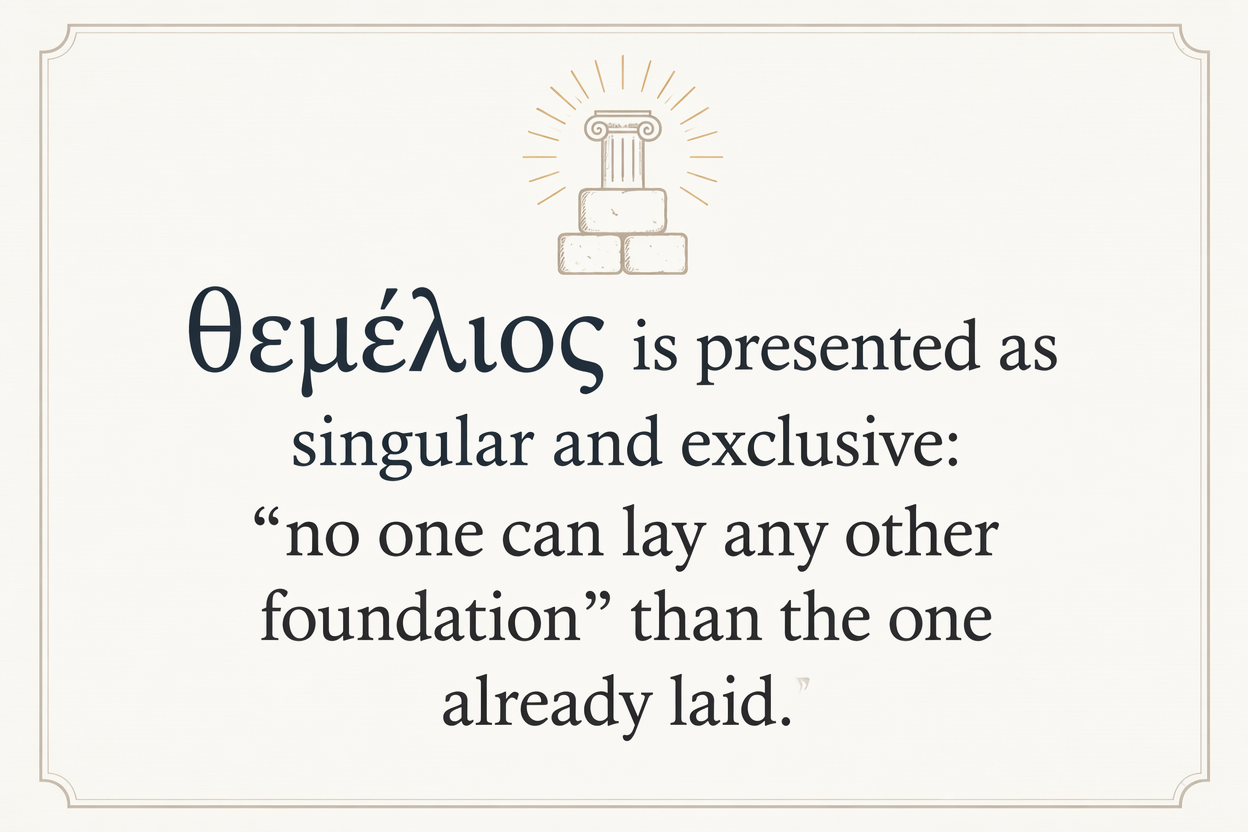
“For no one can lay any other foundation than that which has been laid, which is Jesus Christ.” (1 Corinthians 3:11)
θεμέλιος is presented as singular and exclusive: “no one can lay any other foundation” than the one already laid. The sentence treats the foundation as the non-negotiable base that governs what may legitimately be built. By naming “Jesus Christ” as that laid foundation, the verse locates the entire building image on a fixed base rather than on competing starting points.
“But if anyone builds on the foundation with gold, silver, costly stones, wood, hay, or stubble,” (1 Corinthians 3:12)
θεμέλιος remains constant while the materials above it vary widely. The list stresses that different kinds of superstructure can be added “on the foundation.” The word’s role is to be the common base shared by all builders in view; the emphasis falls on what sort of work is added once the foundation is in place.
“being built on the foundation of the apostles and prophets, Christ Jesus himself being the chief cornerstone;” (Ephesians 2:20)
In this architectural description, θεμέλιος is the supporting base “of the apostles and prophets,” while “Christ Jesus himself” is named as “the chief cornerstone.” The verse presents a unified building where foundation and cornerstone work together: the foundation is the established base on which the structure is “being built,” and the cornerstone provides a defining, aligning element within that same construction picture.
“laying up in store for themselves a good foundation against the time to come, that they may lay hold of eternal life.” (1 Timothy 6:19)
θεμέλιος is applied to the future: a “good foundation” is something stored up “against the time to come.” The foundation is not pictured as a stone platform already visible, but as something secured in advance for what lies ahead. Within the verse’s own terms, this foundation functions as a prepared base connected with “the time to come” and the aim of “lay[ing] hold of eternal life.”
“However God’s firm foundation stands, having this seal, “The Lord knows those who are his,” and, “Let every one who names the name of the Lord depart from unrighteousness.”” (2 Timothy 2:19)
θεμέλιος is “God’s firm foundation” that “stands.” The imagery is of an established base that remains upright and stable, and it is marked as identified and authoritative by a “seal” with two statements. In this setting, foundation evokes stability and permanence, while the “seal” language portrays the foundation as bearing definitive identification and implications for those who “name the name of the Lord.”
“Therefore leaving the teaching of the first principles of Christ, let’s press on to perfection—not laying again a foundation of repentance from dead works, of faith toward God,” (Hebrews 6:1)
θεμέλιος is used for an initial stage in instruction: a “foundation of repentance from dead works, of faith toward God.” The verse assumes that a foundation is laid once and then built upon; the call is to move forward rather than repeat the same foundational laying. The word thus supports a progression model in which beginnings are necessary but not the endpoint.
Sense and Usage
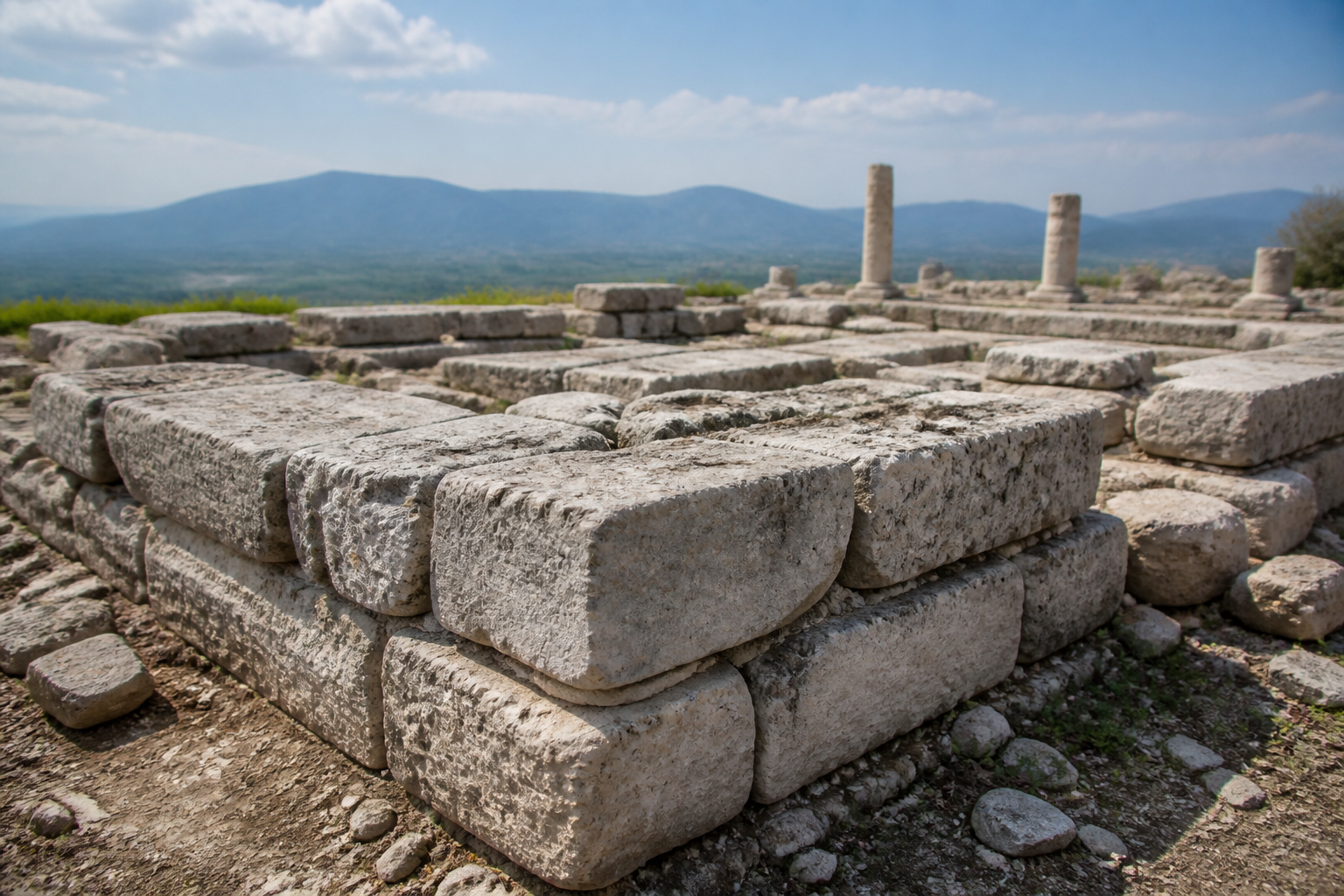
Across these passages, θεμέλιος consistently points to what is laid down first so that something else can be built and endure. In the literal scenes, the foundation is beneath the house (Luke 6:48–49) and at the deepest structural level of a prison (Acts 16:26). These texts highlight two basic characteristics of a foundation: it is prepared deliberately (“dug and went deep”), and it is tested by forces that strike the structure (“flood,” “stream,” “earthquake”). A foundation may be unseen during ordinary conditions, yet it determines whether the visible work stands or falls when stress arrives.
The figurative uses keep the same building logic. A foundation can be someone else’s prior work that one might build upon (Romans 15:20), or it can be the base laid by a “master builder” that shapes the accountability of later builders (1 Corinthians 3:10). The exclusivity of a single laid foundation (1 Corinthians 3:11) intensifies the metaphor: the base is treated as fixed, not subject to replacement, while a range of materials can be built on it (1 Corinthians 3:12). The metaphor also supports a corporate description of being built upon a foundation associated with “the apostles and prophets,” with “Christ Jesus himself” named as “the chief cornerstone” (Ephesians 2:20), keeping the picture of a coherent structure with distinct architectural roles.
Several occurrences extend the concept of foundation beyond present construction into time and endurance. A foundation can be “laid” and yet the builder might fail to finish, exposing the project to public judgment (Luke 14:29). It can be something “laid up in store” as a “good foundation against the time to come” (1 Timothy 6:19), connecting foundation with foresight and future readiness. And it can be described as “God’s firm foundation” that “stands” and bears a “seal” (2 Timothy 2:19), using the stability of a foundation as an image for what remains in place and carries authoritative marking.
Imagery
The word’s imagery is consistently architectural and physical: digging deep, laying a base, building upward, and withstanding shocks. Whether it is a house resisting floodwaters (Luke 6:48), a structure collapsing for lack of a base (Luke 6:49), or the deep supports of a prison moving in an earthquake (Acts 16:26), θεμέλιος keeps attention on what lies underneath and what must be set before anything lasting can be built.
Sources: Lexical data from Strong’s Exhaustive Concordance and the Translators Brief Lexicon of Extended Strongs for Greek (STEPBible, CC BY). Occurrence data from the Translators Amalgamated Greek New Testament (STEPBible, CC BY). Scripture quotations from the World English Bible (public domain).