Exploring the Meaning of Thalpo in Greek
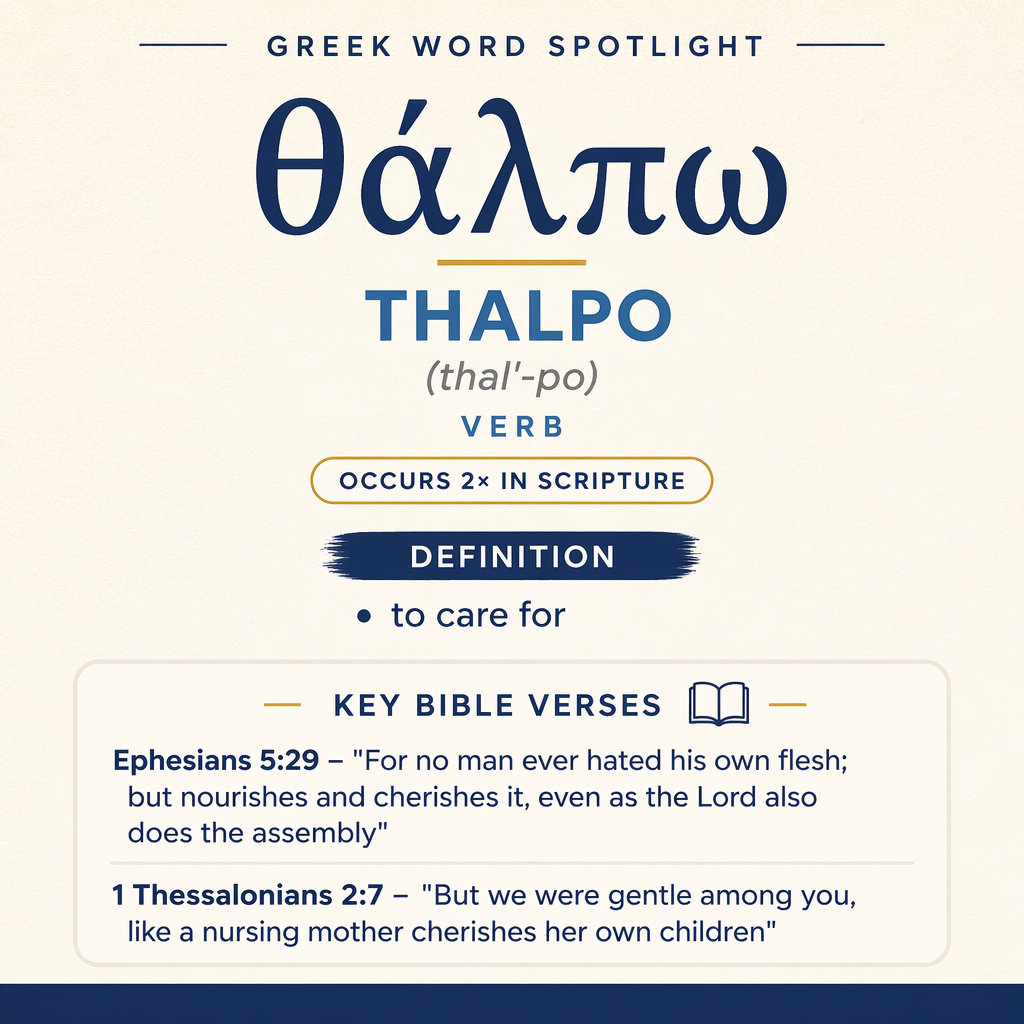
θάλπω (Thalpo) means “to care for” and appears in Ephesians 5:29 and 1 Thessalonians 2:7.
Scripture Occurrences
This verb occurs 2 times in Scripture: Ephesians 5:29 and 1 Thessalonians 2:7.
Learn More →Contextual Picture
In Ephesians 5:29 it is used of cherishing one’s own flesh; in 1 Thessalonians 2:7 it describes a nursing mother cherishing her children.
Learn More →θάλπω speaks of caring for someone, and it appears in two New Testament passages: one about a man’s relation to his own body and the Lord’s relation to the assembly, and one comparing apostolic gentleness to a nursing mother with her children. In both places it functions as a vivid, intimate way to describe care that is personal and attentive.
Occurrences
Ephesians 5:29 — “For no man ever hated his own flesh; but nourishes and cherishes it, even as the Lord also does the assembly;”
Here θάλπω is represented by “cherishes,” paired closely with “nourishes.” The verse argues from a basic human pattern: a man does not habitually act with hostility toward “his own flesh,” but instead sustains it and treats it with care. Within that logic, θάλπω contributes the warm, protective side of self-care—care that is not merely functional but affectionate and preserving. The comparison then extends the same kind of care to “the Lord” in relation to “the assembly.” In the shape of the sentence, the verb helps carry an analogy: as ordinary self-regard expresses itself in nourishing and cherishing one’s body, so the Lord’s action toward the assembly is described with the same caring posture. The word thus participates in a relational argument, where the model for care is drawn from the body’s instinctive, continual attention to itself.

The immediate context within the verse is concrete and embodied: “flesh,” “nourishes,” and “cherishes.” θάλπω fits naturally in that cluster because it portrays care as something done toward a living, vulnerable reality—one’s own flesh—rather than toward an abstract object. The comparison “even as the Lord also does the assembly” places this care in the realm of an active relationship: the Lord’s involvement is presented not as distant oversight but as intimate tending.
1 Thessalonians 2:7 — “But we were gentle among you, like a nursing mother cherishes her own children.”
In this line θάλπω again appears as “cherishes,” but the scene shifts from self-care and the Lord’s care to the apostles’ manner “among you.” The controlling description is “we were gentle,” and θάλπω supplies the illustrative picture that defines what that gentleness looks like: “like a nursing mother” with “her own children.” The verb gives gentleness a particular texture—care that is close, personal, and shaped by attachment. The image of a nursing mother foregrounds the child’s dependence and the mother’s attentive response; by using θάλπω in that comparison, the verse frames apostolic gentleness as more than soft speech or restraint. It is gentleness expressed through cherishing—care that is deliberate and protective in the very space where vulnerability is greatest.
The phrase “her own children” further tightens the meaning in context. The care in view is not generic benevolence but the kind of cherishing that belongs to a bond of belonging. θάλπω, as it functions in this sentence, depicts a manner of presence “among you” that is relationally committed: it treats the community not as an audience or project but as those to be cared for with familial tenderness.

Sense and Usage
Across these two occurrences θάλπω expresses care in settings where the object of care is not distant but intimately connected to the one who cares. In Ephesians 5:29 the first illustration is the self’s relation to “his own flesh,” and the second is “the Lord” in relation to “the assembly.” In 1 Thessalonians 2:7 the illustration is the apostolic “we” in relation to “you,” clarified by the mother–child bond. In each case, the verb’s force is strengthened by the closeness of the relationship: flesh belonging to oneself, a community belonging to the Lord’s concern, children belonging to their mother’s nurture.
Because θάλπω is placed alongside other language of sustenance (“nourishes”) and gentleness (“we were gentle”), the care it depicts is not merely a sentiment. It is care shown in ongoing, practical attentiveness. Ephesians expresses this as a settled human pattern—“no man ever hated his own flesh; but nourishes and cherishes it”—so the verb fits an action that is habitual and embodied. Thessalonians expresses it as a chosen posture in ministry—“we were gentle among you”—so the verb fits an action that is interpersonal and protective.
The word’s two scenes also show how θάλπω can function within argument and within analogy. In Ephesians 5:29 it helps make a comparison persuasive: the normal instinct to care for one’s body becomes a bridge to understanding the Lord’s care for the assembly. The verb therefore carries explanatory weight; it contributes to the logic of likeness (“even as”). In 1 Thessalonians 2:7 it helps make a manner vivid: the community is to understand apostolic gentleness by picturing a mother cherishing her own children. The verb therefore carries illustrative weight; it makes a relational claim concrete by embedding it in a home-like, nurturing image.
Even though both verses translate θάλπω with the same English verb, the surrounding words give it slightly different contours. In Ephesians 5:29 it is paired with “nourishes,” so the care described includes the idea of providing what is needed and treating the object of care as something to be kept in health and well-being. In 1 Thessalonians 2:7 it is paired with “gentle” and framed by “nursing mother,” so the care described emphasizes tenderness and a protective closeness. These contextual pairings keep θάλπω from being heard as detached concern: it is care expressed through nearness and personal investment.
Imagery
The two passages that use θάλπω both choose pictures where care is most naturally expected and most easily recognized. Ephesians 5:29 invokes the ordinary, unselfconscious way a person looks after his own body, then extends that picture to “the Lord” and “the assembly,” framing divine care as active and cherishing. 1 Thessalonians 2:7 evokes the gentleness of a nursing mother with “her own children,” using that domestic scene to describe how the speakers were “among you.” In these images θάλπω carries warmth and closeness: care that is protective, sustaining, and bound up with belonging.
Sources: Lexical data from Strong’s Exhaustive Concordance and the Translators Brief Lexicon of Extended Strongs for Greek (STEPBible, CC BY). Occurrence data from the Translators Amalgamated Greek New Testament (STEPBible, CC BY). Scripture quotations from the World English Bible (public domain).