Exploring the Meaning of Teras in Greek
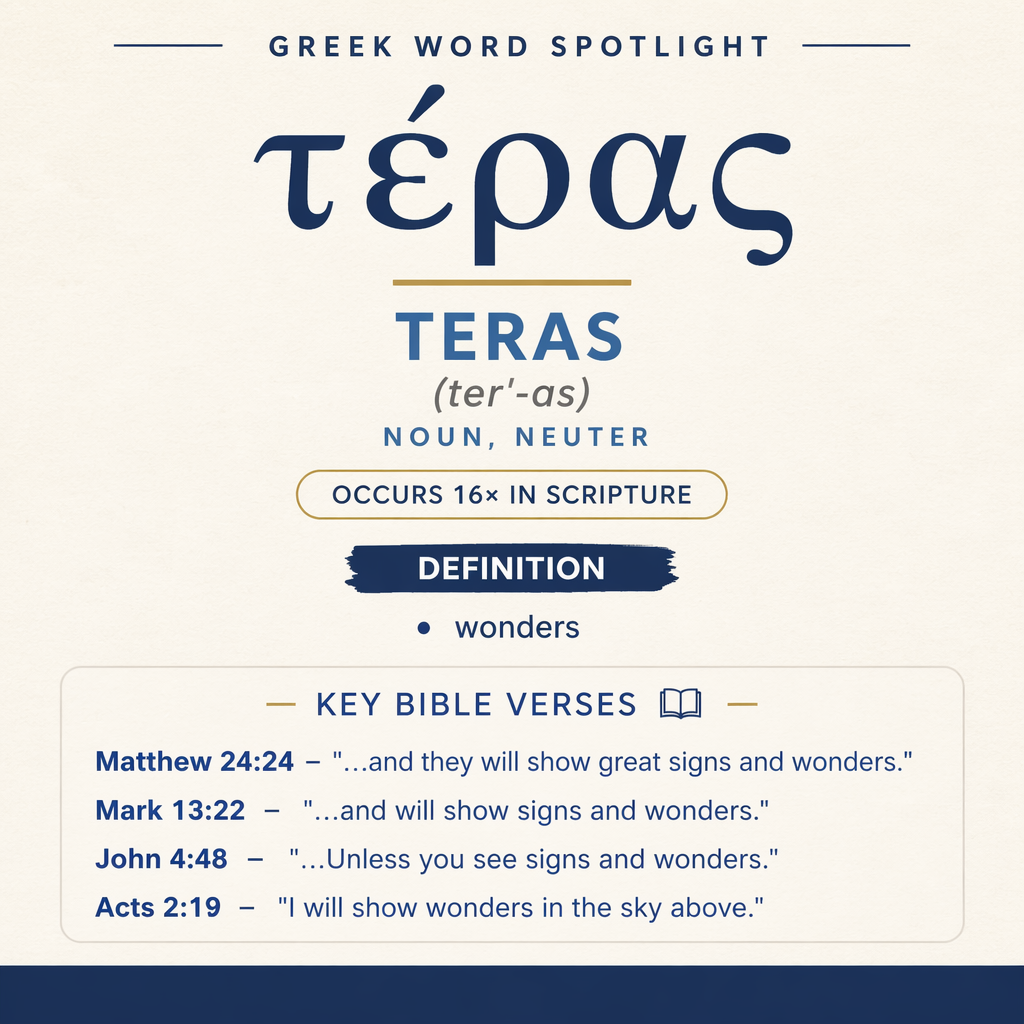
τέρας means “wonders” in Greek and occurs 16 times in Scripture, often paired with “signs” in Gospel and Acts contexts.
Core Meaning
τέρας is defined as “wonders.” In the cited passages it appears alongside “signs,” forming the recurring phrase “signs and wonders.”
Learn More →Gospel Usage
In Matthew 24:24 and Mark 13:22, false christs and false prophets show “signs and wonders” to lead astray. In John 4:48, Jesus notes a demand for “signs and wonders” to believe.
Learn More →Acts Usage
Acts uses τέρας for divine wonders in the sky and on earth (Acts 2:19) and for wonders done through Jesus and the apostles (Acts 2:22; 2:43; 4:30; 5:12).
Learn More →τέρας speaks of “wonders,” a term repeatedly paired with “signs” in passages that describe extraordinary acts that arrest attention and shape response. In the New Testament scenes where it appears, it can be associated both with deception and with God’s validating activity in public view.
Occurrences
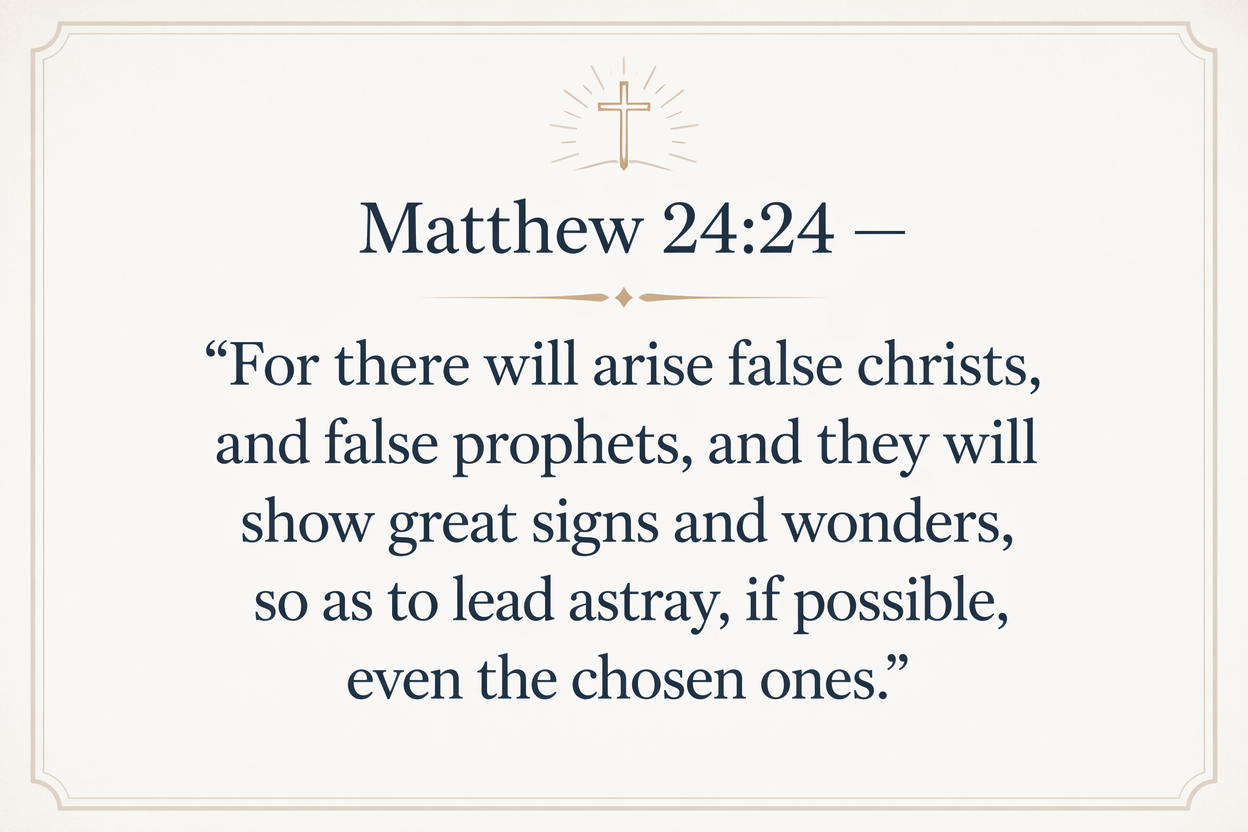
Matthew 24:24 — “For there will arise false christs, and false prophets, and they will show great signs and wonders, so as to lead astray, if possible, even the chosen ones.”
Here “wonders” belongs to what false claimants “will show,” and the adjective “great” heightens their impact. The verse links these wonders with an intended effect: “to lead astray.” In this setting, the presence of wonders does not itself authenticate the agents performing them; instead, wonders function as persuasive displays capable of exerting pressure even on “the chosen ones.”
Mark 13:22 — “For there will arise false christs and false prophets, and will show signs and wonders, that they may lead astray, if possible, even the chosen ones.”
This parallel statement again puts “wonders” in the toolkit of false christs and prophets. The clause “that they may lead astray” makes the practical role of wonders explicit: they serve as attention-grabbing phenomena aimed at misdirection. “Wonders” are not described in detail, but their function in the sentence is clear—an instrument used to influence judgment.
John 4:48 — “Jesus therefore said to him, “Unless you see signs and wonders, you will in no way believe.””
In this exchange, “wonders” appears in Jesus’ diagnosis of what drives belief for the person addressed (“Unless you see…”). The pairing with “signs” frames wonders as visible experiences that can become a prerequisite for faith. The statement does not deny that wonders occur; it highlights a demand for them as the condition of being persuaded.
Acts 2:19 — “I will show wonders in the sky above, and signs on the earth beneath: blood, and fire, and billows of smoke.”
“Wonders” here are explicitly located “in the sky above,” contrasted with “signs on the earth beneath.” The verse illustrates the wonder-language with striking phenomena—“blood, and fire, and billows of smoke”—depicting an environment marked by dramatic, visible disturbances. Wonders, in this line, belong to what “I will show,” emphasizing disclosure and spectacle on a cosmic scale.
Acts 2:22 — ““Men of Israel, hear these words! Jesus of Nazareth, a man approved by God to you by mighty works and wonders and signs which God did by him among you, even as you yourselves know,”
“Wonders” is part of a threefold description—“mighty works and wonders and signs”—that expresses how Jesus was “approved by God” in the audience’s midst. The wonders are not portrayed as private experiences but as deeds done “among you,” appealing to shared public knowledge (“even as you yourselves know”). Wonders thus serve as part of a recognizable pattern of divine action within communal memory.
Acts 2:43 — “Fear came on every soul, and many wonders and signs were done through the apostles.”
This verse ties “wonders” directly to the community’s emotional response: “Fear came on every soul.” The wonders are “many,” and they are mediated “through the apostles,” indicating that the phenomena are both numerous and socially visible. Wonders here contribute to an atmosphere of awe and seriousness in the whole group.
Acts 4:30 — “while you stretch out your hand to heal; and that signs and wonders may be done through the name of your holy Servant Jesus.”
“Wonders” appears within a prayer that connects healing with “signs and wonders.” The wording asks that such acts “may be done through the name of your holy Servant Jesus,” locating the agency and authorization in that name. Wonders, in this request, are not ends in themselves; they are sought alongside healing as part of what God may do in response to prayer.
Acts 5:12 — “By the hands of the apostles many signs and wonders were done among the people. They were all with one accord in Solomon’s porch.”
Here “wonders” again are “many,” and they are performed “by the hands of the apostles,” stressing concrete, observable action. The phrase “among the people” places the wonders in public space, and the note about being “with one accord in Solomon’s porch” situates them within a recognizable communal gathering. Wonders belong to an outward, shared life rather than a hidden spirituality.
Acts 6:8 — “Stephen, full of faith and power, performed great wonders and signs among the people.”
In Stephen’s case, “wonders” are “great” and occur “among the people,” continuing the theme of public visibility. The verse links Stephen’s capacity to perform them with being “full of faith and power,” associating wonders with a personal characterization that frames the actions. Wonders here distinguish Stephen’s ministry as marked by notable, attention-commanding deeds.
Acts 7:36 — “This man led them out, having worked wonders and signs in Egypt, in the Red Sea, and in the wilderness for forty years.”
“Wonders” reaches back into Israel’s story: the one who “led them out” is credited with having “worked wonders and signs” across multiple arenas—“in Egypt, in the Red Sea, and in the wilderness”—and across a long span, “for forty years.” Wonders in this retelling are not a brief burst but a sustained pattern accompanying deliverance and guidance through varied settings.
Acts 14:3 — “Therefore they stayed there a long time, speaking boldly in the Lord, who testified to the word of his grace, granting signs and wonders to be done by their hands.”
In this missionary setting, “wonders” are described as something the Lord “granting” to be done “by their hands.” The wonders function as the Lord’s testimony “to the word of his grace,” so they appear as corroborating acts alongside proclamation. The verse intertwines speech (“speaking boldly”) and deed (granted wonders), presenting wonders as part of how the message is publicly confirmed.
Acts 15:12 — “All the multitude kept silence, and they listened to Barnabas and Paul reporting what signs and wonders God had done among the nations through them.”
“Wonders” here are the content of missionary report: what “God had done among the nations through them.” The audience response—“All the multitude kept silence”—depicts wonders as weighty evidence that commands attention. Wonders also mark the extension of God’s activity beyond a single locale, occurring “among the nations,” while still being attributed to God as the primary actor.

Sense and Usage
Across these passages, τέρας repeatedly appears as a plural phenomenon—“wonders”—often coupled with “signs,” and sometimes grouped with “mighty works.” The consistent pairing suggests that wonders are recognized as striking occurrences that stand out in experience and memory; they are things people can “see,” that can be “shown” in sky or enacted “among the people,” and that can be “reported” afterward as notable events.
The word’s usage also highlights how wonders operate within human response. In Matthew 24:24 and Mark 13:22, wonders are associated with the attempt “to lead astray,” warning that impressive displays can be recruited for manipulation. In John 4:48, wonders become the demanded precondition of belief: the issue is not merely that wonders exist, but that people can set their trust on the basis of seeing them. In Acts 2:43, wonders contribute to communal fear and awe—“Fear came on every soul”—showing their capacity to shape atmosphere and reverence within a gathered community.
In Acts, wonders also serve a public, corroborating role. Acts 2:22 speaks of Jesus being “approved by God” through deeds characterized as “mighty works and wonders and signs” done “among you,” while Acts 14:3 describes the Lord “testified to the word of his grace” by “granting signs and wonders.” Acts 4:30 places wonders alongside healing as something sought in prayer, and Acts 15:12 portrays wonders as evidence of God’s work “among the nations,” compelling a listening silence. Even when carried out “by the hands” of apostles or missionaries, wonders are consistently framed as what God does, grants, or shows, keeping the focus on divine initiative rather than human showmanship.
Finally, Acts 2:19 and Acts 7:36 broaden the horizon of wonder-language beyond immediate church life. Wonders can be cosmic (“in the sky above”) and can stretch across the remembered geography of deliverance (“in Egypt, in the Red Sea, and in the wilderness for forty years”). The term is thus at home both in sweeping, skyward imagery and in long, historical narratives of leadership and rescue.
Imagery
The imagery attached to “wonders” in these verses is vivid and public. Acts 2:19 paints wonders as sky-bound events that can be seen overhead, with earthly upheaval named in concrete terms—“blood, and fire, and billows of smoke.” Elsewhere, wonders take the form of deeds done “among the people,” leaving a communal trace: fear, silence, testimony, and report. Whether used as deceptive spectacle or as God’s validating action, τέρας carries the feel of extraordinary happenings that demand notice and provoke response.
Sources: Lexical data from Strong’s Exhaustive Concordance and the Translators Brief Lexicon of Extended Strongs for Greek (STEPBible, CC BY). Occurrence data from the Translators Amalgamated Greek New Testament (STEPBible, CC BY). Scripture quotations from the World English Bible (public domain).