
Exploring the Meaning of Teleiotes in Greek
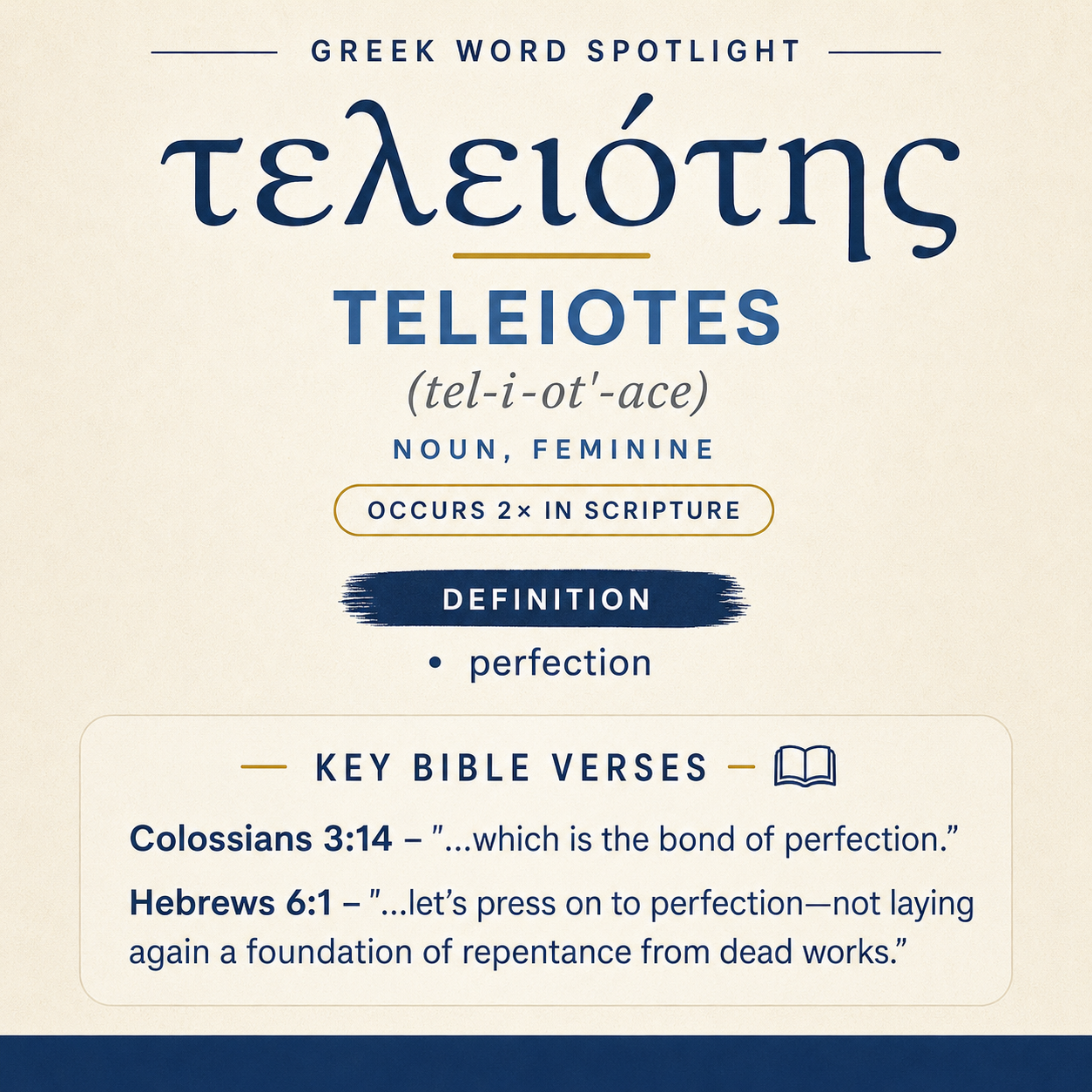
τελειότης means “perfection” and appears twice in Scripture: Colossians 3:14 and Hebrews 6:1.
Scripture Occurrences
It occurs two times in Scripture. The references are Colossians 3:14 and Hebrews 6:1.
Learn More →Verse Context
In Colossians 3:14, love is called “the bond of perfection.” In Hebrews 6:1, believers are urged to “press on to perfection.”
Learn More →τελειότης expresses “perfection” in two New Testament settings: a call to let love function as a binding force, and an exhortation to move beyond elementary instruction toward a fuller goal. In both passages, the term names an intended completeness that shapes how the Christian life is held together and how Christian teaching is pursued.
Root and Related Words
τελειότης is associated with the adjective teleios (τέλειος), “perfect” (Strong’s G5046). The noun form names the quality or state corresponding to what the adjective describes.

Occurrences
“Above all these things, walk in love, which is the bond of perfection.” (Colossians 3:14)
Here τελειότης stands at the end of a short but densely packed statement: love is called “the bond of perfection.” The imagery is concrete and relational—something functions as a “bond,” a tying or fastening element, and the result is “perfection.” Within the sentence, τελειότης is not presented as an isolated achievement but as the outcome that love binds together. The verse frames love as supreme (“Above all these things”) and active (“walk in love”), then describes its effect with the metaphor of binding. In this setting, “perfection” is pictured as a coherence or wholeness produced when love holds the various elements of life together, the way a binding keeps parts from separating.

The line also places τελειότης in close connection with community and practice: “walk” suggests an ongoing pattern, and “bond” suggests joined pieces. The word therefore contributes a goal-oriented force to the exhortation. Love is not merely one virtue among others; it is depicted as the connecting strength that carries the whole arrangement toward its intended completed state.
“Therefore leaving the teaching of the first principles of Christ, let’s press on to perfection—not laying again a foundation of repentance from dead works, of faith toward God,” (Hebrews 6:1)
In Hebrews 6:1 τελειότης appears as the destination of forward motion: “let’s press on to perfection.” The verse begins with “Therefore,” linking the call to what has just been argued, and then contrasts two stages of instruction and growth. On the one hand is “the teaching of the first principles of Christ”; on the other is the act of pressing forward. τελειότης names what lies ahead, the point toward which the community is urged to move.
The verse clarifies the contrast by using building language: “not laying again a foundation.” Repentance and faith are mentioned as part of this foundational layer (“a foundation of repentance from dead works, of faith toward God”). Within this construction metaphor, τελειότης stands over against repeatedly restarting the basics. The word supplies the sense of an intended endpoint for instruction and maturity: the community is to build beyond the foundation rather than continually re-establish it. In this scene, “perfection” is not defined by the list of foundational items; it is the larger objective beyond them, the goal implied by “press on,” as one advances from beginning stages to a more complete state.
Sense and Usage
Across these two passages, “perfection” functions as a named goal that organizes movement and cohesion. In Colossians, τελειότης is bound to the present practice of love: love is described as the bonding element that produces a unified, completed condition. The emphasis falls on how the life of love holds things together so that the whole is not fragmented. “Perfection” there is pictured less as a private internal state and more as a wholeness that emerges when love binds.
In Hebrews, τελειότης is the forward aim of a learning and growth process: the community is urged to leave elementary instruction and press onward. The building metaphor (“foundation”) makes “perfection” sound like the completed structure rather than the first layer. The word thus carries a directional pull: it indicates the point at which something has reached its intended fullness, contrasted with returning again and again to the initial stage.
Put together, the two uses portray “perfection” as both integrative and progressive. It is integrative in that it is something “bonded” by love—an achieved coherence. It is progressive in that it is something one “press[es] on to”—an intended completion ahead of the present stage. In each case, τελειότης does not float as an abstract ideal detached from concrete verbs and images. It is tied to “walk” and to “press on,” and it is framed by metaphors of binding and building. Those surrounding features determine how the reader is meant to understand “perfection” in these contexts: as a completing wholeness that love secures and as a maturity that growth aims to reach.
Imagery in Context
The passages attach τελειότης to two vivid pictures. Colossians speaks of a “bond,” evoking a fastening that keeps a set of things joined; “perfection” is what that binding serves. Hebrews speaks of leaving beginnings and not laying “a foundation” again, implying construction that continues toward a finished result; “perfection” names the direction of that continued building. Together these images portray “perfection” as something that both holds a life together and stands as the terminus toward which teaching and practice advance.
Sources: Lexical data from Strong’s Exhaustive Concordance and the Translators Brief Lexicon of Extended Strongs for Greek (STEPBible, CC BY). Occurrence data from the Translators Amalgamated Greek New Testament (STEPBible, CC BY). Scripture quotations from the World English Bible (public domain).




