Exploring the Meaning of Talanton in Greek
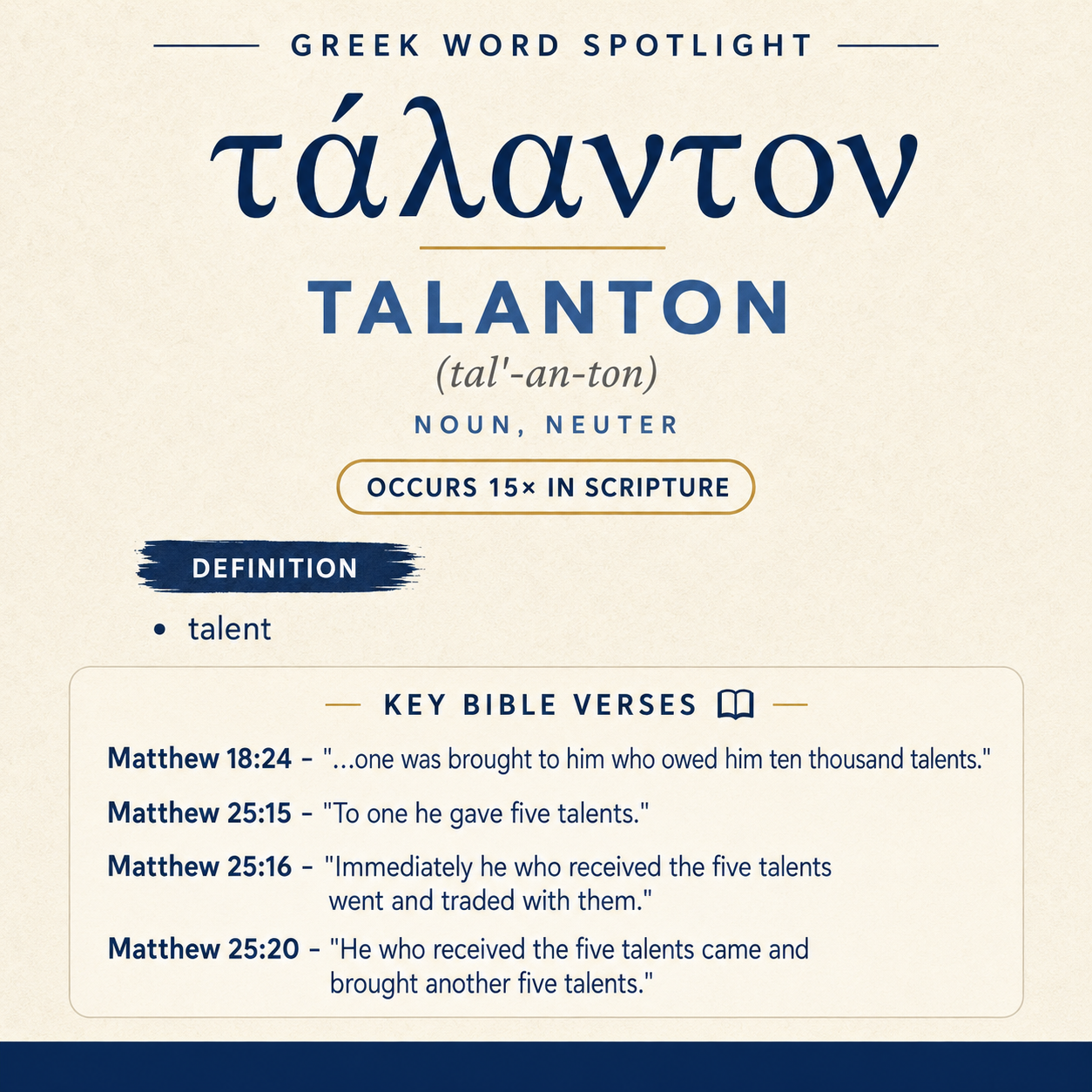
τάλαντον (Talanton) means “talent” and appears 15 times in Scripture, including Matthew 18:24 and Matthew 25:15–28.
Matthew 18 Usage
In Matthew 18:24, it names a debt: “ten thousand talents.” The term functions as the unit of what is owed.
Learn More →Matthew 25 Usage
In Matthew 25:15–28, servants receive five, two, or one talent, and one hides his talent in the earth. The talent can be taken away and given to the one with ten talents (Matthew 25:28).
Learn More →τάλαντον means “talent,” appearing in passages where large sums are counted, entrusted, increased, withheld, or transferred. In the cited texts it functions as a concrete unit of value within scenes of reckoning and accountability.
Occurrences
Matthew 18:24
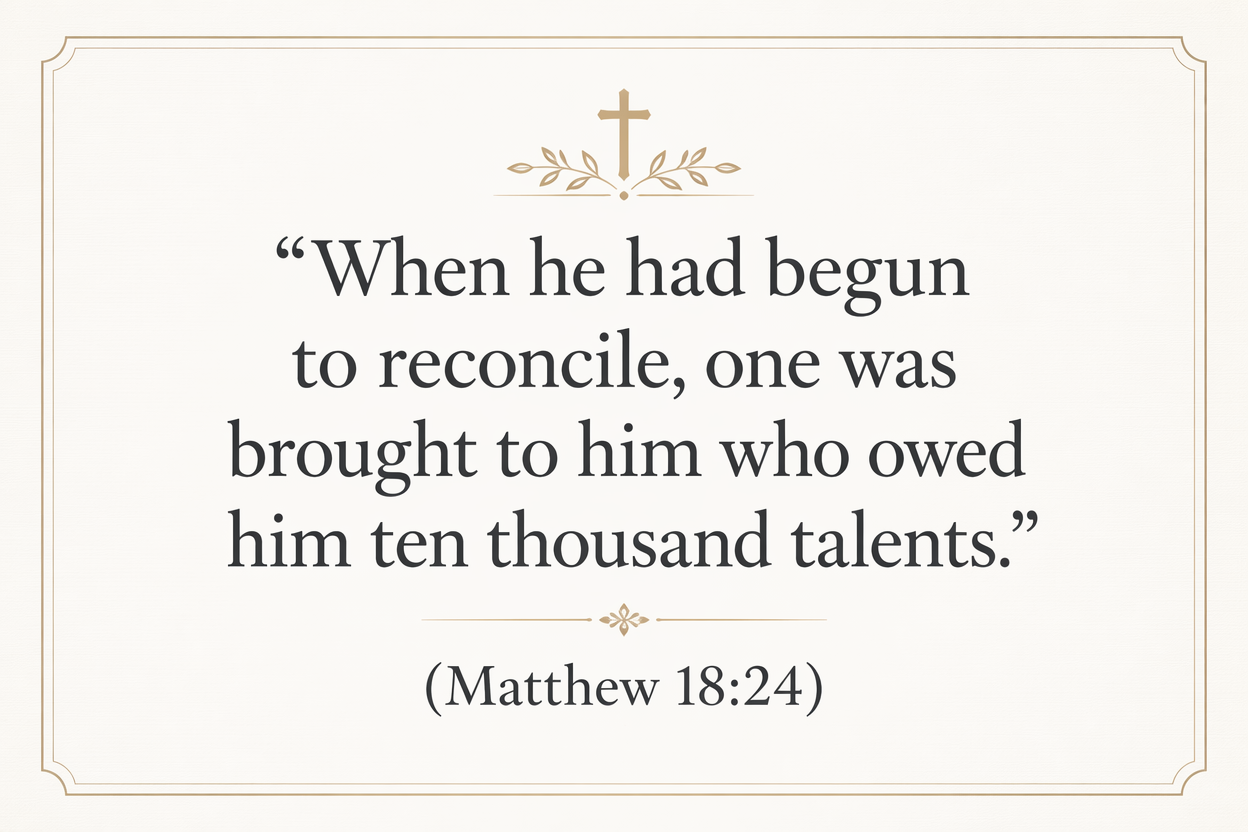
“When he had begun to reconcile, one was brought to him who owed him ten thousand talents.” (Matthew 18:24)
Here τάλαντον marks the scale of what is owed during a process of reconciliation. The phrase “ten thousand talents” frames the debt as extraordinarily large, so that the situation is defined from the outset by the sheer magnitude of what must be addressed. The word contributes the concrete, countable form of the obligation: this is not a vague wrongdoing but an itemized liability that can be named and totaled as “talents.”
Matthew 25:15
“To one he gave five talents, to another two, to another one; to each according to his own ability. Then he went on his journey.” (Matthew 25:15)
In this distribution scene τάλαντον is the thing entrusted by the giver and received by each servant in differing amounts. The word anchors the narrative’s variety—“five,” “two,” and “one”—in a single, shared unit, allowing comparison while highlighting unequal allotment. It also sets up the later evaluation: what follows will concern how each person handles the particular number of “talents” committed to him.
Matthew 25:16
“Immediately he who received the five talents went and traded with them, and made another five talents.” (Matthew 25:16)
τάλαντον here is both the initial deposit (“the five talents”) and the measure of the gain (“another five talents”). The narrative uses the same unit to describe input and output, making the increase plain and symmetrical: the servant’s activity results in a doubling expressed in talents. The word thus serves as the accounting term by which the servant’s conduct is evaluated, since the outcome can be stated in the same unit as the trust.
Matthew 25:20
“He who received the five talents came and brought another five talents, saying, ‘Lord, you delivered to me five talents. Behold, I have gained another five talents in addition to them.’” (Matthew 25:20)
In the report to the “Lord,” τάλαντον becomes the language of testimony and proof. The servant recounts what was “delivered” and what was “gained,” and in both clauses the concrete totals (“five” and “another five”) are expressed through “talents.” The word carries the weight of verification: the servant can “bring” the result and can state it numerically, presenting the “talents” as the visible measure of faithful handling.
Matthew 25:22
““He also who got the two talents came and said, ‘Lord, you delivered to me two talents. Behold, I have gained another two talents in addition to them.’” (Matthew 25:22)
τάλαντον again functions as the stable unit that makes a fair comparison possible across different starting amounts. The servant with “two talents” uses the same pattern of speech as the one with “five”: what was entrusted is matched by an equivalent gain “in addition to them.” Because the word remains constant, the focus falls not on identical totals but on the responsible outcome relative to what was received.
Matthew 25:24
““He also who had received the one talent came and said, ‘Lord, I knew you that you are a hard man, reaping where you didn’t sow, and gathering where you didn’t scatter.” (Matthew 25:24)
This verse introduces the “one talent” as the context for the servant’s explanation, even though his speech begins by describing his perception of the “Lord.” τάλαντον identifies the scope of his entrusted responsibility: it is singular (“the one talent”), and the narrative positions his approach in contrast to the earlier servants. The word quietly fixes what is at stake—one entrusted “talent”—before the rationale for his conduct is voiced.
Matthew 25:25
“I was afraid, and went away and hid your talent in the earth. Behold, you have what is yours.’” (Matthew 25:25)
Here τάλαντον is the object that is hidden and then returned. The servant calls it “your talent,” emphasizing ownership and the entrusted nature of the item: it belongs to the “Lord” even while it has been in the servant’s custody. By placing the “talent” “in the earth,” the servant treats it as something to be preserved unchanged rather than used for increase, and the final statement—“you have what is yours”—casts the “talent” as the minimal, untouched remainder of the trust.
Matthew 25:28
“Take away therefore the talent from him, and give it to him who has the ten talents.” (Matthew 25:28)
τάλαντον here is the subject of removal and reassignment. The command treats the “talent” as a transferable asset: it can be “take[n] away” from one person and “give[n]” to another. The contrast between “the talent” (singular) and “the ten talents” (plural) places the word within an explicit redistribution, where the unit of value is gathered to the one who already “has” many talents.

Sense and Usage
Across these scenes τάλαντον operates as a counted “talent,” a unit that can be owed, delivered, traded with, gained, hidden, brought back, taken away, and given. The word’s contribution is consistently concrete and measurable: the texts emphasize numerals attached to it (“ten thousand,” “five,” “two,” “one,” “ten”), and those numerals shape the reader’s sense of proportion—especially where the amounts are extreme or sharply contrasted.
In Matthew 18:24, τάλαντον belongs to a setting of financial reckoning: reconciliation begins with the presentation of a debtor whose liability is described in talents. The word thereby supports the picture of an obligation that can be stated as a sum, making the confrontation with debt precise and unavoidably large.
In Matthew 25:15–28, τάλαντον becomes the narrative’s accounting term for stewardship. It is “gave[n]” according to ability, and then it serves as the common denominator in the servants’ actions and reports: the one who trades “with them” can describe his outcome as “another five talents,” and the one who gains can present the gain as “in addition to them.” Because the same unit is used for what was entrusted and what was produced, the word naturally fits the theme of evaluation: increase and non-increase are expressed in the identical measure.
Notably, τάλαντον can be handled in sharply different ways without changing what it is. In the trading scenes it functions as capital used in activity (“traded with them”), while in the fearful servant’s account it is treated as a deposit to be safeguarded (“hid your talent in the earth”). The word itself remains the stable, countable item; the story’s tension arises from what is done with that item—growth measured in talents, or preservation of a single talent unchanged.
Finally, τάλαντον is shown to be movable between persons under authority. In Matthew 25:28 a “talent” is not merely possessed but reassigned: the same unit that was once received by one servant becomes the object of an order transferring it to another. This reinforces the way τάλαντον, in these texts, stands for a concrete entrusted value that remains accountable to its giver and can be reclaimed and redistributed.
Imagery
The imagery associated with τάλαντον in these passages is that of visible sums passing through hands in moments of reckoning: a debtor “owe[s]… ten thousand talents” (Matthew 18:24), servants receive differing counts (Matthew 25:15), gains are presented as additional talents (Matthew 25:20, 25:22), and one “hid[s] your talent in the earth” (Matthew 25:25) before the “talent” is taken and given elsewhere (Matthew 25:28). The “talent” thus functions as a tangible measure that can be counted, buried, carried, and transferred, making responsibility and outcome legible in the plain language of totals.
Sources: Lexical data from Strong’s Exhaustive Concordance and the Translators Brief Lexicon of Extended Strongs for Greek (STEPBible, CC BY). Occurrence data from the Translators Amalgamated Greek New Testament (STEPBible, CC BY). Scripture quotations from the World English Bible (public domain).