
Exploring the Meaning of Tachu in Greek
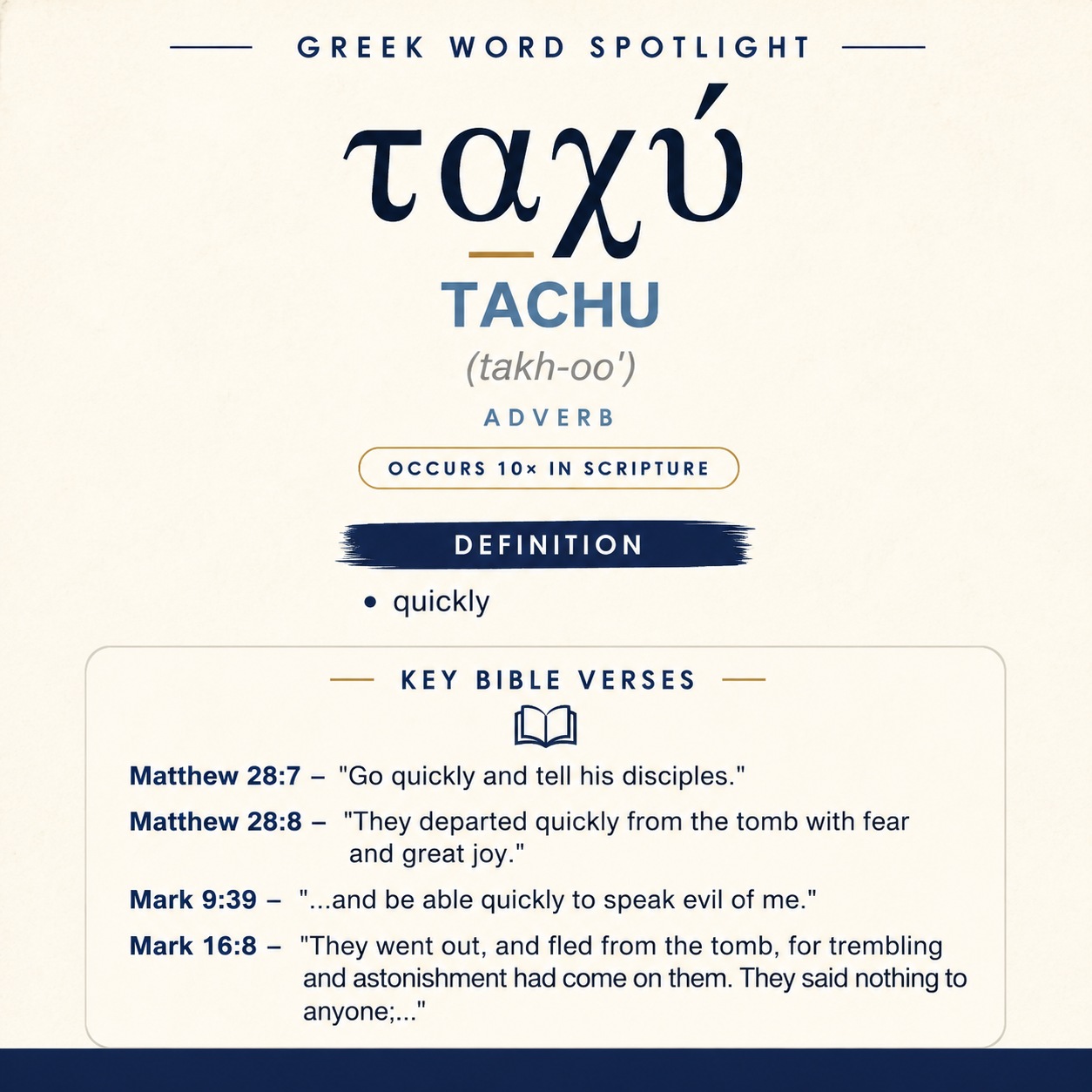
ταχύ means “quickly” and occurs 10 times in Scripture, including Matthew 28:7–8, Mark 9:39; 16:8, John 11:29, and Revelation 2:16; 3:11; 11:14.
Core Meaning
ταχύ means “quickly.” It expresses prompt action or rapid timing in the passages where it appears.
Learn More →Gospel Scenes
In Matthew 28:7–8, the women are told to go quickly and then depart quickly from the tomb. In John 11:29, Martha rises quickly and goes to Jesus.
Learn More →Revelation Warnings
In Revelation 2:16 and 3:11, Jesus says, “I am coming quickly.” Revelation 11:14 declares that the third woe comes quickly.
Learn More →ταχύ expresses the idea of something happening quickly. In the passages where it appears, it presses urgency into actions (going, rising, coming) and into announcements that events are near at hand.
Occurrences
“Go quickly and tell his disciples, ‘He has risen from the dead, and behold, he goes before you into Galilee; there you will see him.’ Behold, I have told you.” (Matthew 28:7)
Here ταχύ drives the messenger-task: the hearers are not simply to go and tell, but to do so with speed. The instruction ties quick movement to the spreading of a specific report (“He has risen from the dead”) and to coordinating a meeting point (“into Galilee; there you will see him”). The adverb makes the announcement time-sensitive: the telling is to match the immediacy of what has happened and what is about to happen (“he goes before you”).

“They departed quickly from the tomb with fear and great joy, and ran to bring his disciples word.” (Matthew 28:8)
ταχύ characterizes the women’s departure itself. The verse already contains emotion (“fear and great joy”) and purposeful motion (“ran”), and the adverb sharpens the pace: their leaving the tomb is rapid, not delayed. In this narrative moment, quickness fits the combination of intense feeling and a clear goal—carrying news to the disciples.
“But Jesus said, “Don’t forbid him, for there is no one who will do a mighty work in my name, and be able quickly to speak evil of me.” (Mark 9:39)
In this saying, ταχύ modifies a change in speech: the one who does “a mighty work in my name” is not positioned to turn around quickly and “speak evil of me.” The adverb focuses on speed of reversal—how rapidly someone might shift from acting in Jesus’ name to opposing speech. The point is not about whether opposition can ever arise, but about the improbability of an immediate pivot in attitude and words.
“They went out, and fled from the tomb, for trembling and astonishment had come on them. They said nothing to anyone; for they were afraid.” (Mark 16:8)
Although ταχύ is not represented by an English adverb in this verse, the scene is still dominated by sudden, urgent motion: they “fled from the tomb,” propelled by “trembling and astonishment.” Within this compressed description, the idea of quickness coheres with flight and fear—events move rapidly from discovery to retreat and silence.
“When she heard this, she arose quickly and went to him.” (John 11:29)
ταχύ marks the immediacy of response. Hearing triggers action (“she arose”), and the adverb stresses that the rising is prompt rather than gradual. The quick rising flows directly into purposeful direction (“and went to him”), so the word contributes a sense of decisive, unhindered movement from message to meeting.
“Repent therefore, or else I am coming to you quickly, and I will make war against them with the sword of my mouth.” (Revelation 2:16)
Here ταχύ intensifies a warning. The command “Repent therefore” is set against an alternative: a coming that is quick. The adverb heightens pressure on the hearers by presenting the arrival as near and sudden, and it links that quick coming to swift intervention (“I will make war against them with the sword of my mouth”). The speed implied by ταχύ makes the threat feel imminent, not distant.
“I am coming quickly! Hold firmly that which you have, so that no one takes your crown.” (Revelation 3:11)
ταχύ again attaches to “I am coming,” but in a context that pairs nearness with exhortation. Because the coming is quick, the community is told to “Hold firmly that which you have.” The adverb supports the logic of vigilance: a near arrival leaves little room for loosening one’s grip, and the warning about loss (“so that no one takes your crown”) gains urgency from the quickness of the promised coming.
“The second woe is past. Behold, the third woe comes quickly.” (Revelation 11:14)
In this brief announcement, ταχύ compresses the interval between successive woes. With “The second woe is past,” the next line signals that the third does not linger in the future: it “comes quickly.” The adverb thus functions as a narrative accelerator, moving the reader from one completed stage to the next impending stage with minimal delay.
““Behold, I come quickly. Blessed is he who keeps the words of the prophecy of this book.” (Revelation 22:7)
ταχύ frames a declaration of arrival together with a blessing. The quick coming is presented as a reality that matters for conduct: “Blessed is he who keeps the words of the prophecy of this book.” The adverb strengthens the connection between promise and practice—keeping the words is cast as the fitting posture when the coming is near and may break in swiftly.
“He who testifies these things says, “Yes, I come quickly.” Amen! Yes, come, Lord Jesus.” (Revelation 22:20)
Here ταχύ appears in a final, affirmed statement: “Yes, I come quickly.” The community response (“Amen! Yes, come, Lord Jesus.”) echoes the readiness appropriate to a quick arrival. The adverb lends a sense of closeness to the expectation, turning the testimony into something that invites immediate assent and longing.

Sense and Usage
Across these occurrences, ταχύ consistently works as an adverb of quickness, but it shades the scenes in distinct ways depending on what it modifies. In narrative actions (Matthew 28:7–8; John 11:29), it presses human movement into an urgent tempo. “Go quickly” (Matthew 28:7) is not merely about speed for its own sake; it suits the content of the message and the need to relay it. “They departed quickly” (Matthew 28:8) aligns with embodied reactions—fear, joy, and running—so that the whole scene feels propelled forward. “She arose quickly” (John 11:29) highlights responsiveness: hearing leads immediately to going.
In Mark 9:39, ταχύ attaches not to travel but to a potential shift in speech (“be able quickly to speak evil of me”). Quickness here measures the speed of a reversal, making the point that such a turnaround would not be immediate. The adverb thus serves discernment: it cautions against rapid suspicion by arguing that immediate hostility is unlikely in the stated circumstance.
In Revelation, ταχύ repeatedly modifies “coming,” and the word’s force is rhetorical as much as temporal. In Revelation 2:16 and 3:11, quick coming functions as leverage for exhortation: repent, hold firmly. The nearness implied by quickness turns commands into urgent appeals, because the time for response is portrayed as short. In Revelation 11:14, quickness marks the rapid approach of the next woe, giving the sequence a driving momentum. In Revelation 22:7 and 22:20, the repeated “I come quickly” sets the tone for the book’s closing: the blessing on keeping the prophecy’s words and the final prayerful response both sit naturally under the pressure of an arrival described as quick.
Even where the English line in Mark 16:8 concentrates on fleeing, trembling, astonishment, and silence, the narrative shape remains compatible with the same semantic domain: quickness belongs to the texture of sudden events, swift exits, and immediate reactions. Taken together, these passages show ταχύ as a compact way to inject urgency—whether urging rapid obedience, portraying prompt response, discouraging assumptions about instant reversal, or presenting future developments as near enough to demand readiness.
Closing Imagery
Several scenes pair ταχύ with motion: leaving a tomb, running with news, rising at a message, and the approach of events described as coming. The word’s imagery is therefore kinetic—quickness felt in feet moving, decisions made without delay, and announcements framed as too near to treat casually.
Sources: Lexical data from Strong’s Exhaustive Concordance and the Translators Brief Lexicon of Extended Strongs for Greek (STEPBible, CC BY). Occurrence data from the Translators Amalgamated Greek New Testament (STEPBible, CC BY). Scripture quotations from the World English Bible (public domain).




