Exploring the Meaning of Sunthapto in Greek
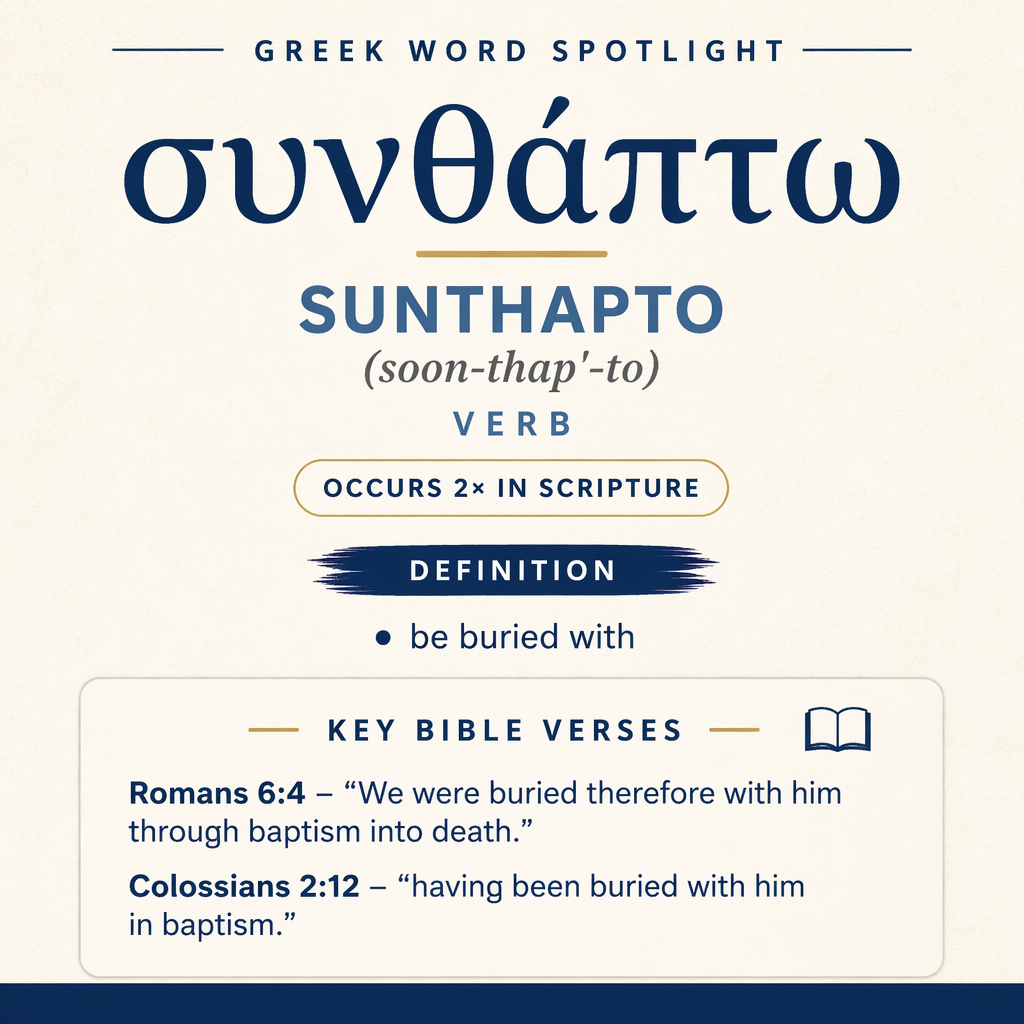
συνθάπτω means “be buried with” and appears in Romans 6:4 and Colossians 2:12.
Scripture Occurrences
It occurs 2 times in Scripture: Romans 6:4 and Colossians 2:12.
Learn More →Baptism Context
In both Romans 6:4 and Colossians 2:12, it describes being buried with Christ in baptism.
Learn More →συνθάπτω means “be buried with,” and it appears in two baptism-centered passages that pair burial with resurrection: Romans 6:4 and Colossians 2:12. In both, the verb serves as a compact image for participation in what happened to Christ, expressed as a shared burial that is closely linked to being raised.
Root and Related Words
συνθάπτω (Sunthapto) is formed from syn (σύν), meaning “with” (Strong’s G4862), and thapto (θάπτω), meaning “to bury” (Strong’s G2290). The compound brings the idea of burial into a shared frame: burial conceived explicitly as something done “with” another.

Occurrences
“We were buried therefore with him through baptism into death, that just as Christ was raised from the dead through the glory of the Father, so we also might walk in newness of life.” (Romans 6:4)
Here συνθάπτω anchors a sequence of tightly linked actions and purposes: burial “with him,” baptism “into death,” Christ’s being “raised from the dead,” and the resulting goal that “we also might walk in newness of life.” The verb contributes the shared, participatory character of the transition being described. Burial is not treated as an isolated event but as something that occurs “with him,” and it is specifically connected to baptism as the means (“through baptism into death”) by which that shared burial is spoken of. Within the verse’s logic, the “therefore” signals that this burial-with is a conclusion drawn from the surrounding argument, and its function is to set up the analogy: as surely as Christ’s raising is real and effective (“raised from the dead through the glory of the Father”), so the shared burial provides the basis for a changed mode of living (“walk in newness of life”). The word thus supplies concrete imagery for a decisive break: burial marks the end of a former state, and doing so “with him” places that end in direct relation to Christ’s death and resurrection as described in the same sentence.
“having been buried with him in baptism, in which you were also raised with him through faith in the working of God, who raised him from the dead.” (Colossians 2:12)
In Colossians, συνθάπτω appears in a clause that is grammatically dependent (“having been buried with him”) and immediately coordinated with a second shared action (“you were also raised with him”). The verse keeps the burial-with and the raised-with closely paired, and it specifies the sphere in which both are being spoken of: “in baptism.” The word contributes the same participatory imagery as in Romans, but here the verse explicitly places the raising alongside the burial within one continuous description of what baptism signifies. The raising is further qualified: it is “through faith in the working of God,” and God is characterized as the one “who raised him from the dead.” In this setting, being buried with him functions as one side of a two-part movement—burial and raising—where both are described as shared with Christ. The verb’s contribution is to insist that the burial being described is not merely personal or solitary; it is relationally defined (“with him”), and it is integrated into a larger account of divine action that culminates in resurrection language.
Sense and Usage
Across these two occurrences, “be buried with” is consistently attached to baptism and consistently set beside resurrection. In Romans 6:4, the burial-with is expressed as a past reality (“We were buried therefore with him”) and is presented as a premise for a new pattern of life (“so we also might walk in newness of life”). The shared burial is not an end in itself; within the verse it has a forward-looking aim, moving from death-language to life-language. The verb supports that movement by providing a vivid boundary marker: burial is the definitive placement of what has died, and the “with him” makes that boundary marker inseparable from Christ’s own death and resurrection as referenced in the same breath.
In Colossians 2:12, the same sense is used to knit together two parallel “with him” statements: buried with him and raised with him. The verse explicitly ties the second to “faith in the working of God,” and it returns again to the resurrection of Christ (“who raised him from the dead”). Within that framework, “be buried with” functions as the matching counterpart to being “raised with,” reinforcing the portrayal of baptism as a participation that encompasses both the burial side and the resurrection side of the story told about Christ. The repetition of “with him” across burial and raising makes shared participation the controlling idea, and συνθάπτω is the burial term that carries that idea into the death side of the pair.
Because both verses speak of burial “with him” rather than burial as a standalone image, the verb’s usage emphasizes association and shared identification in the act described. The imagery is concrete and bodily (burial), yet in both passages it is used to interpret what baptism signifies in relation to death and resurrection. The word therefore works as a compressed metaphorical statement within theological argumentation: it takes a single, forceful picture—burial—and locates it “with” Christ, then allows the surrounding clauses to draw out its implications (a new walk in life in Romans; being raised through faith in God’s working in Colossians).
Imagery
Both texts set burial imagery beside resurrection imagery, creating a single narrative arc within each verse. In Romans 6:4 the movement is from “buried… through baptism into death” to “raised from the dead” and finally to “walk in newness of life,” so the burial-with functions like the closing of one chapter that makes the opening of another intelligible. In Colossians 2:12 the burial-with is immediately balanced by “raised with him,” and the focus on God “who raised him from the dead” keeps the burial image from standing alone; it is framed as part of a larger divine action in which death is not the final word.
Sources: Lexical data from Strong’s Exhaustive Concordance and the Translators Brief Lexicon of Extended Strongs for Greek (STEPBible, CC BY). Occurrence data from the Translators Amalgamated Greek New Testament (STEPBible, CC BY). Scripture quotations from the World English Bible (public domain).