
Exploring the Meaning of Suntereo in Greek
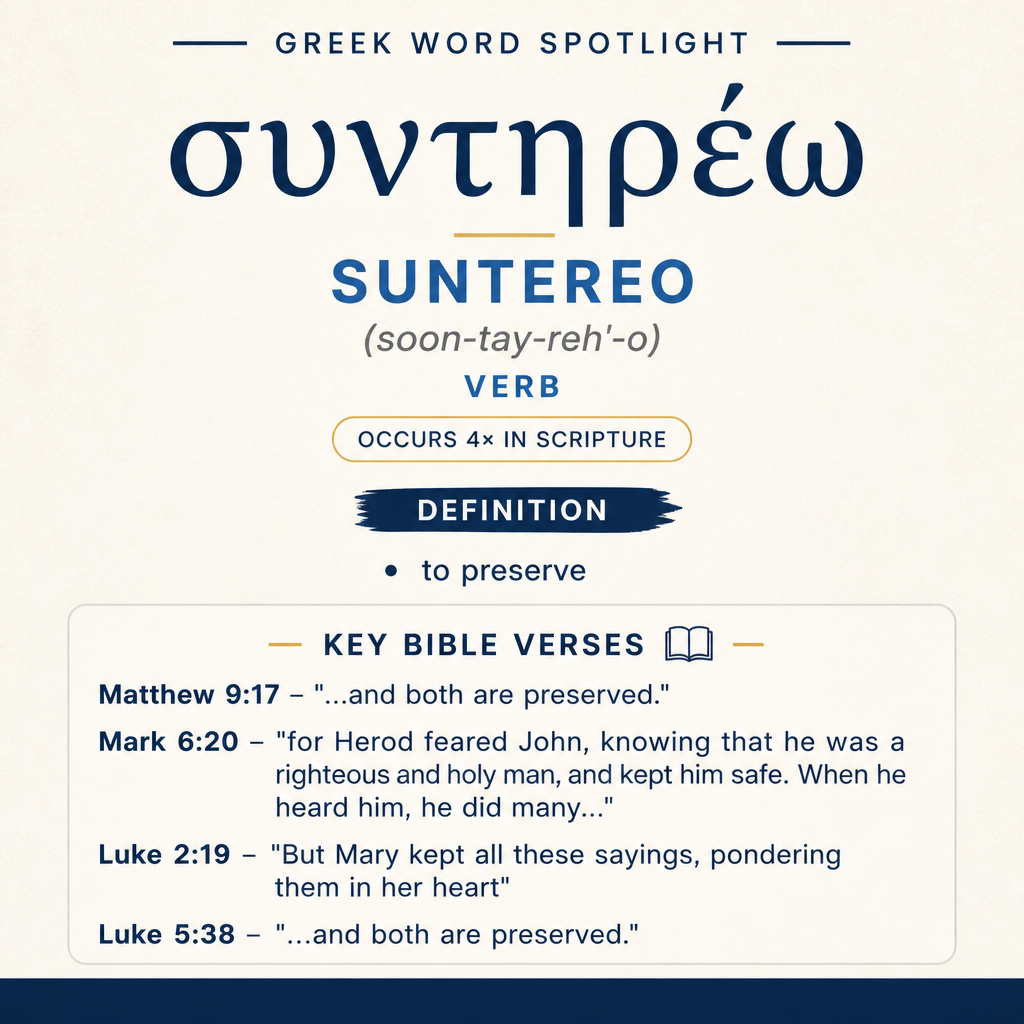
συντηρέω means “to preserve” and occurs four times: Matthew 9:17; Mark 6:20; Luke 2:19; Luke 5:38.
Scripture Occurrences
It appears four times in Scripture: Matthew 9:17; Mark 6:20; Luke 2:19; Luke 5:38.
Learn More →Usage Examples
In Mark 6:20, Herod “kept him safe.” In Luke 2:19, Mary “kept all these sayings” in her heart.
Learn More →συντηρέω expresses the idea of preserving, and it appears in scenes that range from the practical care of wineskins to the guarded safety of a prisoner and the inward safeguarding of remembered words. In these passages, preservation can describe keeping something intact, safe, or held onto rather than lost.
Root and Related Words
συντηρέω is formed from syn (σύν), “with” (Strong’s G4862), and tereo (τηρέω), “to keep: observe” (Strong’s G5083). The compound shape of the verb matches the contexts where something is kept together in an enduring state—whether a material container, a person under protection, or treasured sayings held in memory.

Occurrences
“Neither do people put new wine into old wine skins, or else the skins would burst, and the wine be spilled, and the skins ruined. No, they put new wine into fresh wine skins, and both are preserved.” (Matthew 9:17)
Here preservation is the outcome of fitting “new wine” to “fresh wine skins.” The verse paints a chain of cause and effect: a wrong pairing leads to bursting, spillage, and ruin; the right pairing results in “both” being preserved. συντηρέω gathers up the intact state of two goods at once—the wine retained rather than spilled, and the skins remaining unruined rather than burst. The word’s contribution is practical and material: preservation is what prevents loss and waste when the container is suited to what it holds.
“for Herod feared John, knowing that he was a righteous and holy man, and kept him safe. When he heard him, he did many things, and he heard him gladly.” (Mark 6:20)
In this narrative, preservation is applied to a person. Herod’s fear of John, together with his recognition of John as “a righteous and holy man,” leads him to “kept him safe.” συντηρέω frames Herod’s action as protective custody: John’s condition is maintained as safe rather than harmed. The verse also places this preservation alongside Herod’s continued exposure to John’s words—he “heard him,” responded with action (“he did many things”), and listened with pleasure (“he heard him gladly”). The verb thus marks a concrete restraint against danger, holding John’s life and well-being intact within a tense moral setting.
“But Mary kept all these sayings, pondering them in her heart.” (Luke 2:19)
Here the object preserved is not a thing like wine, nor a person under guard, but “all these sayings.” Mary’s keeping is paired with “pondering,” and its location is “in her heart.” συντηρέω describes an inner safeguarding: the sayings are held onto rather than slipping away. The verse presents preservation as a deliberate act of retention, where remembering is not passive but sustained—carried within, attended to, and turned over in thought.
“But new wine must be put into fresh wine skins, and both are preserved.” (Luke 5:38)
This parallel to the earlier wineskin image again ends with the result that “both are preserved.” The wording is direct: “must be put” signals necessity, and preservation is the reason that necessity exists within the logic of the illustration. συντηρέω again embraces the integrity of paired realities—wine and skins—kept from the destructive outcomes implied by the alternative. The verb is the capstone of the image: when the placement is right, the contents and the container remain intact together.
Sense and Usage
Across these four occurrences, “to preserve” is consistently expressed as maintaining something so it remains whole, safe, or retained rather than lost. In Matthew 9:17 and Luke 5:38, the preservation is explicitly double—“both” wine and wineskins—so the verb summarizes a successful guarding of value on two fronts at once: the liquid is not “spilled,” and the skins are not “ruined.” The imagery assumes that what is preserved is vulnerable: wine can be wasted, skins can burst, and the wrong conditions produce damage that cannot be undone within the picture. Preservation, then, is not merely storing something; it is keeping it in an unharmed state against forces that would break, spill, or spoil it.
Mark 6:20 extends that same preserving force into the social sphere. What is kept is a human life placed under the power of another. The verb works within the tension of the verse’s details: Herod “feared John,” he “knew” John’s character, and he acted to keep him safe. Preservation here is protection—an active holding-back of harm. It also sits alongside ongoing interaction (“When he heard him…”), showing that the preserved person remains present, accessible, and consequential.
Luke 2:19 shows preservation as inward and personal. The sayings are not protected by walls or containers but by an attentive heart. The coupling of “kept” with “pondering” portrays preservation as a mental and emotional custody: the words are gathered up (“all these sayings”) and held in a way that allows continued reflection. The verb thus bridges the external and internal: whether the object is material, personal, or verbal, preservation is the maintenance of what might otherwise be scattered, damaged, or forgotten.
Imagery
The wineskin sayings give συντηρέω a vivid picture of preservation as intactness under pressure: a container that does not burst and contents that do not spill. Mark’s account relocates that pressure into a ruler’s court where safety depends on restraint, and Luke’s portrayal of Mary places it within the heart where words are held together for careful thought. In each setting, preservation is a kind of keeping that resists loss and keeps what is entrusted from coming undone.
Sources: Lexical data from Strong’s Exhaustive Concordance and the Translators Brief Lexicon of Extended Strongs for Greek (STEPBible, CC BY). Occurrence data from the Translators Amalgamated Greek New Testament (STEPBible, CC BY). Scripture quotations from the World English Bible (public domain).




