
Exploring the Meaning of Sundrome in Greek
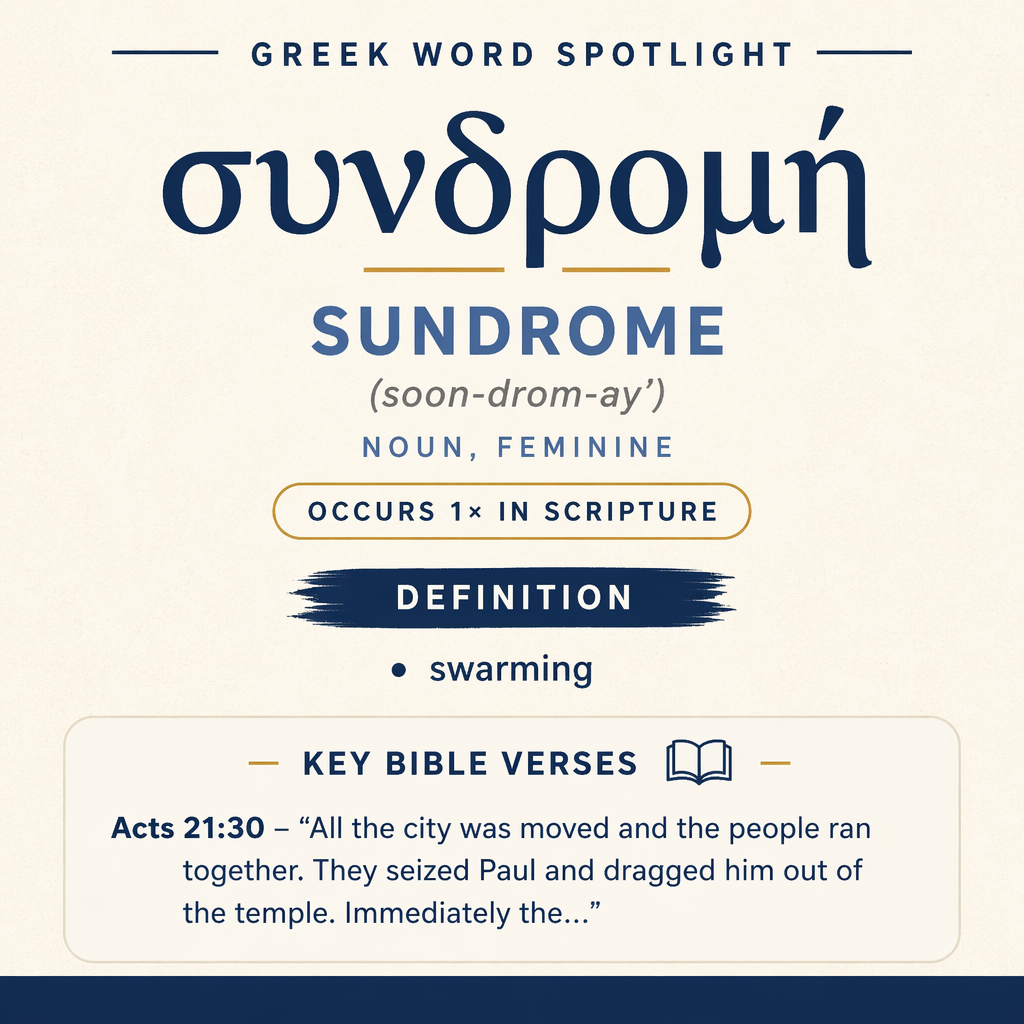
συνδρομή means “swarming” and appears once in Scripture, in Acts 21:30.
Context in Acts
In Acts 21:30, all the city was moved and the people ran together as Paul was seized and dragged from the temple.
Learn More →συνδρομή means “swarming” and appears in a single New Testament scene of public upheaval. In Acts it captures the sudden, collective rush of people as a disturbance spreads through Jerusalem.
Root and Related Words
συνδρομή derives from the verb syntrecho (συντρέχω), “to flock” (Strong’s G4936). The noun form turns the action of converging into a named event: a mass running together that can be pointed to as a distinct surge of people.

Occurrences
“All the city was moved and the people ran together. They seized Paul and dragged him out of the temple. Immediately the doors were shut.” (Acts 21:30)
Here συνδρομή belongs to a tightly packed chain of actions. The verse first sets a citywide reaction—“All the city was moved”—and then focuses it into a physical motion: “the people ran together.” The word’s force lies in depicting not a calm gathering but a sudden convergence that feels like a living mass. It is a “swarming” that forms quickly, as if the crowd itself becomes a single, pressing body in motion.

The narrative then shows what this “swarming” produces. Once the people have run together, the next steps happen without pause: “They seized Paul and dragged him out of the temple.” The crowd’s movement is not merely background atmosphere; it becomes the mechanism by which Paul is overwhelmed, handled, and forcibly removed. A swarming crowd is hard to resist because it multiplies hands and collapses personal space—exactly the kind of setting implied by the swift transition from running together to seizing and dragging.
The final sentence, “Immediately the doors were shut,” underscores the urgency and containment that follows the crowd’s rush. The shut doors mark a boundary: Paul is dragged out, and the temple space is closed off at once. In that flow, συνδρομή helps frame the moment as a flash of public agitation that spills into sacred precincts and then is abruptly cut off by a decisive closing. The swarming is therefore not only motion but escalation—an outbreak of collective action that forces authorities or attendants to respond instantly by shutting the doors.
Sense and Usage
The gloss “swarming” captures the vivid, almost tactile character of συνδρομή. In Acts 21:30 it is not an orderly assembly with time for deliberation; it is a crowd-behavior term. The verse presents three connected elements that clarify how “swarming” functions as a sense:
First, it is rapid. The people “ran together,” and the doors were “Immediately… shut.” The word fits a scene where movement outpaces explanation, where the crowd arrives before any calm assessment can take place.
Second, it is collective. The city is “moved,” and “the people” act as a unit. The swarming is the crowd’s convergence into a single force, making individual actors less visible than the surge itself. In such a moment, the story describes “the people” doing what, in a quieter setting, would require identifiable leaders or a formal decision.
Third, it is pressing and overpowering. The immediate result is physical control over Paul: he is “seized” and “dragged.” The term “swarming” naturally belongs to actions that depend on overwhelming presence. It evokes density and momentum—the kind of crowding that enables seizure and removal simply because many bodies arrive at once and push the event forward.
Because the word is tied to the verb syntrecho (συντρέχω), “to flock,” it also carries the idea of convergence from multiple directions into one point. Acts 21:30 depicts a focal point at the temple, where the crowd’s motion condenses into direct contact with Paul. The swarming is therefore spatial as well as emotional: the people close distance quickly, surround, and then propel the scene outward as Paul is dragged “out of the temple.”
Within the verse’s structure, “swarming” also functions as a hinge between a general disturbance (“All the city was moved”) and concrete outcomes (seizing, dragging, doors shutting). It names the transitional event in which agitation becomes action. The city’s being “moved” could remain a feeling or rumor; the crowd running together makes that movement visible, audible, and dangerous. In this way, συνδρομή marks the moment when unrest takes bodily form.
Imagery
The imagery carried by συνδρομή in Acts 21:30 is that of a sudden human surge—feet running, bodies converging, and a single person caught in the rush. The verse sets this surge against the temple’s doors being shut “Immediately,” so the swarming is pictured as spilling toward a boundary and prompting a swift closing. The word leaves the impression of a crowd that arrives like a wave, gathers force through togetherness, and changes the scene in seconds.
Sources: Lexical data from Strong’s Exhaustive Concordance and the Translators Brief Lexicon of Extended Strongs for Greek (STEPBible, CC BY). Occurrence data from the Translators Amalgamated Greek New Testament (STEPBible, CC BY). Scripture quotations from the World English Bible (public domain).




