
Exploring the Meaning of Sunagoge in Greek
συναγωγή means “synagogue” and occurs 57 times in Scripture, including in Matthew’s Gospel where Jesus teaches and others act within synagogues.
Core Meaning
συναγωγή is defined as “synagogue.” Matthew’s Gospel repeatedly mentions synagogues as public places of religious activity.
Learn More →Matthew References
In Matthew 4:23, 9:35, and 13:54, Jesus teaches in their synagogues while preaching the Good News of the Kingdom. Matthew 12:9 notes Jesus entering their synagogue.
Learn More →Actions In Synagogues
Matthew 6:2 and 6:5 describe hypocrites doing merciful deeds and praying in synagogues. Matthew 10:17 and 23:6 mention scourging in synagogues and seeking the best seats there.
Learn More →συναγωγή refers to a synagogue, a recognizable public setting repeatedly named in Gospel scenes for teaching, prayer, community life, and conflict. In the passages below it appears as a concrete place people enter, stand within, and assign social value to, and it is also a venue where both Jesus’ ministry and opposition to his followers are portrayed.

Occurrences
Matthew 4:23 — “Jesus went about in all Galilee, teaching in their synagogues, preaching the Good News of the Kingdom, and healing every disease and every sickness among the people.”
Here συναγωγή marks a network of local venues (“their synagogues”) in which Jesus’ public work is carried out. The synagogue is paired with preaching and healing, so it functions as a setting where instruction and proclamation are heard and where the needs of “the people” are addressed in a public, communal space.

Matthew 6:2 — “Therefore when you do merciful deeds, don’t sound a trumpet before yourself, as the hypocrites do in the synagogues and in the streets, that they may get glory from men. Most certainly I tell you, they have received their reward.”
In this saying, the synagogue is one of the places where religious behavior can be performed for an audience. By putting “in the synagogues” alongside “in the streets,” the wording treats the synagogue as a visible, public location where one’s deeds may be noticed and praised, and thus where motives can be tested.
Matthew 6:5 — ““When you pray, you shall not be as the hypocrites, for they love to stand and pray in the synagogues and in the corners of the streets, that they may be seen by men. Most certainly, I tell you, they have received their reward.”
Again the synagogue is presented as a place where religious activity is seen: people “stand and pray” there. The emphasis is not on the propriety of praying in that location but on the posture of seeking visibility—so the synagogue, as a communal meeting place, naturally provides an audience and therefore becomes a fitting example in a warning against showy piety.
Matthew 9:35 — “Jesus went about all the cities and the villages, teaching in their synagogues, and preaching the Good News of the Kingdom, and healing every disease and every sickness among the people.”
This verse echoes the earlier description of Jesus’ work, but it expands the setting: “all the cities and the villages.” The repeated phrase “in their synagogues” depicts the synagogue as a regular, accessible local institution across different communities, suitable for teaching and proclamation and closely connected with service to the people’s physical afflictions.
Matthew 10:17 — “But beware of men: for they will deliver you up to councils, and in their synagogues they will scourge you.”
Here συναγωγή appears in a warning about persecution. The synagogue is portrayed as a venue where punishment can be administered (“they will scourge you”), set in parallel with “councils.” The word therefore contributes a sobering note: the same kind of communal religious setting that hosts teaching and prayer can also become a place where opposition is organized and inflicted.
Matthew 12:9 — “He departed from there, and went into their synagogue.”
In this brief narrative transition, συναγωγή functions as a concrete destination: Jesus “went into their synagogue.” The expression “their synagogue” keeps the focus on the local community’s space, and the verb of movement underscores that this is a defined, entered place—an identifiable building or gathering site within the story’s geography.
Matthew 13:54 — “Coming into his own country, he taught them in their synagogue, so that they were astonished, and said, “Where did this man get this wisdom, and these mighty works?”
Here the synagogue is explicitly tied to Jesus’ “own country” and to the people’s reaction. Teaching “in their synagogue” becomes the occasion for astonishment and questioning: the synagogue is a setting where a community listens closely enough to evaluate what is said and to ask how such “wisdom” and “mighty works” could be associated with someone they know.
Matthew 23:6 — “and love the place of honor at feasts, the best seats in the synagogues,”
In this critique, the synagogue is pictured internally, with “seats” and social ranking. The phrase “the best seats in the synagogues” shows that the synagogue is not only a place of gathering but also a place where status can be displayed and desired—spatially expressed through where one sits.
Matthew 23:34 — “Therefore behold, I send to you prophets, wise men, and scribes. Some of them you will kill and crucify; and some of them you will scourge in your synagogues, and persecute from city to city;”
In this forecast of hostility, the synagogue is named as a location of physical abuse (“scourge in your synagogues”) and is linked with broader pursuit (“persecute from city to city”). The repeated “your synagogues” stresses ownership and responsibility: these are the communities’ own institutions, yet they are portrayed as places where violence against messengers can occur.
Mark 1:21 — “They went into Capernaum, and immediately on the Sabbath day he entered into the synagogue and taught.”
This scene anchors the synagogue in time (“on the Sabbath day”) and action (“entered … and taught”). The synagogue is the place where teaching is appropriately situated within the rhythm of communal life, and it is marked as a public interior space one can enter, where instruction is delivered to those gathered.
Mark 1:23 — “Immediately there was in their synagogue a man with an unclean spirit, and he cried out,”
Here the synagogue is the immediate setting of confrontation: a man “in their synagogue” cries out. The word thus contributes the sense that what happens in the synagogue is not limited to orderly teaching or prayer; it is also a place where disruptive events may occur in the presence of the assembled community.
Mark 1:29 — “Immediately, when they had come out of the synagogue, they came into the house of Simon and Andrew, with James and John.”
In this movement from one location to another, the synagogue is contrasted with a private house. Coming “out of the synagogue” marks the end of a public gathering context and the transition into domestic space (“the house of Simon and Andrew”), highlighting the synagogue’s role as a communal venue distinct from family dwellings.
Sense and Usage
Across these passages, συναγωγή consistently functions as the named location for communal religious life. It is the ordinary setting where teaching takes place (Matthew 4:23; Matthew 9:35; Matthew 13:54; Mark 1:21) and a place where the visible practices of devotion can be performed before others (Matthew 6:2; Matthew 6:5). Because it is public and communal, it naturally becomes a stage for social dynamics: it has “best seats,” implying recognized honor and the possibility of pursuing status through position (Matthew 23:6). The same public character also explains why it can become a venue of conflict—both in immediate disruption within the gathering (Mark 1:23) and in broader opposition, where punishment and persecution are carried out “in their synagogues” (Matthew 10:17; Matthew 23:34).
The repeated possessive phrasing (“their synagogues,” “their synagogue,” “your synagogues”) contributes to the word’s nuance in these contexts. It frames the synagogue as embedded within particular communities—Galilee’s towns and villages (Matthew 4:23; Matthew 9:35), Jesus’ home region (Matthew 13:54), and the groups addressed in warnings and indictments (Matthew 10:17; Matthew 23:34). In narrative scenes, verbs of movement (“went into,” “entered,” “come out of”) present the synagogue as an identifiable place within a town’s layout, functioning as a public interior where events unfold before others (Matthew 12:9; Mark 1:21; Mark 1:29). In discourse, its pairing with streets and corners underscores its visibility and its potential to shape reputation (Matthew 6:2; Matthew 6:5).
Imagery
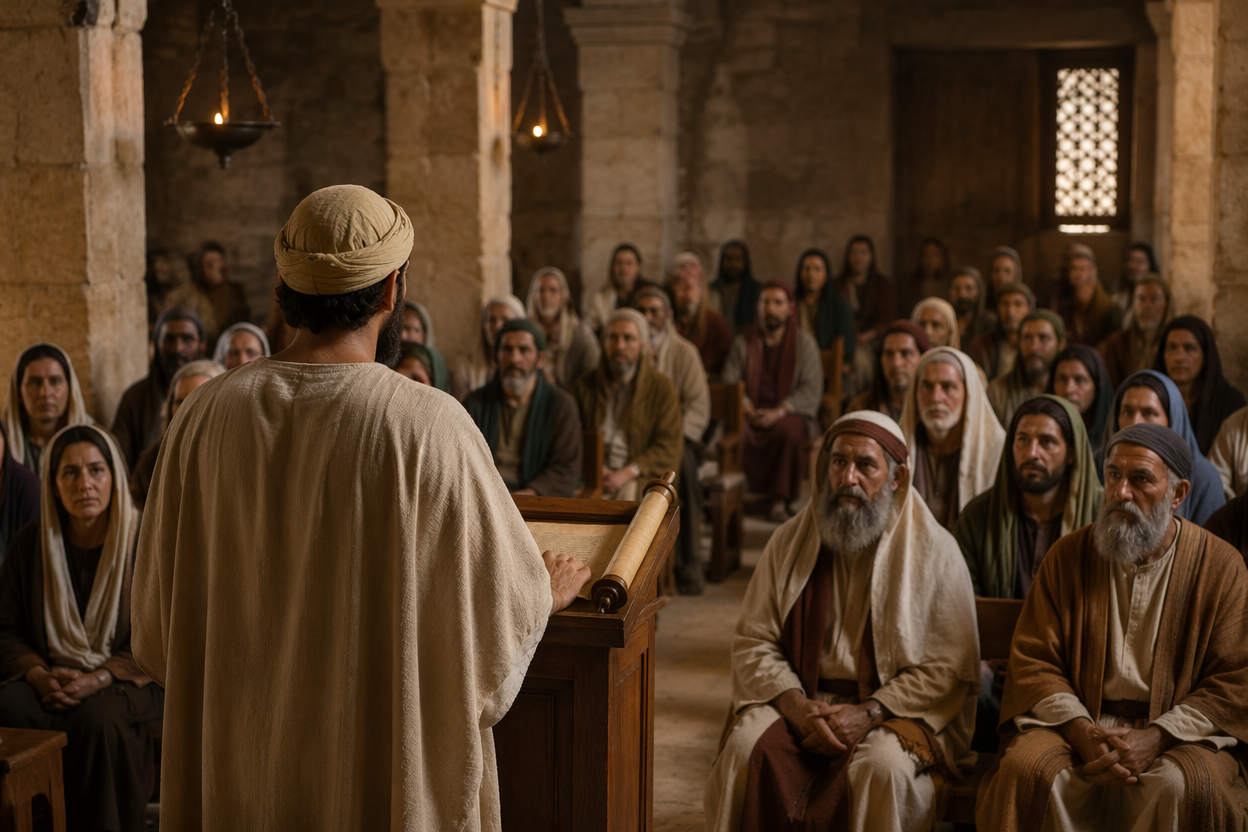
The word carries a consistent picture of a communal room with recognizable features: people enter and leave it (Mark 1:21; Mark 1:29), stand within it to pray (Matthew 6:5), sit in ranked places (Matthew 23:6), listen and react to teaching (Matthew 13:54), and witness sudden disturbance (Mark 1:23). In these passages the synagogue is both a center for instruction and a crossroads for human motives and responses—ranging from astonishment, to status-seeking, to open hostility.
Sources: Lexical data from Strong’s Exhaustive Concordance and the Translators Brief Lexicon of Extended Strongs for Greek (STEPBible, CC BY). Occurrence data from the Translators Amalgamated Greek New Testament (STEPBible, CC BY). Scripture quotations from the World English Bible (public domain).




