Exploring the Meaning of Sumperilambano in Greek
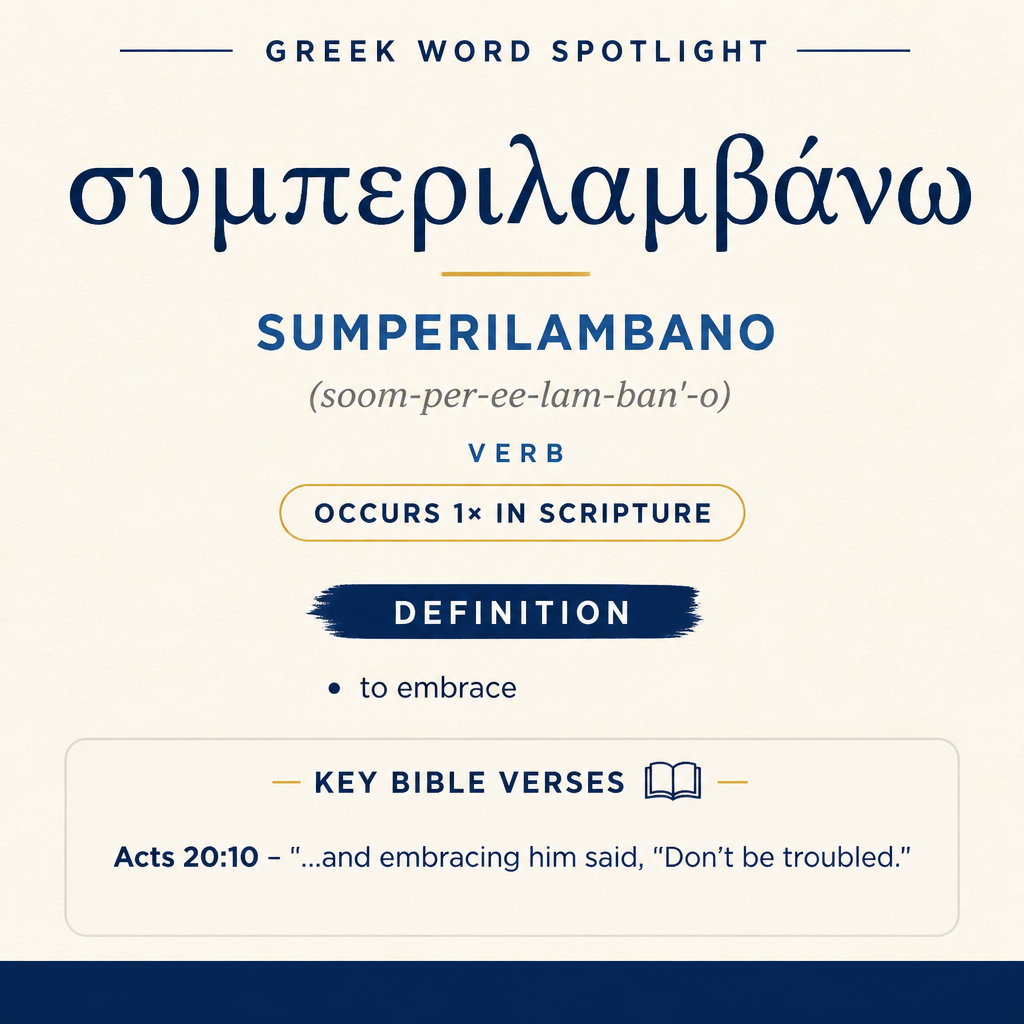
συμπεριλαμβάνω means “to embrace” and appears once in Scripture, in Acts 20:10.
Biblical Occurrence
It occurs 1 time in Scripture. Its single occurrence is in Acts 20:10.
Learn More →Context in Acts
In Acts 20:10, Paul fell upon him and embraced him. Paul said, “Don’t be troubled, for his life is in him.”
Learn More →συμπεριλαμβάνω means “to embrace.” It appears in the account of Paul’s response to a young man’s fall in Acts 20:10.
Root and Related Words
συμπεριλαμβάνω (Sumperilambano) is built from recognizable elements reflected in related words: the verb λαμβάνω (lambano), “to take” (Strong’s G2983), the preposition περί (peri), “about” (Strong’s G4012), and the preposition σύν (syn), “with” (Strong’s G4862). Together these components frame an action that is done “with” someone and “about” them, using a verb of taking—language well suited to describing the physical act of drawing someone into one’s arms.

Occurrences
“Paul went down and fell upon him, and embracing him said, “Don’t be troubled, for his life is in him.”” (Acts 20:10)
In Acts 20:10 the verb describes Paul’s immediate bodily response: he “went down,” “fell upon him,” and then, in the same movement of contact and care, he is “embracing him.” The embrace is not presented as a mere greeting or social gesture; it stands alongside actions that place Paul physically close to the injured person. The scene is urgent and intimate: Paul is close enough to “fall upon him,” and his embrace accompanies speech aimed at calming those present—“Don’t be troubled.”
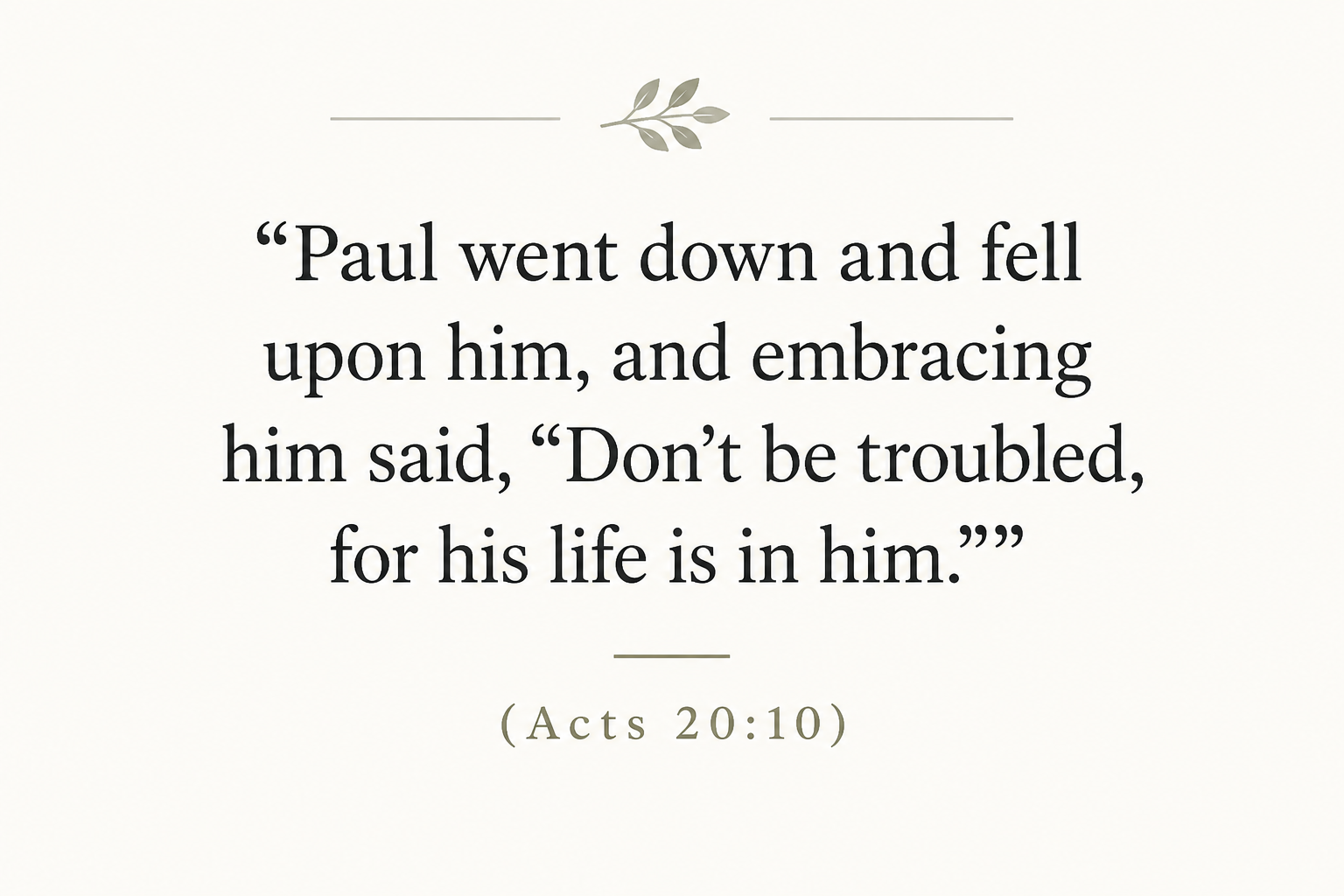
The embrace functions as more than background detail because it is integrated into the reassurance Paul gives. His words, “for his life is in him,” interpret the moment, but the embrace embodies it: Paul’s physical closeness and the act of holding the young man are part of the same response as his verbal comfort. Within the verse’s sequence, the embrace visually confirms Paul’s engagement with the young man’s condition and reinforces the calming message to onlookers that the situation is not to be met with panic.
Sense and Usage
The sense “to embrace” in this passage is concrete and situational. The verb is used for an action in which one person physically gathers another into their arms in a moment of distress. Acts 20:10 places the embrace after Paul has moved toward the fallen young man and made contact (“fell upon him”), and before Paul addresses the fear of others (“Don’t be troubled”). This ordering makes the embrace part of a decisive intervention: it is an act carried out at close range, with the embraced person as the direct object (“embracing him”).
Because the embrace occurs in the middle of a crisis response, its force is not sentimental or decorative; it is an enacted reassurance. The embrace communicates presence and personal involvement at the very place where life and danger are in view. Paul’s spoken assurance—“for his life is in him”—is paired with the embrace as a single posture of calm, care, and confidence. In this setting, “to embrace” depicts a holding that accompanies and supports the spoken effort to steady a frightened community.
The verb’s form also suits the narrative’s emphasis on closeness. Paul “went down,” indicating movement to the level where the young man lay. The embrace then portrays a complete, surrounding contact rather than a partial touch: the action implied by “embracing” fits the scene’s physicality, where nearness is not optional but required. The embrace is thus one of the narrative’s key embodied actions: it signals that Paul does not remain at a distance, and it contributes to the verse’s overall movement from alarm toward reassurance.
Imagery
Acts 20:10 gives the word a vivid, grounded image: a person going down to someone in danger and holding them close. The embrace stands at the center of the verse’s emotional turn—between the descent and contact on one side, and the calming words on the other—so that the reader sees reassurance not only spoken but enacted.
Sources: Lexical data from Strong’s Exhaustive Concordance and the Translators Brief Lexicon of Extended Strongs for Greek (STEPBible, CC BY). Occurrence data from the Translators Amalgamated Greek New Testament (STEPBible, CC BY). Scripture quotations from the World English Bible (public domain).