Exploring the Meaning of Sullupeo in Greek
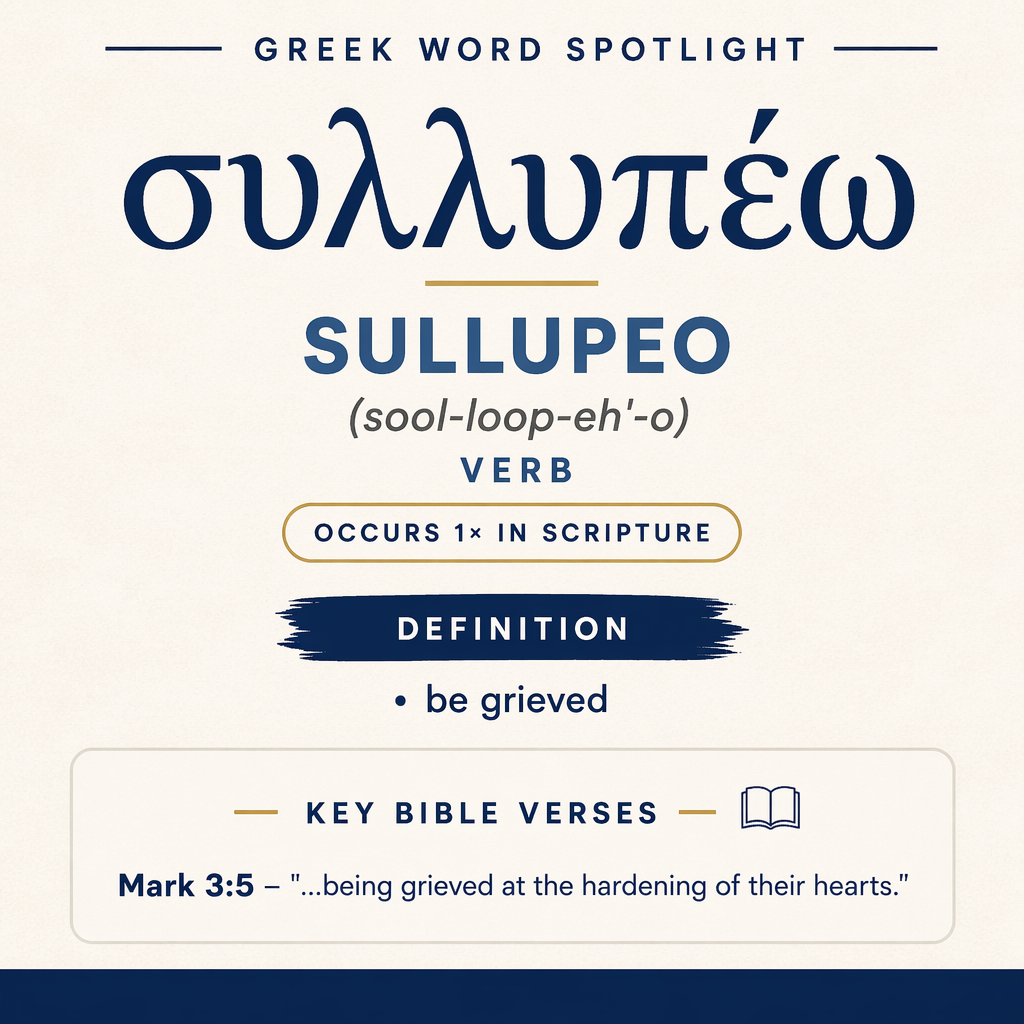
συλλυπέω means “be grieved” and appears once in Scripture, in Mark 3:5.
Scripture Occurrence
This word occurs 1 time in Scripture. Its single occurrence is in Mark 3:5.
Learn More →Mark 3:5 Context
In Mark 3:5, Jesus looks around with anger, being grieved at the hardening of their hearts.
Learn More →Sullupeo means “be grieved” and is used once in the Greek New Testament, in the narrative of Jesus healing a man’s hand in Mark 3:5. In that scene it names Jesus’ inner response to what he sees in his opponents.
Root and Related Words
Sullupeo derives from lypeo (λυπέω), “to grieve” (Strong’s G3076), and syn (σύν), “with” (Strong’s G4862). The combination signals that the verb’s idea of grief is expressed with an added “with-” component drawn from syn.

Occurrences
“When he had looked around at them with anger, being grieved at the hardening of their hearts, he said to the man, “Stretch out your hand.” He stretched it out, and his hand was restored as healthy as the other.” (Mark 3:5)
In Mark’s account, sullupeo appears in a tightly packed description of Jesus’ posture toward the people watching him: he “looked around at them with anger,” and at the same time he is “being grieved at the hardening of their hearts.” The verb therefore functions as an interior counterpart to the visible act of looking; it gives voice to a moral and relational pain that accompanies his assessment of what is happening in front of him.
The immediate cause of this grief is specified: “the hardening of their hearts.” The narrative does not present the grief as a reaction to physical suffering or to the man’s condition directly; instead it is tied to the hardened response of the onlookers. In this way the verb points to grief that arises from encountering resistance within human hearts in the midst of a moment where restoration is about to be displayed.
Mark places this grief alongside “anger,” not as a separate episode but as concurrent features of Jesus’ response. The coordination of these elements (“with anger… being grieved”) shows that grief here is not mere sadness at a distance; it is bound up with a direct confrontation. Jesus addresses the man with a simple imperative—“Stretch out your hand”—and the man obeys, resulting in a public outcome: “his hand was restored as healthy as the other.” The grief therefore stands in sharp relief against the restoration that follows: even as a damaged hand is healed, hardened hearts remain the stated object of grief.

Within the verse’s flow, sullupeo helps the reader understand the emotional and ethical stakes of the moment. It portrays Jesus’ engagement as personally affected by the hardness he observes, even while he proceeds to act with authority and effectiveness. The healing does not erase the grief named earlier; rather, the grief frames the healing as something occurring in the face of opposition that is not merely intellectual but lodged “in their hearts.”
Sense and Usage
The single use of sullupeo anchors its sense in a scene where grief is directed “at” something: “at the hardening of their hearts.” The construction gives grief a clear object, making it more than a general mood. It is a response to a moral condition described as hardening, a process-like portrayal of inward resistance. The verb thus depicts grief as an engaged reaction to what is perceived in others, arising from a relational encounter rather than from private misfortune.
Because Mark sets this grief alongside anger, the term bears the weight of complex feeling without changing its basic definition. In this verse, grief does not cancel anger, and anger does not cancel grief; instead, grief describes a pained involvement with the situation that accompanies a firm, confrontational stance. The narrative shows Jesus neither detached nor overwhelmed: he looks around, he feels, he speaks, and he heals. Sullupeo contributes by naming that felt pain as part of the same purposeful movement that leads to the man’s restoration.
The object of grief—“the hardening of their hearts”—also clarifies the scope of what grieves. It is not simply that opponents disagree, but that their inner disposition is characterized as hardening. The verb therefore sits at the intersection of emotion and evaluation: it expresses an affective response to a condition that is assessed as spiritually and ethically serious, situated in “hearts.” In Mark 3:5, grief is the response of one who recognizes that the deeper problem in the room is not the man’s hand, which can be restored, but the onlookers’ hardened hearts, which are presented as the occasion for grief.
Imagery
The verse paints a concrete tableau in which sullupeo is felt: a room where Jesus “looked around” at people who oppose him, a man poised to obey a command, and a hand that becomes “restored as healthy as the other.” Against that visible healing stands the unseen but named condition—“hardening of their hearts”—and it is precisely there that the verb locates grief, as an inward sorrow set amid outward restoration.
Sources: Lexical data from Strong’s Exhaustive Concordance and the Translators Brief Lexicon of Extended Strongs for Greek (STEPBible, CC BY). Occurrence data from the Translators Amalgamated Greek New Testament (STEPBible, CC BY). Scripture quotations from the World English Bible (public domain).