
Exploring the Meaning of Sugkatatithemai in Greek
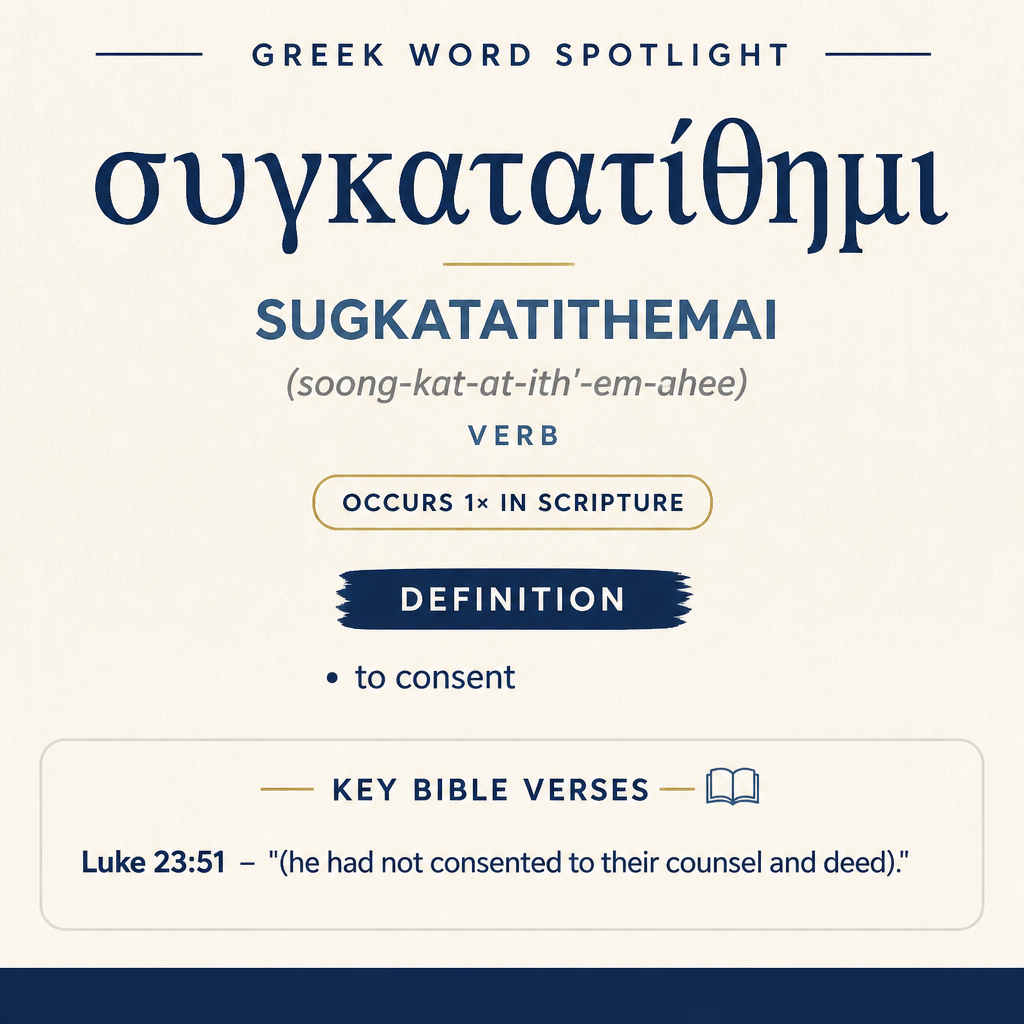
συγκατατίθημι means “to consent” and appears once in Scripture, in Luke 23:51.
Biblical Occurrence
This verb occurs 1 time in Scripture. The occurrence is in Luke 23:51.
Learn More →Context in Luke
In Luke 23:51 it is used of not consenting to “their counsel and deed.”
Learn More →συγκατατίθημι expresses the act of consenting. It appears in the Gospel passion narrative where a man is distinguished by his refusal to give such consent to the decisions that led to Jesus’ death.
Root and Related Words
Sugkatatithemai is formed with syn (σύν), “with,” and katatithemi (κατατίθημι), “to attain.” The combination presents consent as an act done “with” others—an alignment of one’s will alongside a group’s counsel and action.

Occurrences
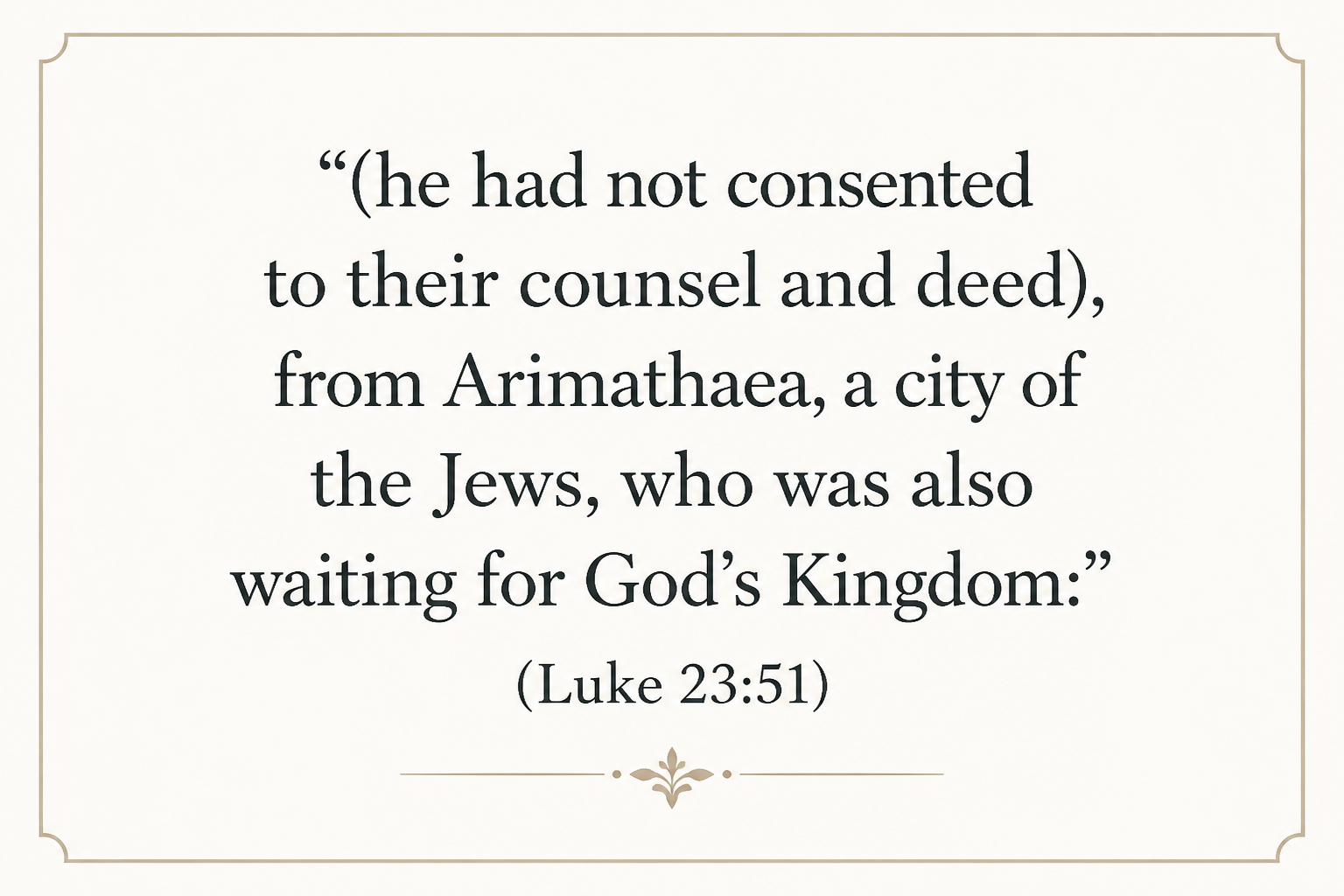
“(he had not consented to their counsel and deed), from Arimathaea, a city of the Jews, who was also waiting for God’s Kingdom:” (Luke 23:51)
In this parenthetical aside Luke characterizes a particular man by negation: “he had not consented to their counsel and deed.” The word marks a decisive moral and social boundary. The surrounding phrases show what his non-consent concerns: it is not merely disagreement with an idea (“counsel”) but refusal to stand with the action that followed (“deed”). By pairing “counsel” and “deed,” the line portrays a movement from deliberation to execution, and Sugkatatithemai is the hinge that would have joined him to that movement. Luke uses it to clarify that, although he is situated within the world where the decision was made, he did not join himself to that collective purpose.
The clause also functions to separate this man’s identity from “their” actions. The pronoun sets an opposing group: “their counsel and deed” is what others owned and enacted; his stance is described as non-participation at the level of consent. In the logic of the sentence, consent is treated as a meaningful contribution to wrongdoing: to consent is to be implicated in both the plan and the act. The statement, therefore, does more than record a private opinion; it defines his posture toward the communal decision, presenting him as one who did not give the agreement that would make the counsel and deed his own as well.
Luke immediately adds local and devotional descriptors: he was “from Arimathaea, a city of the Jews,” and he was “also waiting for God’s Kingdom.” In this context, the refusal to consent sits alongside a posture of expectation—his orientation is toward God’s coming reign rather than toward the counsel that produced the deed. The wording places his non-consent within a larger portrait: he is not simply an objector, but someone whose hopes are set elsewhere. Sugkatatithemai thereby contributes to a contrast between two alignments: alignment with “their counsel and deed,” versus an alignment implied by “waiting for God’s Kingdom.”
Sense and Usage
The single occurrence shows consent as more than a spoken “yes.” It is treated as a joining of oneself to a shared decision and to its outcome. The phrase “consented to their counsel and deed” frames consent as concurrence with both the deliberative process (“counsel”) and the enacted result (“deed”), suggesting that consent is the bridge that connects a person to what a group has decided and carried out. In this sentence, to consent would have meant standing “with” the planners and doers; to withhold consent is to refuse that identification and participation.
The grammar of the statement is also revealing. Luke does not merely say the man disliked or questioned the counsel; he denies that he consented to it. That choice presents consent as a concrete moral act—an inward agreement that counts as involvement. The negation establishes integrity by defining what he did not contribute: he did not provide the supportive assent that would have made him part of “their” enterprise. Consent, then, is portrayed as something that can be granted or withheld, and the granting has ethical weight because it binds a person to both intention and execution.
Because the word is set inside a parenthetical explanation, its function is clarifying. Luke anticipates that readers might associate the man with the decision-makers simply because of his proximity to the events. Sugkatatithemai supplies the needed distinction: proximity is not the same as consent. In the narrative’s moral accounting, consent is a decisive criterion for where someone stands with respect to the counsel and deed.
Finally, the placement of “also waiting for God’s Kingdom” suggests that consent is not only a social alignment but a directional one: a person’s consent can align them with one set of aims rather than another. In Luke 23:51, the man’s hopes are framed as oriented toward God’s Kingdom, and his non-consent marks a refusal to be swept into a counsel and deed that runs counter to that hope. In this way, the verse portrays consent as an act that locates a person—either with “their” purposes or outside them.
Imagery
The verse evokes the quiet intensity of a decisive inner stance amid public action. “Counsel and deed” suggests a gathering where plans become outcomes, and Sugkatatithemai names the moment where a person either joins the collective resolve or refuses to do so. In Luke 23:51, the imagery is not of loud protest but of withheld agreement: a man standing apart from a decision that others have made together, while he waits for God’s Kingdom.
Sources: Lexical data from Strong’s Exhaustive Concordance and the Translators Brief Lexicon of Extended Strongs for Greek (STEPBible, CC BY). Occurrence data from the Translators Amalgamated Greek New Testament (STEPBible, CC BY). Scripture quotations from the World English Bible (public domain).




