Exploring the Meaning of Stugnetos in Greek in Greek
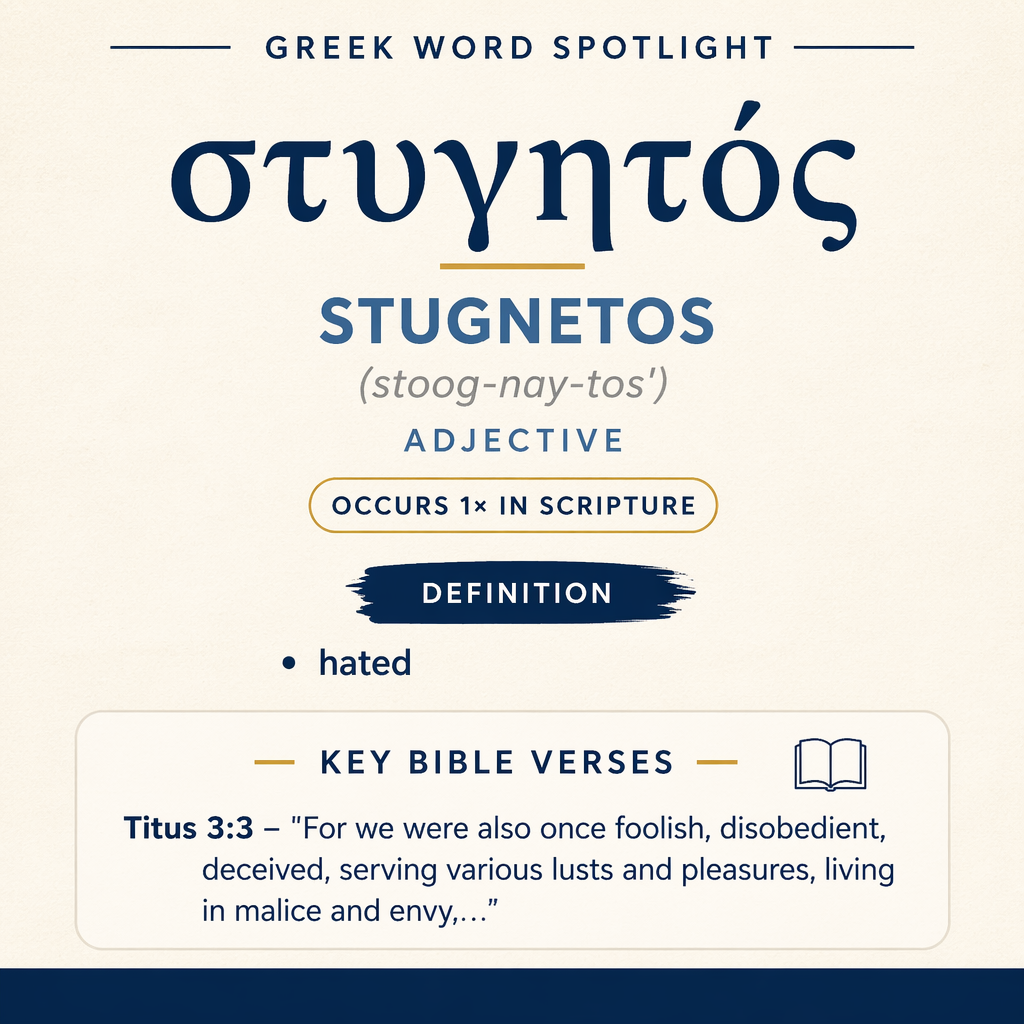
στυγητός means “hated” and appears once in Scripture in Titus 3:3.
Verse Context
In Titus 3:3, it appears within a description of a former way of life marked by malice and envy.
Learn More →στυγητός expresses the condition of being “hated,” portraying a person as an object of hostility rather than as a neutral observer. It appears once, in a compact moral portrait where several traits cluster to describe a former way of life.
Occurrences
Titus 3:3
“For we were also once foolish, disobedient, deceived, serving various lusts and pleasures, living in malice and envy, hateful, and hating one another.” (Titus 3:3)
Here στυγητός (“hated”) stands near the end of a fast-moving list of descriptors that together sketch a shared past (“we were also once…”). The verse moves from inner qualities (“foolish,” “disobedient,” “deceived”) to patterns of service and lifestyle (“serving various lusts and pleasures,” “living in malice and envy”), and then to relational damage (“hateful, and hating one another”). In that progression, “hated” marks the social outcome of the earlier vices: life characterized by malice and envy does not remain private but ripens into a state in which a person is caught up in reciprocal hostility.

The sequence “hateful, and hating one another” places στυγητός as the passive side of a mutual relationship. The phrase “hating one another” names active behavior; “hated” frames how such behavior leaves people positioned toward each other. In this line, the term does not isolate a single enemy or a targeted grievance; it presents a community atmosphere in which people are both marked by animosity and made objects of animosity. The word therefore contributes to the verse’s portrayal of entangled moral and relational collapse: not only do people engage in hatred, but they also live as those who are hated within a web of strained relationships.

Sense and Usage
As an adjective meaning “hated,” στυγητός functions to describe a person’s standing in relation to others: the person is the recipient of hatred. In Titus 3:3, the adjective does not operate as a solitary label; it is set among other terms of moral disorder. That placement shows that “hated” is treated as part of the lived experience produced by a broader pattern of life. The verse’s chain begins with confusion and disobedience, passes through deceptive desires (“serving various lusts and pleasures”), and settles into a settled mode of social ill will (“living in malice and envy”). Within that arrangement, “hated” reads as an exposure of what malice and envy do: they corrode the ability to live peaceably, producing a condition where one becomes repellent to others and where hostility becomes ordinary.
The immediate pairing with “hating one another” sharpens the sense. “Hated” designates not merely a private feeling toward someone but a relational status that belongs to a cycle. The line presents a double-sided reality: people are both agents and recipients within the same relational breakdown. The adjective captures the passive position in that cycle—being the object of hatred—without removing responsibility from the active posture that follows (“hating one another”). In the verse’s logic, these are not two unrelated groups (some hated, others hating), but a single “we” whose former life included both aspects. στυγητός thus helps the clause depict a shared pattern where the boundaries between offender and offended blur in mutual antagonism.
The word also gains definition from contrast with the verbs and participles around it. Many items in the list show action or ongoing practice: “serving,” “living,” and “hating.” Against that kinetic background, “hated” reads as the social result of those actions, almost like the atmosphere they create. It summarizes a condition that can be perceived from the outside: a life lived in malice and envy naturally yields relationships characterized by hostility, where being disliked is no longer accidental but expected. στυγητός therefore carries a distinctly relational force in context—it names how persons are regarded in a community marked by corrosive attitudes.
Because the verse speaks in the first-person plural (“we”), the adjective is not directed at an outsider; it is used as part of self-description. The term contributes to a confession-like portrait: the speakers include themselves among those who once belonged to a way of life in which hatred, both given and received, was normal. The form of the statement underscores how “hated” can be a collective trait, not merely an individual reputation. In the scene of Titus 3:3, the adjective functions as one more facet of a corporate memory: a former pattern defined by moral confusion, indulgence, and mutual hostility.
Imagery
Titus 3:3 frames “hated” with the language of a poisoned social environment—“living in malice and envy” and “hating one another.” The imagery is not of a single dramatic act but of an everyday mode of life where relationships are habitually sharpened against each other, and where people come to inhabit the position of being disliked as a settled condition.
Sources: Lexical data from Strong’s Exhaustive Concordance and the Translators Brief Lexicon of Extended Strongs for Greek (STEPBible, CC BY). Occurrence data from the Translators Amalgamated Greek New Testament (STEPBible, CC BY). Scripture quotations from the World English Bible (public domain).