
Exploring the Meaning of Spoudaioteros in Greek
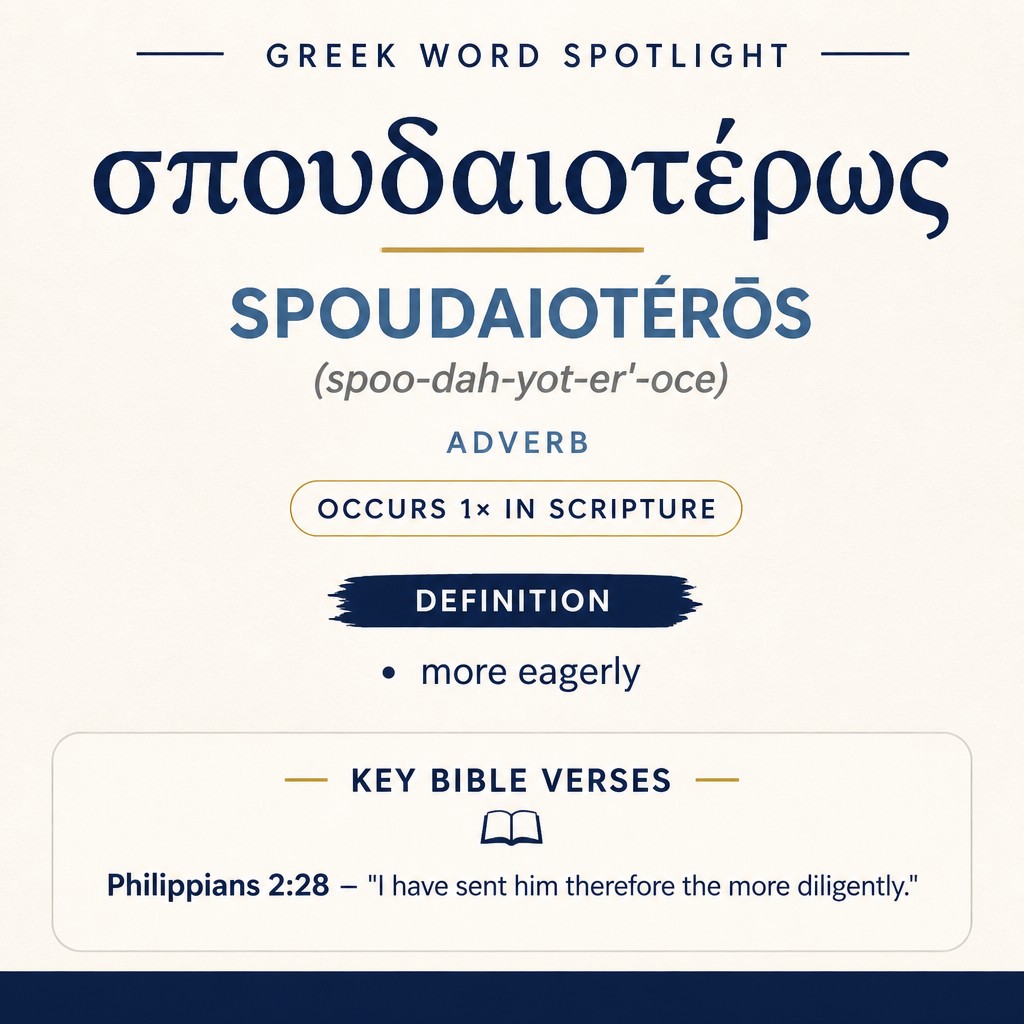
σπουδαιοτέρως means “more eagerly” and appears once in Scripture, in Philippians 2:28.
Scripture Occurrence
It occurs 1 time in Scripture. The occurrence is in Philippians 2:28.
Learn More →Verse Context
In Philippians 2:28 it is rendered “the more diligently” within the sentence “I have sent him therefore the more diligently….”
Learn More →σπουδαιοτέρως means “more eagerly” and appears in the New Testament in Paul’s statement about sending a coworker to the Philippians. In its lone occurrence it colors the action of sending with heightened readiness and urgency.
Root and Related Words
σπουδαιοτέρως is an adverb formed from σπουδαιότερος (spoudaióteros), meaning “more diligent” (Strong’s G4707). The comparative form in the related word stands behind the comparative force of the adverb.
Occurrences
“I have sent him therefore the more diligently, that when you see him again, you may rejoice, and that I may be the less sorrowful.” (Philippians 2:28)
In this sentence Paul ties his act of sending directly to two anticipated outcomes: the Philippians’ joy at seeing the man “again,” and Paul’s own relief—“that I may be the less sorrowful.” Within that purpose statement, σπουδαιοτέρως (“more eagerly”) intensifies the manner of the sending. The word does not add a new action alongside sending; it sharpens how the sending is carried out, presenting it as marked by increased readiness and energetic promptness.
The structure of the verse makes the adverb’s contribution especially clear. Paul’s “therefore” frames the sending as a considered decision with reasons behind it, and “that” introduces the intended results. Against that backdrop, “more eagerly” functions as the rhetorical signal that Paul is not dispatching this person reluctantly or casually; he is leaning into the sending as the appropriate course to secure the stated ends. The adverb thus sits at the hinge between Paul’s decision and the practical step that will let the community “rejoice” through reunion.
The comparative idea carried by “more eagerly” also implies a scale of earnestness: Paul’s sending is not merely eager, but more so—heightened beyond an ordinary level. The verse itself supplies the situational pressure that explains this comparative shading. The Philippians’ rejoicing is tied to seeing him “again,” suggesting absence and the desire for restored presence. Paul’s own emotional state is implicated as well: he expects to be “the less sorrowful” when that reunion occurs. In that emotional and relational setting, σπουδαιοτέρως points to a stronger-than-usual urgency in arranging the visit, because the hoped-for joy and relief are not abstract goals but personal and immediate ones.
At the same time, the adverb keeps the focus on the sending rather than on a bare feeling. “More eagerly” is not presented as a detached internal mood; it is embodied in a concrete decision to send someone. The word therefore casts Paul’s eagerness as purposeful and outward-facing: the increased readiness expresses itself as action aimed at the well-being of others (“that when you see him again, you may rejoice”) and at the easing of Paul’s own sorrow (“that I may be the less sorrowful”).
Sense and Usage
Because σπουδαιοτέρως is attested only here, its sense is best traced by watching how “more eagerly” functions within this single, tightly reasoned sentence. The word is comparative in force: it portrays eagerness that has been intensified. In Philippians 2:28, that intensification concerns the manner and decisiveness of sending—an eagerness that moves from intention to execution with greater speed and careful follow-through.
The immediate context in the verse gives the term a relational shape. Paul’s “more eagerly” is not eagerness for its own sake, but eagerness directed toward a reunion (“when you see him again”). The adverb therefore conveys an urgency that serves community joy: Paul anticipates the Philippians’ rejoicing as the natural response to seeing the person once more, and he accelerates or strengthens his action accordingly. “More eagerly” underscores that he is not indifferent to the congregation’s emotional and spiritual state; rather, he acts with increased earnestness to facilitate their joy.
The word also carries an affective logic tied to Paul’s own condition. The second purpose clause—“and that I may be the less sorrowful”—places Paul’s sorrow on the stage of the sentence. σπουδαιοτέρως does not name sorrow; it describes eagerness. Yet in this verse, eagerness is presented as the practical response to sorrow: Paul’s heightened readiness to send is aimed at reducing grief through the comfort and encouragement he expects the Philippians’ renewed joy will bring. In other words, “more eagerly” frames urgency as compassion-driven and relief-seeking, not as impatience.
Finally, the verse shows that σπουδαιοτέρως belongs to the language of responsible initiative. Paul is not merely waiting for circumstances to change; he initiates change by sending someone “therefore” with greater eagerness. The adverb highlights intentionality—an increased willingness to act promptly when action can serve joy and lighten sorrow.
Imagery
The imagery implied by σπουδαιοτέρως in Philippians 2:28 is the bustle of dispatch and travel arrangements: a person being sent with heightened readiness so that an awaited meeting can happen “again.” Within the verse’s emotional frame—rejoicing on one side and sorrow on the other—the word evokes an urgent movement toward reunion, where prompt action becomes the pathway to shared joy and diminished grief.
Sources: Lexical data from Strong’s Exhaustive Concordance and the Translators Brief Lexicon of Extended Strongs for Greek (STEPBible, CC BY). Occurrence data from the Translators Amalgamated Greek New Testament (STEPBible, CC BY). Scripture quotations from the World English Bible (public domain).




