
Exploring the Meaning of Soros in Greek
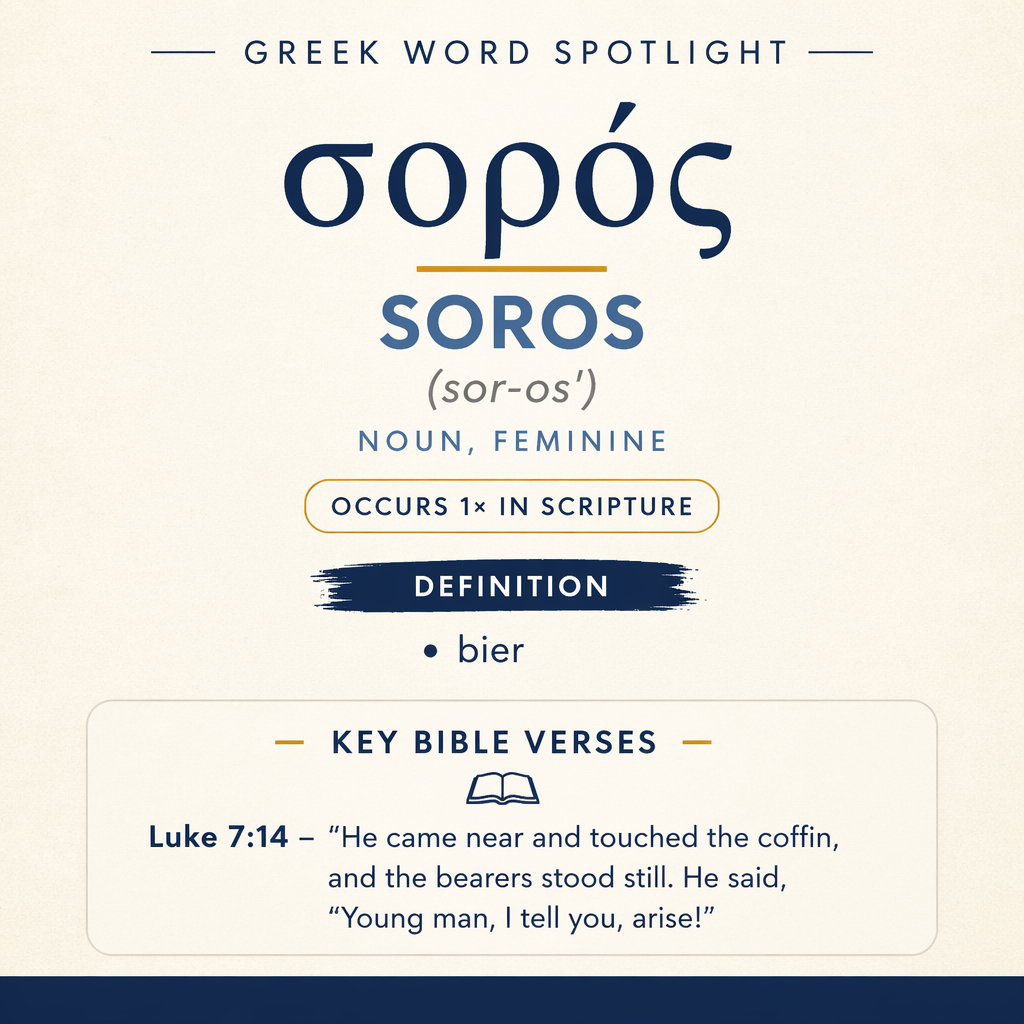
σορός means “bier” and appears once in Scripture, in Luke 7:14.
Scripture Occurrence
It occurs one time in Scripture. The occurrence is in Luke 7:14.
Learn More →Context in Luke
In Luke 7:14, Jesus touches the coffin and the bearers stand still. He then says, “Young man, I tell you, arise!”
Learn More →σορός denotes a “bier” and appears in a single New Testament scene: Jesus approaches and interrupts a funeral procession in Luke 7:14. In that moment, the word belongs to the tangible, public equipment of death—an object carried by bearers and close enough to be touched.
Root and Related Words
σορός is related to the verb soreuō (σωρεύω), “to pile up” (Strong’s G4987). That relationship places the noun in the orbit of physical arrangement and handling—language naturally suited to describing an object associated with the transport of a body.

Occurrences
“He came near and touched the coffin, and the bearers stood still. He said, “Young man, I tell you, arise!”” (Luke 7:14)
In Luke 7:14, σορός is the concrete object that mediates between the mourners’ movement and Jesus’ command. The narrative is built around motion: the bearers are carrying the dead, Jesus “came near,” and then the action halts—“the bearers stood still.” The bier is the focal point of that interruption, because it is the item Jesus touches. Within the verse, the touch is not incidental; it is a deliberate contact with the vehicle of the funeral procession, and it immediately affects the people responsible for carrying it. The bearers’ stopping is the visible, communal response to the touch, a pause that creates a public space for the spoken command, “Young man, I tell you, arise!”
The word thus functions in the scene as a boundary-marker between the realm of the dead and the realm of the living. It is the physical platform on which the dead is being borne; by touching it, Jesus engages the procession at its most literal point. Luke’s phrasing ties the object directly to the bearers: it is something with handlers, not a private or hidden container. The bier belongs to an outdoor, witnessed context where movement is coordinated—those carrying it are attentive enough that a single touch brings them to a standstill. In this single verse, σορός contributes immediacy and public visibility: Jesus’ approach is not merely toward the grieving family in general, but toward the object that embodies the funeral’s purpose and direction.
Sense and Usage
As “bier,” σορός refers to a practical item used in the conveyance of the dead. Luke 7:14 underscores this practical character by presenting it as something borne by “bearers,” implying a carried load and a coordinated action. The term’s placement in the sentence makes it the direct object of Jesus’ touch, which shows that it is accessible and close at hand in a moving procession. Rather than being described in detail, the bier is identified by what happens around it: it is approached, touched, and—because it is central to the procession—its touch results in an immediate halt.
The bier in this context is also an object that concentrates social attention. The bearers’ stillness indicates that the procession recognizes a disruption at the point most closely associated with the deceased. Luke does not depict Jesus addressing the bearers first or negotiating space; instead, the act of touching the bier itself governs the scene. The word therefore participates in the narrative logic: touching the bier is the means by which Jesus arrests the forward motion of death’s procession and creates the moment in which his speech-act can be heard and responded to. The command “arise” follows the touch and the stopping, so the bier becomes the hinge between movement toward burial and the possibility of reversal implied by the command.
Because the term occurs here alone, its usage is shaped entirely by this concentrated moment: a carried funeral object, bearers in motion, an authoritative interruption, and a spoken word directed to the dead. The bier stands as the point of contact where Jesus’ nearness is expressed materially (“touched”), and where the crowd’s coordinated activity is compelled to pause (“stood still”). The noun’s sense, as used here, is not abstract or symbolic in itself; it is the ordinary object that makes the extraordinary interruption legible to everyone present.
Imagery
Luke 7:14 frames σορός as a visible sign of a life being carried to its end, surrounded by human hands and human steps. The touch upon the bier is a touch upon the procession’s central object, and the resulting stillness gives the scene a stark, suspended quality: bearers halted, an object held in place, and a command spoken into that silence—“Young man, I tell you, arise!”
Sources: Lexical data from Strong’s Exhaustive Concordance and the Translators Brief Lexicon of Extended Strongs for Greek (STEPBible, CC BY). Occurrence data from the Translators Amalgamated Greek New Testament (STEPBible, CC BY). Scripture quotations from the World English Bible (public domain).





