Exploring the Meaning of Somatikos in Greek
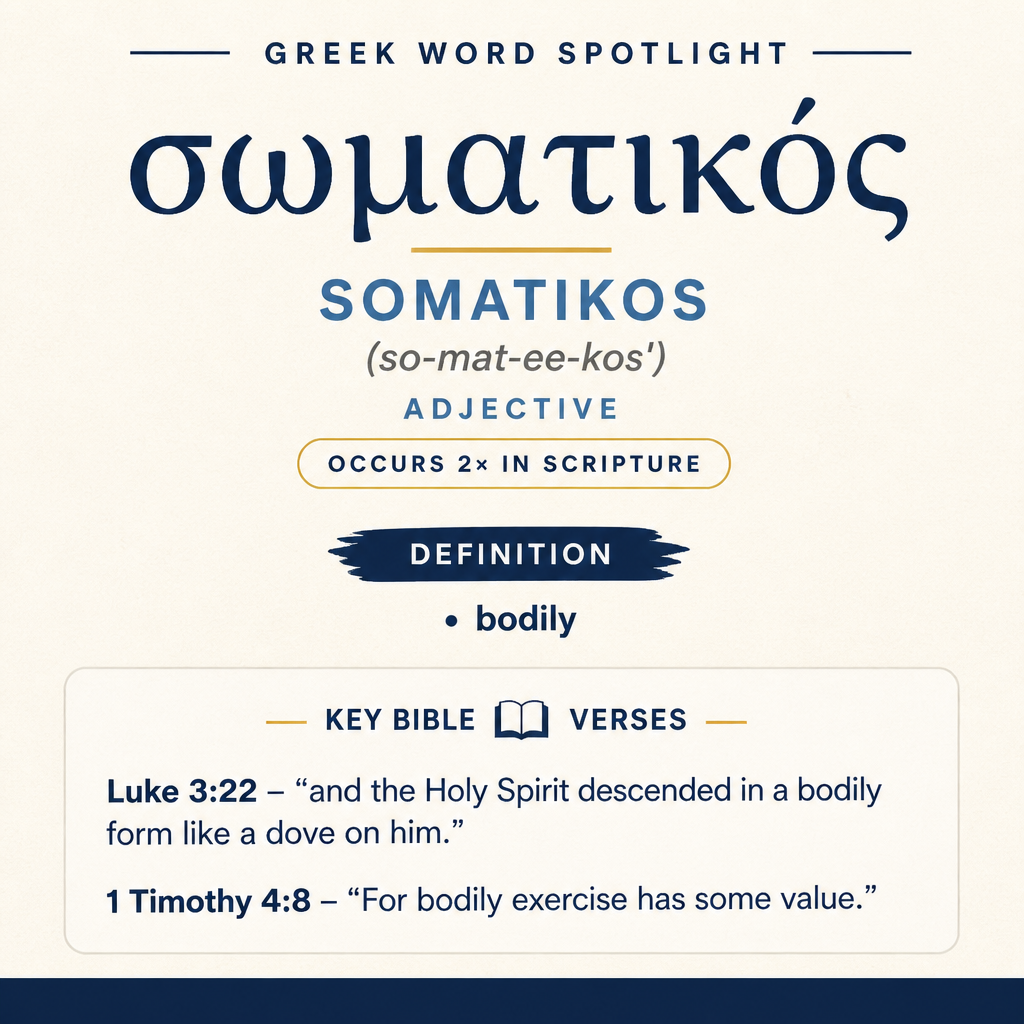
σωματικός means “bodily” and appears in Luke 3:22 and 1 Timothy 4:8.
Context Snapshots
In Luke 3:22, the Holy Spirit descended in a bodily form like a dove. In 1 Timothy 4:8, it describes bodily exercise having some value.
Learn More →σωματικός describes what pertains to the body—“bodily.” It appears in two distinct settings: the descent of the Holy Spirit at Jesus’ baptism and an instruction contrasting “bodily exercise” with godliness.
Root and Related Words
σωματικός is derived from soma (σῶμα), “body” (Strong’s G4983). The adjective expresses a relationship to the body as such, tying what is described directly to embodied, physical existence.

Occurrences
Luke 3:22 — “and the Holy Spirit descended in a bodily form like a dove on him; and a voice came out of the sky, saying “You are my beloved Son. In you I am well pleased.””
In this baptism scene, σωματικός qualifies “form,” specifying that the Spirit’s descent is marked by a form that is bodily. The phrase “in a bodily form like a dove” places emphasis on perceptibility in the event: the descent is narrated not only as an action (“descended”) but as one accompanied by a form described in bodily terms. The comparison “like a dove” gives the reader a concrete frame for imagining how this descent is presented within the scene, but the adjective anchors that comparison in the realm of embodied form rather than an unseen or purely inward experience. Within the verse’s sequence—descent, then a voice from the sky—the bodily descriptor belongs to the descent itself, contributing to the public, scene-setting character of what is happening around Jesus (“on him”).
Because the verse also includes a heavenly voice addressing Jesus (“You are my beloved Son. In you I am well pleased.”), σωματικός functions alongside other outward markers in the narrative: the descent is depicted with a form, and the voice is heard. The adjective helps the descent read as an event with observable features within the story’s world, a narrated occurrence that can be spoken about as happening “in” a describable form.
1 Timothy 4:8 — “For bodily exercise has some value, but godliness has value in all things, having the promise of the life which is now, and of that which is to come.”
Here σωματικός modifies “exercise,” locating that kind of training in the sphere of the body. The sentence sets up a comparison of value: “bodily exercise has some value, but godliness has value in all things.” By marking one side of the comparison as bodily, the adjective helps define what kind of “exercise” is being discussed—exercise characterized by its relation to the body—and therefore what sort of value is being conceded to it (“some value”). The contrast depends on keeping the categories clear: one kind of pursuit is identified as bodily, while the other (“godliness”) is described as valuable “in all things,” extending beyond the bounds implied by bodily qualification.
The verse also links godliness to “the promise of the life which is now, and of that which is to come.” In that framing, σωματικός helps mark bodily exercise as a limited category within the broader horizon of “life … now” and “that which is to come.” The adjective does not demean exercise—its value is affirmed—but it shapes the comparison by delimiting the sphere to which that value belongs, so that the later claim about godliness can be heard as wider in scope.
Sense and Usage
Across these two passages, σωματικός consistently marks something as belonging to the realm of the body. In Luke, that bodily quality attaches to “form,” describing the mode in which a descent is depicted: it is not merely that something happens, but that what happens is narrated with embodied form-language. The adjective thus serves a descriptive, scene-making function. It contributes to the concrete depiction of the event, presenting the descent as something that takes shape in a bodily way within the narrative’s sensory world—something capable of being compared to a dove’s appearance.
In 1 Timothy, the same bodily quality attaches to “exercise,” placing a practice in a bodily category and thereby helping the author make a measured evaluation. The adjective creates a clear domain: bodily exercise is a kind of activity whose value can be affirmed (“some value”) while still being set alongside a pursuit described as universally valuable (“in all things”). The bodily qualifier is essential to how the comparison works. Without it, “exercise” could remain general; with it, the statement turns specifically to exercise understood in relation to the body, which in turn clarifies why the contrast can be drawn between a limited value and an all-encompassing value.
Although the two contexts differ—one narrating a pivotal moment at baptism, the other offering practical instruction—the adjective operates similarly: it signals that what is being described is bodily in character. In one case, bodily language conveys the kind of “form” associated with a divine descent; in the other, bodily language designates the sort of “exercise” under discussion. The word’s contribution is therefore not to introduce a new action or object, but to specify the sphere or mode in which something is to be understood: bodily form, bodily exercise. That specifying function helps each passage communicate with greater precision—Luke by sharpening the portrayal of the descent, and 1 Timothy by sharpening the categories in a value comparison.
Imagery
In Luke 3:22, σωματικός belongs to vivid narrative imagery: a descent “in a bodily form like a dove,” paired with a voice from the sky. The adjective helps the scene read as tangible and depictable, connecting the descent to embodied form. In 1 Timothy 4:8, the imagery shifts from a narrated event to a familiar practice—exercise—yet the adjective still points to the same sphere, the body, and thereby supports the verse’s carefully balanced evaluation: “some value” on the bodily side, contrasted with a value that reaches “in all things” and across “the life which is now, and of that which is to come.”
Sources: Lexical data from Strong’s Exhaustive Concordance and the Translators Brief Lexicon of Extended Strongs for Greek (STEPBible, CC BY). Occurrence data from the Translators Amalgamated Greek New Testament (STEPBible, CC BY). Scripture quotations from the World English Bible (public domain).