
Exploring the Meaning of Smurnizo in Greek
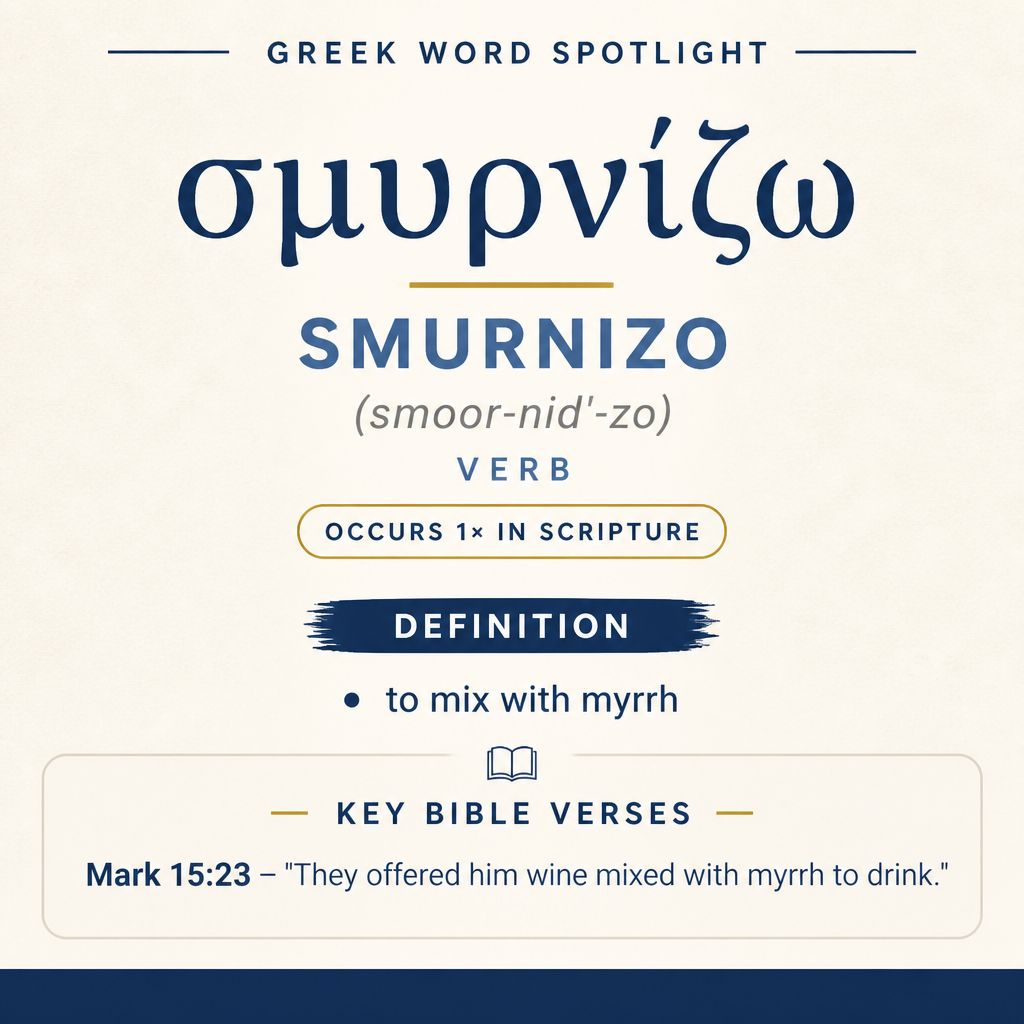
σμυρνίζω means “to mix with myrrh” and appears once in Scripture, in Mark 15:23.
Biblical Occurrence
This verb occurs one time in Scripture. Its single occurrence is Mark 15:23.
Learn More →Verse Context
In Mark 15:23, wine mixed with myrrh was offered to Jesus. He did not take it.
Learn More →σμυρνίζω describes mixing something with myrrh, and it appears in the passion narrative where a drink is offered to Jesus. In its single New Testament attestation, the verb focuses attention on the preparation of the wine that is presented to him.
Root and Related Words
σμυρνίζω is connected with the place-name Σμύρνα (Smýrna), “Smyrna” (Strong’s G4667), as the related word from which it derives in Strong’s.

Occurrences
“They offered him wine mixed with myrrh to drink, but he didn’t take it.” (Mark 15:23)
Here σμυρνίζω anchors the action in a concrete, physical preparation: the wine is not merely offered, but offered in a particular state—wine that has been mixed with myrrh. The verb shapes the reader’s sense of the moment by identifying what kind of drink is being presented and by keeping the focus on the act of offering something prepared for drinking (“to drink”). Because the sentence immediately notes the response—“but he didn’t take it”—the mixing is not an incidental detail; it is part of the defined object of the offer, and the refusal is directed toward this specific preparation.

The wording also places σμυρνίζω within a tightly framed sequence of actions. First comes the offering (“They offered him”), then the description of the drink (“wine mixed with myrrh”), then the intended purpose (“to drink”), and finally the outcome (“but he didn’t take it”). In that progression, σμυρνίζω functions adjectivally in English (“mixed”), specifying the wine’s condition as it is held out. The verb’s contribution is therefore both descriptive and narrative: it describes what was done to the wine and helps explain what, exactly, was declined.
Sense and Usage
In Mark 15:23, the idea of mixing with myrrh is applied to a beverage in a context of immediate consumption. The verb highlights an act of combining—bringing myrrh into the wine so that the offered drink is characterized by that mixture. Within the clause, the mixing is presented as a completed preparation prior to the offer: the wine comes to Jesus already “mixed with myrrh,” and the scene turns on the presentation of that prepared drink and his refusal to take it.
The single attestation also shows the verb’s practical, material orientation. σμυρνίζω is not used abstractly; it is tied to an ordinary object (“wine”) and a bodily action (“to drink”). The term therefore carries a sensory concreteness: it invites the reader to notice the composition of what is offered rather than treating it as generic wine. Even without additional occurrences to widen the picture, the verse itself indicates how the verb works in discourse—naming a specific kind of mixture in order to define the object involved in a decisive moment.
Because Mark frames the offer and refusal in one sentence, σμυρνίζω also participates in the contrast between what is presented and what is accepted. The refusal does not stand alone; it is refusal of the particular cup described. The verb thus serves the narrative by attaching significance to the preparation of the drink as part of what is being rejected.
Imagery
The imagery of σμυρνίζω in Mark 15:23 is the imagery of a prepared draught: wine that has been altered by the addition of myrrh and then placed into someone’s hands to be consumed. The verse evokes the moment of offering—an extended cup—and sets beside it the decisive non-reception: “but he didn’t take it.”
Sources: Lexical data from Strong’s Exhaustive Concordance and the Translators Brief Lexicon of Extended Strongs for Greek (STEPBible, CC BY). Occurrence data from the Translators Amalgamated Greek New Testament (STEPBible, CC BY). Scripture quotations from the World English Bible (public domain).





