Exploring the Meaning of Skandalizo in Greek
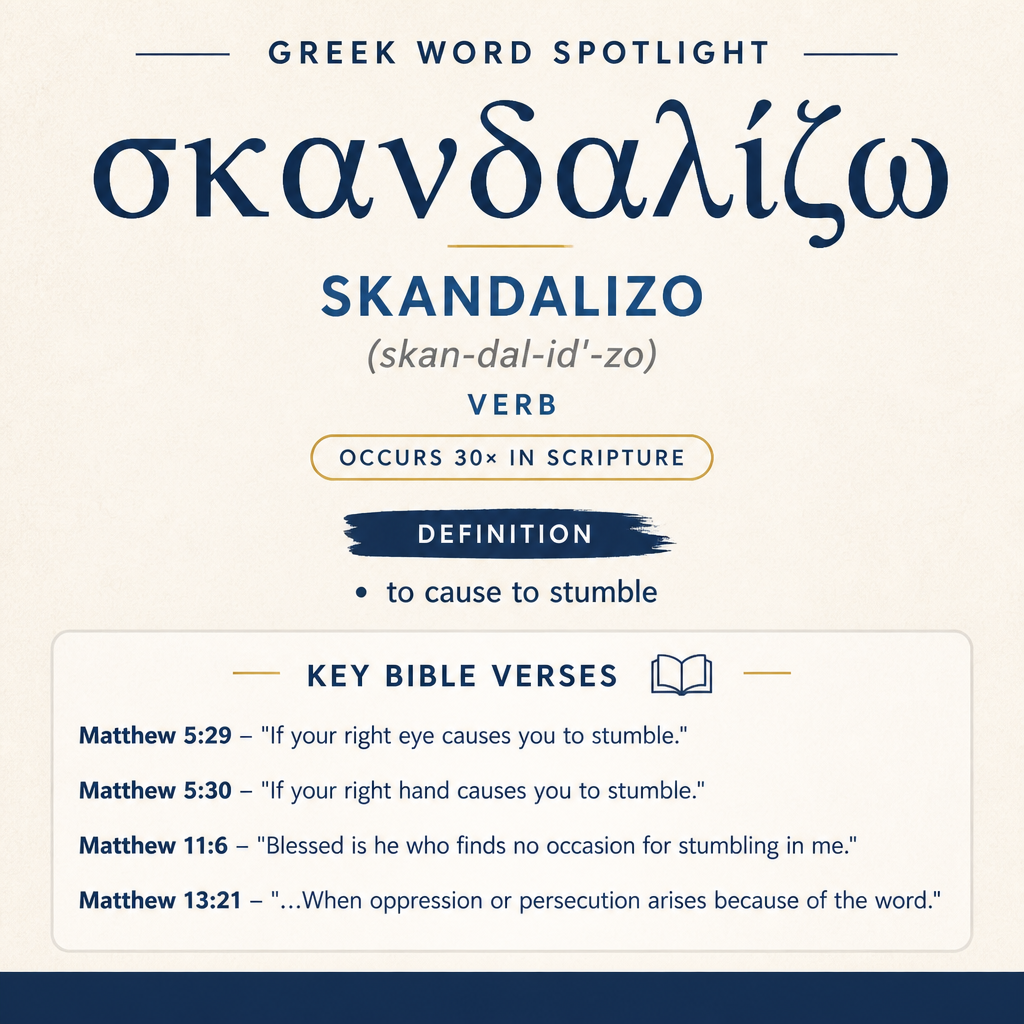
σκανδαλίζω means “to cause to stumble” and occurs 30 times in Scripture, including in Matthew 5, 11, 13, 15, 17, and 18.
Core Meaning
σκανδαλίζω is defined as “to cause to stumble.” In Matthew 5:29–30, it describes something that “causes you to stumble.”
Learn More →Matthew Examples
Matthew 11:6 links it to finding “no occasion for stumbling” in Jesus. Matthew 15:12 reports the Pharisees were “offended” when they heard Jesus’ saying.
Learn More →Practical Warnings
Matthew 17:27 speaks of acting carefully “lest we cause them to stumble.” Matthew 18:6 warns against causing “little ones who believe in me” to stumble.
Learn More →σκανδαλίζω names the act of “caus[ing] to stumble,” whether the source is a body part that leads one into ruin, a response to Jesus himself, pressure that follows the word, or conduct that might trip others. In the passages below it frames both personal vulnerability and interpersonal responsibility, often with severe consequences pictured in concrete, bodily terms.
Occurrences
Matthew 5:29: “If your right eye causes you to stumble, pluck it out and throw it away from you. For it is more profitable for you that one of your members should perish, than for your whole body to be cast into Gehenna.”
Here σκανδαλίζω depicts an internal cause of stumbling located in “your right eye.” The saying treats the eye as an avenue by which a person is tripped into a course ending in destruction; the drastic imagery (“pluck it out and throw it away”) underscores how seriously the stumbling is regarded because the alternative is “your whole body” being “cast into Gehenna.”
Matthew 5:30: “If your right hand causes you to stumble, cut it off, and throw it away from you. For it is more profitable for you that one of your members should perish, than for your whole body to be cast into Gehenna.”
The same verb is applied to “your right hand,” shifting the picture from seeing to doing. The hand is presented as a member that can become the mechanism of stumbling, and the argument again measures the loss of one part against the peril of the whole person being “cast into Gehenna.”
Matthew 11:6: “Blessed is he who finds no occasion for stumbling in me.”
σκανδαλίζω is now oriented toward Jesus: the issue is whether someone “finds” a stumbling point “in me.” The blessing pronounced on the one who does not stumble suggests that encountering Jesus can become a decisive test—either an impediment that trips a person, or a path traversed without falling.
Matthew 13:21: “yet he has no root in himself, but endures for a while. When oppression or persecution arises because of the word, immediately he stumbles.”
Stumbling is described as an immediate reaction to external pressure. The verb marks a collapse under “oppression or persecution” that comes “because of the word,” and it is linked to the prior description of lacking “root,” so that the stumble is the visible failure of endurance.
Matthew 13:57: “They were offended by him. But Jesus said to them, “A prophet is not without honor, except in his own country, and in his own house.”
Here σκανδαλίζω characterizes the crowd’s response to Jesus: “They were offended by him.” Their stumble is not portrayed as a minor irritation but as a reaction that blocks honor; Jesus’ proverb about a prophet’s honor in his “own country” and “own house” situates the offense within familiar proximity, where recognition should have been easiest.
Matthew 15:12: “Then the disciples came, and said to him, “Do you know that the Pharisees were offended when they heard this saying?”
The disciples report that the Pharisees “were offended” at Jesus’ “saying.” σκανδαλίζω highlights the disruptive effect of spoken teaching: hearing becomes the occasion, and the result is stumbling—an adverse reaction that the disciples consider significant enough to bring to Jesus’ attention.
Matthew 17:27: “But, lest we cause them to stumble, go to the sea, cast a hook, and take up the first fish that comes up. When you have opened its mouth, you will find a stater coin. Take that, and give it to them for me and you.”
In this narrative instruction the verb is used proactively: the goal is to avoid causing others to stumble (“lest we cause them to stumble”). The steps are concrete and practical—fishing, finding a coin, paying “for me and you”—so σκανδαλίζω governs a decision to act in a way that removes a potential stumbling point for “them.”
Matthew 18:6: “but whoever causes one of these little ones who believe in me to stumble, it would be better for him if a huge millstone were hung around his neck, and that he were sunk in the depths of the sea.”
σκανδαλίζω here is explicitly interpersonal: “caus[ing]” “one of these little ones who believe in me” to stumble. The saying weighs this act against a grim alternative—having “a huge millstone” hung on the offender and being “sunk in the depths of the sea”—which portrays the seriousness of tripping up vulnerable believers.
Matthew 18:8: “If your hand or your foot causes you to stumble, cut it off, and cast it from you. It is better for you to enter into life maimed or crippled, rather than having two hands or two feet to be cast into the eternal fire.”
The verb again frames an internal cause, now broadened to “your hand or your foot.” The imagery pairs stumbling with bodily action and movement, and the comparison is sharpened: entering “into life” even “maimed or crippled” is set against being “cast into the eternal fire” with an intact body.
Matthew 18:9: “If your eye causes you to stumble, pluck it out, and cast it from you. It is better for you to enter into life with one eye, rather than having two eyes to be cast into the Gehenna of fire.”
This returns to the “eye” as a cause of stumbling, repeating the extreme remedy (“pluck it out, and cast it from you”). The contrast is between impaired entry “into life” and a catastrophic end: being “cast into the Gehenna of fire.” σκανδαλίζω thus stands at the hinge between present temptation and ultimate outcome.
Matthew 24:10: “Then many will stumble, and will deliver up one another, and will hate one another.”
Stumbling is projected onto a collective future: “many will stumble.” The verb introduces a cascade of social breakdown—betrayal (“deliver up one another”) and hostility (“hate one another”). σκανδαλίζω marks the initial faltering that correlates with fractured community relations.
Matthew 26:31: “Then Jesus said to them, “All of you will be made to stumble because of me tonight, for it is written, ‘I will strike the shepherd, and the sheep of the flock will be scattered.’”
Jesus predicts a forced stumble: “All of you will be made to stumble because of me tonight.” The verb is tied to a crisis that scatters a group (“the sheep of the flock will be scattered”), so stumbling functions as the trigger for dispersal. The cause is again Jesus’ role in the unfolding events (“because of me”), and the result is disorientation and separation.

Sense and Usage
Across these scenes σκανδαλίζω consistently expresses stumbling as a decisive disruption rather than a minor misstep. In Matthew 5:29–30 and 18:8–9 the verb is anchored in bodily members (“eye,” “hand,” “foot”), making the cause of stumbling feel immediate and personal; the language of removal (“pluck it out,” “cut it off,” “throw it away,” “cast it from you”) frames stumbling as something to be dealt with urgently because it is linked to being “cast” into destructive judgment (“Gehenna,” “the eternal fire”). In these sayings, stumbling is the dangerous turning that makes radical loss seem preferable to total ruin.
Other occurrences locate the stumble in response to Jesus and his message. Matthew 11:6 pronounces blessing on the one who finds “no occasion for stumbling in me,” implying that the encounter with Jesus can present a point at which one either remains steady or falls. Matthew 13:57 and 15:12 portray stumbling as offense taken: people are “offended by him” or “offended when they heard this saying,” so σκανδαλίζω can describe a reaction to person and word that interrupts proper reception and honor. Matthew 13:21 adds the element of pressure over time: under “oppression or persecution…because of the word,” the one with “no root” stumbles immediately, showing how external hardship can expose inner instability.
The verb also carries ethical weight in relation to others. Matthew 17:27 shows a deliberate choice to avoid being the cause of another’s stumble; the practical act of paying with the found coin is framed as a safeguard so that “we” do not trip “them.” Matthew 18:6 intensifies the warning by focusing on “little ones who believe in me” and attaching a vivid penalty image to the one who causes such stumbling. Finally, Matthew 24:10 and 26:31 broaden the horizon to communal and group experience: many stumble and the outcome is mutual betrayal and hatred; the disciples are told they will be made to stumble, and the consequence is scattering. In these settings, stumbling is not only personal failure but also a catalyst for relational collapse.
Imagery
These passages regularly clothe stumbling in stark physical and spatial pictures: hands, feet, and eyes become the locus of a fall; bodies can be “cast” into fire; a person can be dragged down like a weight-sunk victim “in the depths of the sea.” Even where no body part is mentioned, σκανδαλίζω still evokes loss of footing: persecution makes one stumble “immediately,” offense makes honor collapse at home, and a night of stumbling leaves “the sheep of the flock…scattered.”
Sources: Lexical data from Strong’s Exhaustive Concordance and the Translators Brief Lexicon of Extended Strongs for Greek (STEPBible, CC BY). Occurrence data from the Translators Amalgamated Greek New Testament (STEPBible, CC BY). Scripture quotations from the World English Bible (public domain).