Exploring the Meaning of Scholazo in Greek
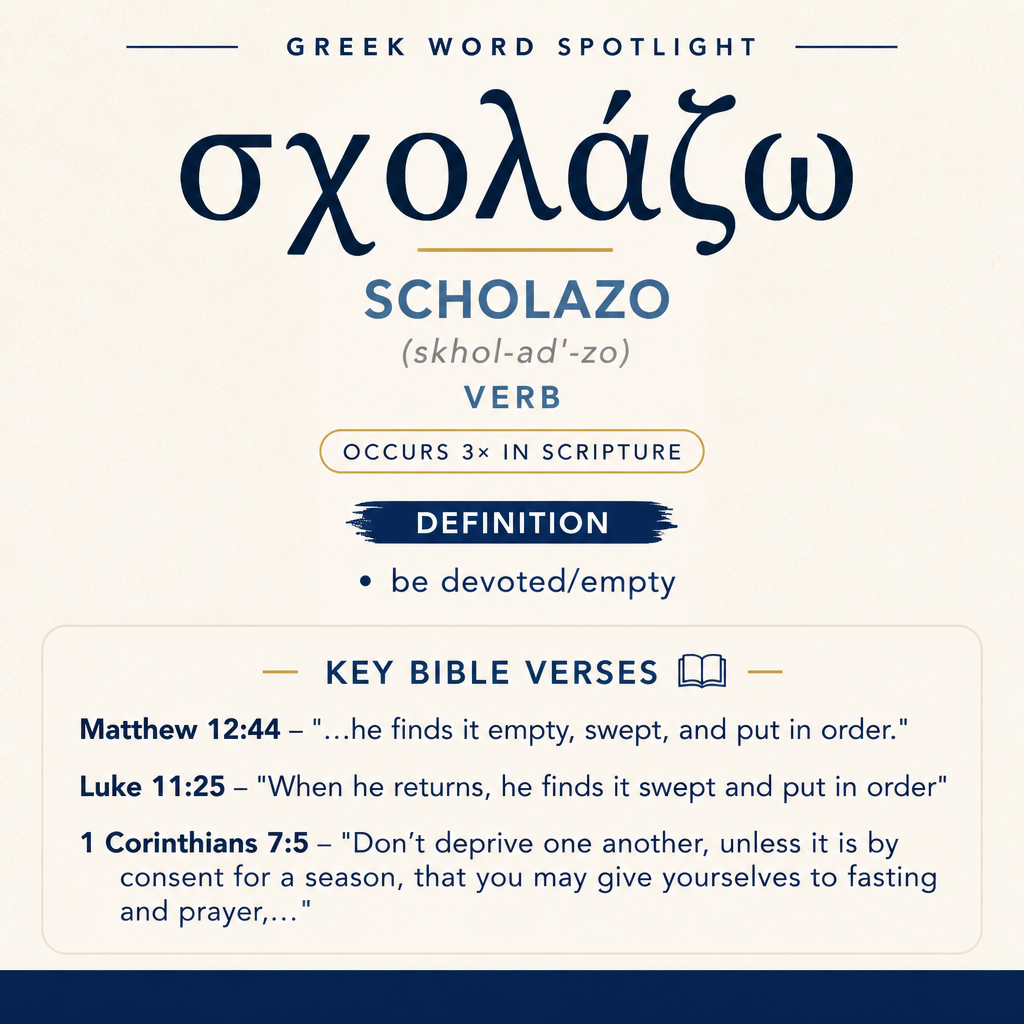
σχολάζω means “be devoted/empty” and occurs three times in Scripture: Matthew 12:44, Luke 11:25, and 1 Corinthians 7:5.
Core Meaning
σχολάζω is defined as “be devoted/empty.” In its Scriptural contexts, it describes either an “empty” state or being “devoted” to spiritual activity.
Learn More →Gospel Scenes
In Matthew 12:44 the returning spirit finds the house “empty, swept.” In Luke 11:25 it is found “swept and put in order.”
Learn More →Pauline Instruction
In 1 Corinthians 7:5 it appears in guidance about abstaining by mutual consent for a season. The purpose given is devotion to fasting and prayer.
Learn More →σχολάζω expresses the idea of being devoted or empty, and it appears in two closely related scenes about a “house” left in a certain condition and in Paul’s counsel about a mutually agreed season set apart for fasting and prayer. The word’s force is felt in the way a space or time is left open or set apart, either to be filled by something else or to be given over to a specific purpose.
Root and Related Words
σχολάζω is related to scholē (σχολή), “lecture hall” (Strong’s G4981). That connection places the verb alongside a word associated with a setting devoted to instruction, a place characterized by being set aside for a particular activity.

Occurrences
Matthew 12:44 — “Then he says, ‘I will return into my house from which I came out,’ and when he has come back, he finds it empty, swept, and put in order.”
In this saying, the word contributes to the description of a “house” that is found “empty,” even though it has been “swept, and put in order.” The picture is not of chaos but of vacancy: the space is prepared, arranged, and yet unoccupied. In the narrative flow of the sentence, the emptiness becomes the key feature that invites the return—“I will return into my house”—because the house is still available. The cluster of descriptions (“empty, swept, and put in order”) makes the emptiness vivid: the house is not merely uninhabited; it is unfilled after being tidied, a readiness without a resident.
This use also frames emptiness as a condition discovered upon inspection (“when he has come back, he finds it…”). The word thus helps mark the “house” as a place that has been left open. The scene depends on the contrast between external order and internal vacancy: the space looks managed, yet it remains available to be entered again.
Luke 11:25 — “When he returns, he finds it swept and put in order.”
This parallel phrasing keeps the same domestic imagery: someone returns and “finds it” in a particular state. Here, the emphasis in the quoted wording falls on being “swept and put in order,” the condition of preparation and arrangement. In context, the verb’s contribution is bound up with that condition: the place is treated as a cleared space—something attended to, readied, and therefore accessible. The returning figure’s discovery focuses on what has been done to the space (swept; ordered), which complements the idea that the place has been left in an open state rather than being filled with a new occupant.
The effect is similar to the Matthean picture: the “house” is not described as ruined or abandoned in neglect. Instead it is maintained, which makes its openness more striking. The verb’s sense works with the household imagery to portray a place that is “available” precisely because it has been cleared and arranged.
1 Corinthians 7:5 — “Don’t deprive one another, unless it is by consent for a season, that you may give yourselves to fasting and prayer, and may be together again, that Satan doesn’t tempt you because of your lack of self-control.”
In Paul’s instruction, the word belongs to the practical guidance about marital relations: spouses are not to “deprive one another,” except “by consent for a season.” The purpose of that limited interval is explicit: “that you may give yourselves to fasting and prayer.” Here the word’s idea of being devoted or empty is expressed through the notion of a period deliberately set apart—time made open from ordinary marital intimacy so that it can be directed to a specific spiritual activity. The consent and the season underline that this is not an indefinite withdrawal but a bounded setting-aside.
The sentence also shows the pastoral aim of that temporary devotion: “and may be together again, that Satan doesn’t tempt you because of your lack of self-control.” The word’s contribution therefore sits in a tension between purposeful dedication (fasting and prayer) and the need to return to normal togetherness. The “season” is a kind of intentionally cleared interval—emptied of one set of activities so it can be occupied by another—after which the couple reunites. In this occurrence, the verb does not describe a room but a shared rhythm of life: availability for fasting and prayer is created through mutually agreed abstention.
Sense and Usage
Across these passages, σχολάζω operates in two closely related directions within the single frame “be devoted/empty.” In the sayings about the “house,” the stress falls on emptiness as an exposed openness: the space is clean and ordered yet still unoccupied, so it remains a place that can be entered. The domestic imagery makes emptiness concrete—emptiness can coexist with tidiness and careful arrangement. The house is presented as ready, but readiness is not the same as being filled.
In 1 Corinthians, the stress falls on devotion as a deliberate setting apart. The interval “by consent for a season” is an emptiness that is chosen: a temporary clearing in the pattern of life that creates room for “fasting and prayer.” This shows the word’s capacity to speak not only of a place that happens to be vacant but of time that is intentionally made available for a particular aim. The devotion is not vague; it is given a clear direction in the clause “that you may give yourselves to fasting and prayer.”
Taken together, the occurrences show that the word can describe an “open” condition that has consequences. In the house scenes, the consequence is that the returning figure finds a space still open to reentry. In the marital counsel, the consequence is twofold: the openness allows focused spiritual practice, and the ending of the season (“be together again”) guards against vulnerability connected with “lack of self-control.” In both, the word’s idea presses the reader to consider what fills an empty space or time once it has been cleared—whether the clearing is accidental or deliberate, whether the openness is guarded and bounded or left simply available.
Imagery
The passages give two vivid pictures that belong together: a house that is “swept, and put in order,” and a season in marriage set aside “that you may give yourselves to fasting and prayer.” In both, the imagery is of something made ready—either a room arranged or a time agreed upon—so that it is open for an occupant or an activity. The word’s scenes are therefore not about disorder but about the power and risk of cleared space: what is left empty can be entered; what is set apart can be devoted.
Sources: Lexical data from Strong’s Exhaustive Concordance and the Translators Brief Lexicon of Extended Strongs for Greek (STEPBible, CC BY). Occurrence data from the Translators Amalgamated Greek New Testament (STEPBible, CC BY). Scripture quotations from the World English Bible (public domain).