Exploring the Meaning of Sbennumi in Greek
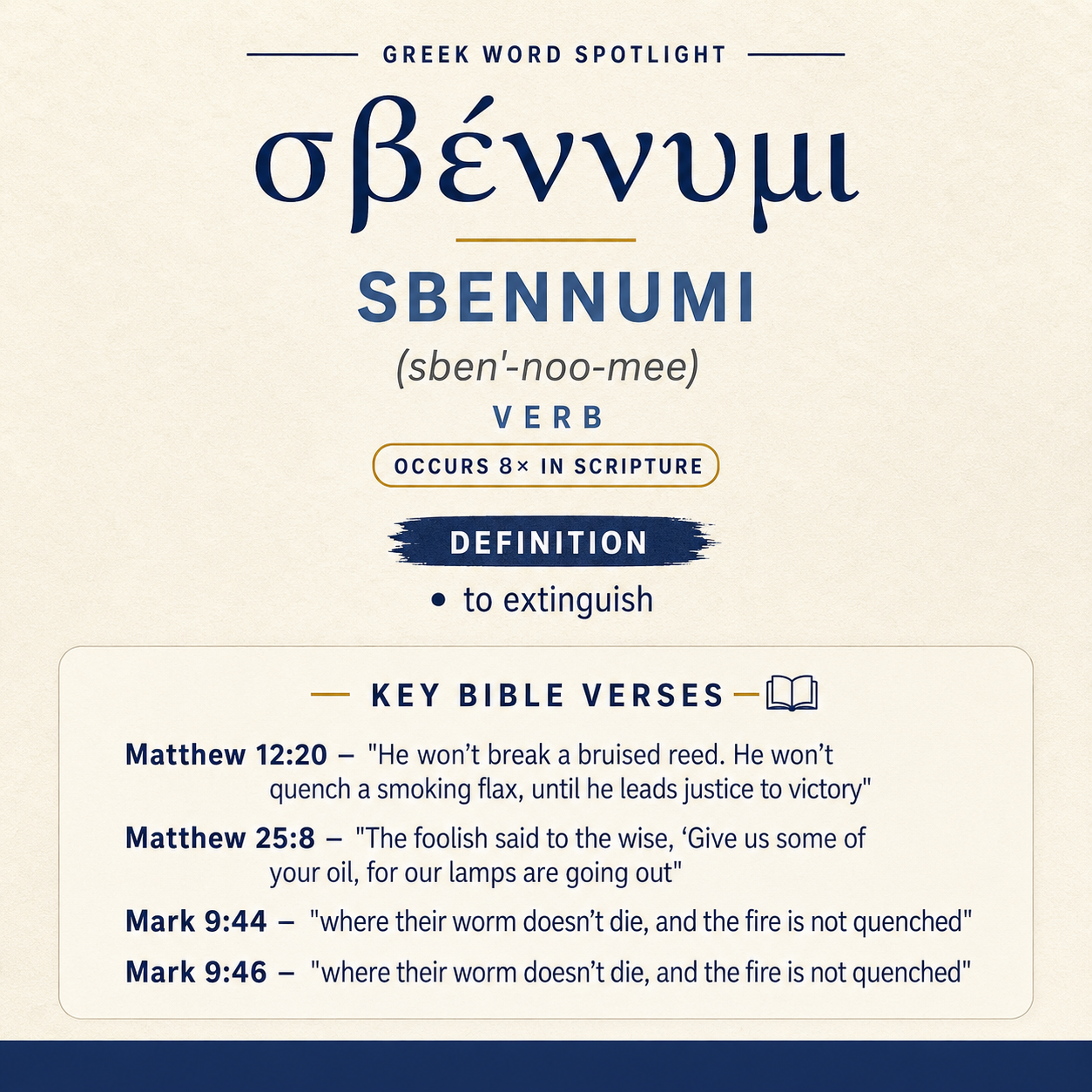
σβέννυμι means “to extinguish” and occurs 8 times in Scripture, including Matthew, Mark, Ephesians, 1 Thessalonians, and Hebrews.
Core Meaning
σβέννυμι is defined as “to extinguish.” In context it can describe quenching fire, lamps going out, or stopping something from burning.
Learn More →Gospel Occurrences
In Matthew 12:20 it is used of not quenching a smoking flax, and in Matthew 25:8 of lamps going out. In Mark 9:44, 9:46, and 9:48 it appears in the phrase “the fire is not quenched.”
Learn More →Epistles and Hebrews
Ephesians 6:16 uses it for quenching the fiery darts of the evil one with the shield of faith. 1 Thessalonians 5:19 warns, “Don’t quench the Spirit,” and Hebrews 11:34 speaks of quenching the power of fire.
Learn More →σβέννυμι speaks of putting something out—extinguishing what is burning or active. In Scripture it appears in scenes of dimming lamps, unquenchable fire, threatened harm that can be stopped, and a direct warning about the Spirit.
Occurrences
Matthew 12:20
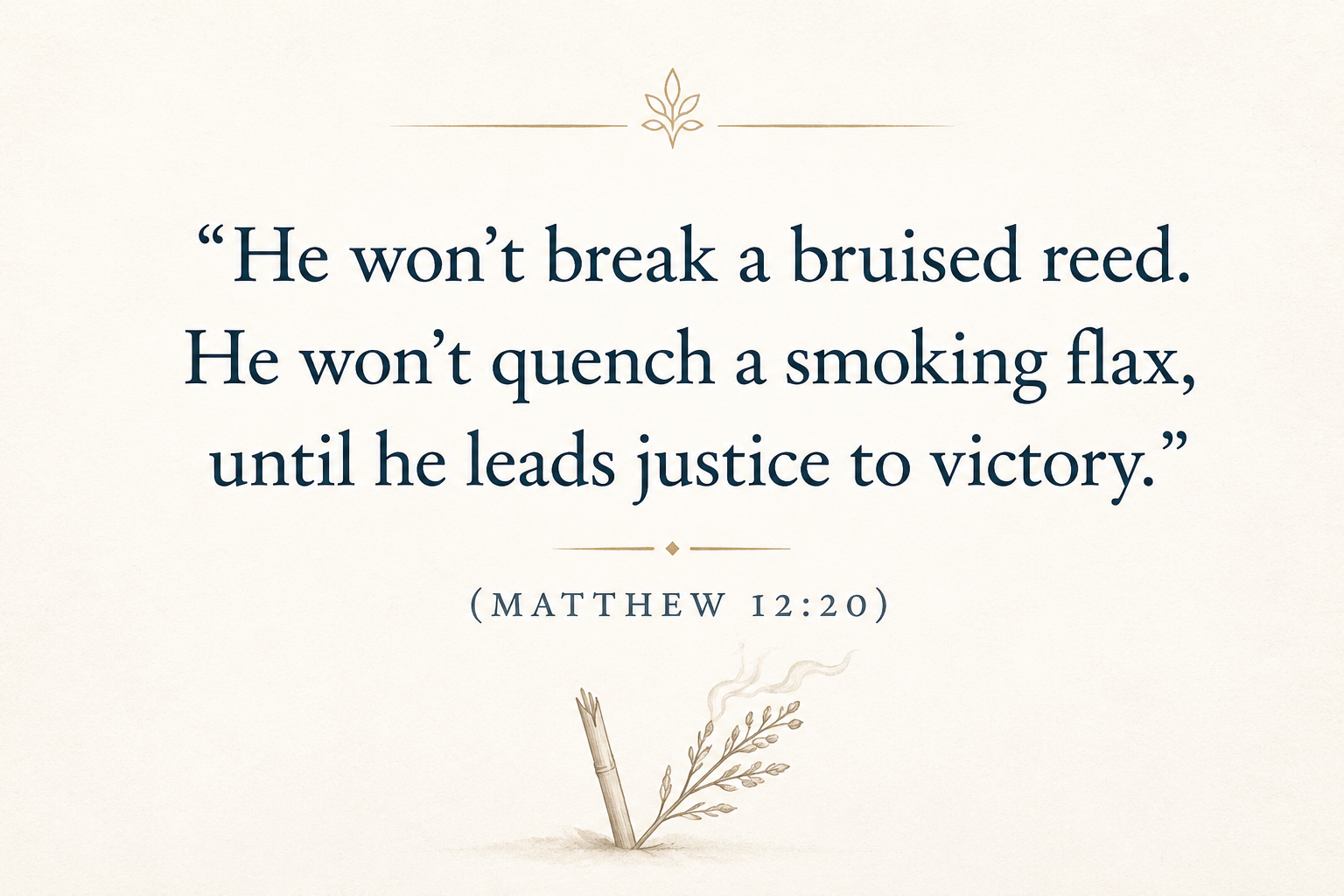
“He won’t break a bruised reed. He won’t quench a smoking flax, until he leads justice to victory.” (Matthew 12:20)
Here σβέννυμι is set in a picture of something barely still alight: “a smoking flax.” The point of the image is not the vigor of the flame but its fragility—smoke without a steady blaze. To “quench” in this setting is the decisive act that ends what little burning remains. In the verse’s paired images (“won’t break… won’t quench”), the verb contributes the idea of not finishing off what is already weak; the scene assumes that a small ember or wick could easily be extinguished, yet it is not.
Matthew 25:8
“The foolish said to the wise, ‘Give us some of your oil, for our lamps are going out.’” (Matthew 25:8)
σβέννυμι underlies the crisis of failing light: “our lamps are going out.” Extinguishing is not described as an outside attacker snuffing the flame, but as the lamps themselves slipping toward darkness. The verb’s force lies in the approaching finality of the loss—light is on the verge of being extinguished. The request for oil shows that, in this scene, what prevents extinguishing is fuel; without it, the lamp’s flame collapses.
Mark 9:44
“‘where their worm doesn’t die, and the fire is not quenched.’” (Mark 9:44)
In this refrain, σβέννυμι describes a fire that cannot be extinguished. The verb is framed by negation (“is not quenched”), emphasizing not merely that a fire burns, but that no extinguishing action brings it to an end. Paired with “their worm doesn’t die,” the unquenched fire functions as a marker of ongoing, uninterrupted burning.
Mark 9:46
“‘where their worm doesn’t die, and the fire is not quenched.’” (Mark 9:46)
The repeated wording keeps σβέννυμι tied to the same point: a fire that remains beyond any attempt to put it out. Repetition here intensifies the impression of persistence—what normally happens to fire (it is extinguished) does not happen in this scene.
Mark 9:48
“‘where their worm doesn’t die, and the fire is not quenched.’” (Mark 9:48)
Again σβέννυμι serves as the boundary term between ordinary experience and the verse’s depiction: this is a fire that does not reach the usual endpoint of being extinguished. The image depends on a familiar expectation—fires can be put out—only to deny it.
Ephesians 6:16
“above all, taking up the shield of faith, with which you will be able to quench all the fiery darts of the evil one.” (Ephesians 6:16)
σβέννυμι is applied to “fiery darts,” shifting the verb from a standing flame to burning projectiles. “Quench” portrays an active stopping of their burning effect as they come against a defender. The verse sets up a means (“taking up the shield of faith”) and an outcome (“you will be able to quench”), so the verb carries the sense of preventing a threatening, flaming assault from continuing to burn upon impact.
1 Thessalonians 5:19
“Don’t quench the Spirit.” (1 Thessalonians 5:19)
This direct command uses σβέννυμι with “the Spirit,” drawing on extinguishing as an image for stopping something that is active. The brevity sharpens the verb’s force: to “quench” would be to bring to an end what is presently at work, as one would end a flame. The imperative assumes that such extinguishing is possible as a human action and warns against it.
Hebrews 11:34
“quenched the power of fire, escaped the edge of the sword, from weakness were made strong, grew mighty in war, and caused foreign armies to flee.” (Hebrews 11:34)
Here σβέννυμι describes extinguishing in a setting of danger and deliverance: some “quenched the power of fire.” The wording focuses not simply on the presence of flames but on their “power”—fire as a destructive force that can be brought under control. In the chain of actions (“quenched… escaped… were made strong… grew mighty… caused… to flee”), the verb contributes a concrete example of peril neutralized: the harmful effect of fire is stopped, like a blaze brought down so it no longer consumes.

Sense and Usage
Across these passages, “extinguish” operates with a consistent core idea: bringing burning to an end, whether the burning is literal, weaponized, or used as an image for a living activity. The word’s scenes cluster around three main patterns.
First, σβέννυμι names the vulnerable threshold where light and heat are easiest to lose. In Matthew 12:20, the “smoking flax” is already reduced to smoldering; extinguishing would be the final, small act that turns smoke into coldness. In Matthew 25:8, the lamps are in the process of failing—“going out”—so extinguishing is not sudden drama but the predictable outcome of neglecting what sustains the flame. In both places, the verb highlights how near the end can be for a small fire: a wick with only smoke left, a lamp with dwindling oil. Extinguishing is the decisive crossing from faint light to darkness.
Second, the verb can define what cannot happen. Mark 9:44, 9:46, and 9:48 all use the negative form: “the fire is not quenched.” This does more than say “there is fire.” It says no extinguishing succeeds; the ordinary human experience of fire—something that can be smothered, doused, or die down—is excluded. The repetition of the same line makes the unquenchable quality the controlling feature of the image. In these sayings, σβέννυμι marks the usual terminus of a flame and then denies that terminus.
Third, σβέννυμι can describe preventing harm by stopping what burns. Ephesians 6:16 applies extinguishing to “fiery darts,” portraying an incoming threat that carries fire with it. The “shield” is effective because it enables quenching—stopping the burning component of the attack so it cannot do what fire does. Hebrews 11:34 similarly frames extinguishing as triumph over danger: “quenched the power of fire.” The focus is not on a campfire’s end but on halting fire as a destructive power within a wider set of deliverances (“escaped the edge of the sword”). In both, the verb keeps its physical sense while functioning in contexts of conflict, where extinguishing means neutralizing a deadly force.
Within this range, 1 Thessalonians 5:19 stands out by taking the extinguishing image and applying it to “the Spirit.” The imperative “Don’t quench” assumes that extinguishing is an act of suppression: something can be stopped the way a flame can be put out. The verse’s choice of σβέννυμι ties the Spirit to the kind of active, ongoing reality that extinguishing would end—an activity comparable, in the verse’s imagery, to a fire that ought to keep burning rather than be smothered.
Imagery
The occurrences of σβέννυμι gather around fire and light as things with an end-point: they can be put out, they can fade out, they can be stopped in mid-attack, and they can—strikingly—be depicted as beyond all extinguishing. The word therefore carries the tension between fragility (a wick that only smokes; lamps that are going out) and permanence (a fire “not quenched”), while also serving as a practical verb for overcoming danger (“fiery darts,” “the power of fire”).
Sources: Lexical data from Strong’s Exhaustive Concordance and the Translators Brief Lexicon of Extended Strongs for Greek (STEPBible, CC BY). Occurrence data from the Translators Amalgamated Greek New Testament (STEPBible, CC BY). Scripture quotations from the World English Bible (public domain).