Exploring the Meaning of Samareia in Greek
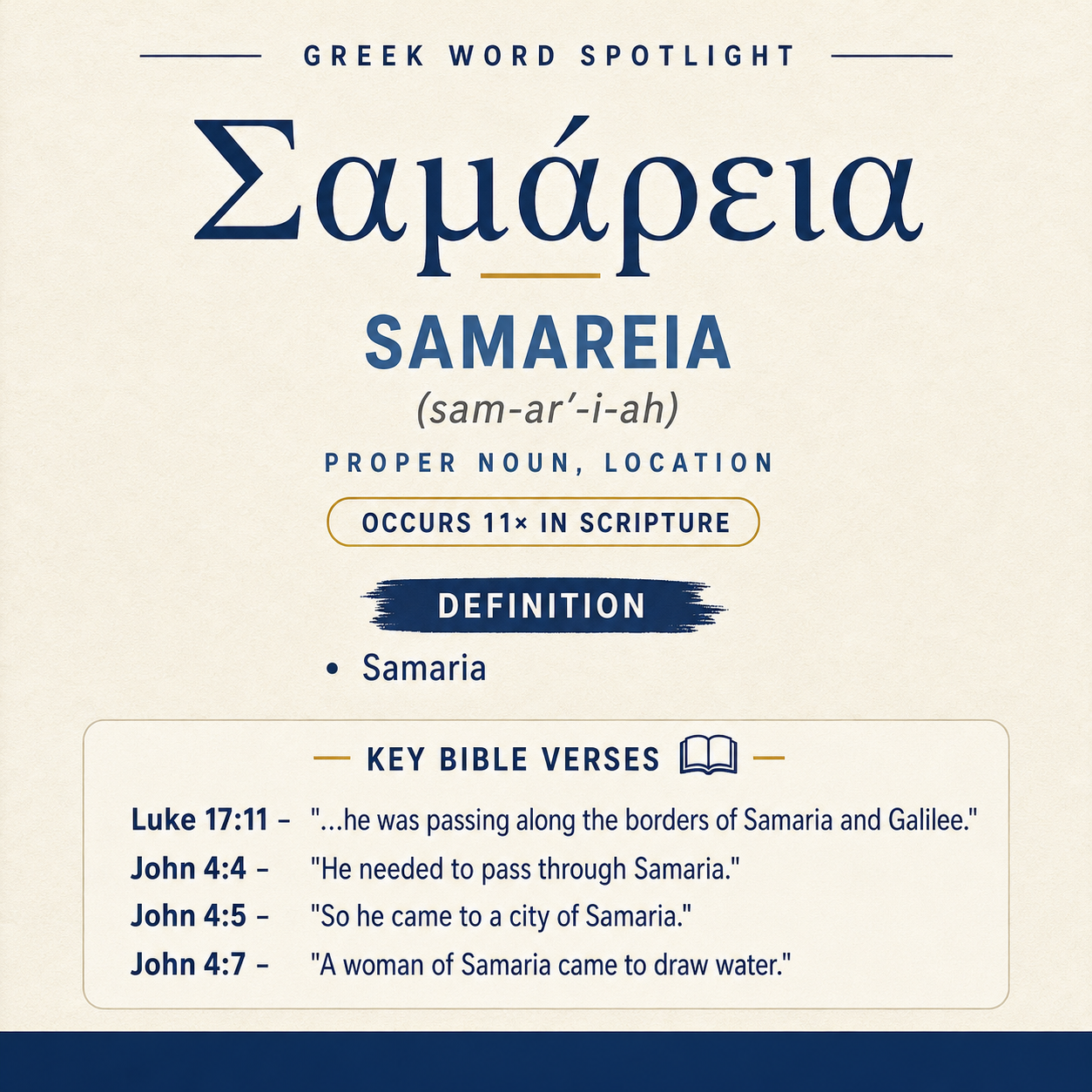
Σαμάρεια (Samareia) means “Samaria” and appears 11 times in the New Testament, including Luke 17:11, John 4, and Acts 1 and 8.
Gospel Scenes
Luke 17:11 places Jesus along the borders of Samaria and Galilee. John 4 records Jesus passing through Samaria and coming to a city called Sychar.
Learn More →Acts References
Acts 1:8 includes Samaria in the widening scope of witness. Acts 8 mentions Samaria during persecution and Philip’s proclamation in a city of Samaria.
Learn More →Σαμάρεια names Samaria, a geographic location that functions in these passages as a borderland, a route of travel, a setting for encounter, and a region within a widening mission. It appears in Luke, John, and Acts in scenes that move from Jesus’ travel and ministry to the spread and stabilization of early Christian communities.
Occurrences
Luke 17:11: “As he was on his way to Jerusalem, he was passing along the borders of Samaria and Galilee.”
Here Samaria marks a boundary zone on the way to Jerusalem. The wording “along the borders of Samaria and Galilee” places Jesus’ travel at an edge rather than inside a single district, and Σαμάρεια contributes the sense of liminal space—movement adjacent to regions, not merely through anonymous countryside.
John 4:4: “He needed to pass through Samaria.”
Samaria is the necessary corridor of travel in this statement. The verb “needed to pass through” makes Σαμάρεια more than a place name: it is the required path embedded in the journey, setting up a scene where the route itself is significant, not just the destination.
John 4:5: “So he came to a city of Samaria, called Sychar, near the parcel of ground that Jacob gave to his son, Joseph.”
Σαμάρεια provides the regional frame for a more precise location (“a city of Samaria, called Sychar”). The verse situates that city “near the parcel of ground that Jacob gave to his son, Joseph,” anchoring the scene in remembered land and specific geography; Samaria functions as the wider area within which this particular city and landmark are located.
John 4:7: “A woman of Samaria came to draw water. Jesus said to her, “Give me a drink.””
In this encounter, Σαμάρεια identifies the woman by place of origin or association (“of Samaria”), shaping the social and narrative setting of the request for water. Samaria is not merely backdrop; it qualifies the participant in the scene and ties the ordinary act of drawing water to a particular locale and its people.
Acts 1:8: “But you will receive power when the Holy Spirit has come upon you. You will be witnesses to me in Jerusalem, in all Judea and Samaria, and to the uttermost parts of the earth.”
Samaria stands as one named segment in an expanding geographic sequence. The phrase “in Jerusalem, in all Judea and Samaria, and to the uttermost parts of the earth” places Σαμάρεια alongside Judea as a distinct region included within the scope of witness, bridging the move from a city (“Jerusalem”) to broader territories and beyond.
Acts 8:1: “Saul was consenting to his death. A great persecution arose against the assembly which was in Jerusalem in that day. They were all scattered abroad throughout the regions of Judea and Samaria, except for the apostles.”
Here Σαμάρεια is a destination region produced by scattering under persecution. The assembly’s dispersion “throughout the regions of Judea and Samaria” makes Samaria one of the concrete places where displaced believers go, while the exception “except for the apostles” keeps Jerusalem as the remaining center; Samaria becomes part of the new, widened map of where the community now exists.
Acts 8:5: “Philip went down to the city of Samaria, and proclaimed to them the Christ.”
Σαμάρεια here identifies the city where proclamation occurs. The movement “went down to the city of Samaria” frames Philip’s ministry as geographically directed; Samaria is the setting in which proclamation is addressed “to them,” highlighting a local audience within that city.
Acts 8:9: “But there was a certain man, Simon by name, who used to practice sorcery in the city and amazed the people of Samaria, making himself out to be some great one,”
Samaria designates the populace affected by Simon’s activity: “the people of Samaria.” The verse contrasts an individual’s self-presentation (“making himself out to be some great one”) with the collective being “amazed,” and Σαμάρεια supplies the communal scope—this is not a private influence but one that reaches a defined regional people.
Acts 8:14: “Now when the apostles who were at Jerusalem heard that Samaria had received the word of God, they sent Peter and John to them,”
In this report-and-response scene, Σαμάρεια is treated as a receiving region: “Samaria had received the word of God.” The apostles’ location “at Jerusalem” and their sending “Peter and John to them” set Samaria as a connected but distinct field of response, one that prompts apostolic attention and visitation.
Acts 9:31: “So the assemblies throughout all Judea, Galilee, and Samaria had peace, and were built up. They were multiplied, walking in the fear of the Lord and in the comfort of the Holy Spirit.”
Samaria appears in a triad of regions that together describe the extent of the assemblies’ condition. Σαμάρεια helps mark the breadth of communal life—peace, edification (“were built up”), growth (“were multiplied”), and a shared manner of life (“walking in the fear of the Lord and in the comfort of the Holy Spirit”) across Judea, Galilee, and Samaria.
Acts 15:3: “They, being sent on their way by the assembly, passed through both Phoenicia and Samaria, declaring the conversion of the Gentiles. They caused great joy to all the brothers.”
In this travel narrative, Σαμάρεια is a corridor region: they “passed through both Phoenicia and Samaria.” The action in transit is “declaring the conversion of the Gentiles,” and the result is relational and emotional—“great joy to all the brothers.” Samaria functions as one of the places where news is announced and fellowship is strengthened along the way.
Sense and Usage
Across these passages, Σαμάρεια operates consistently as a place name, yet it carries different narrative roles depending on the scene. In Luke 17:11 it is a border marker, helping describe Jesus’ approach to Jerusalem by locating him “along the borders of Samaria and Galilee.” In John 4:4–7 it is first a route (“pass through Samaria”), then a regional frame for a specific town (“a city of Samaria, called Sychar”), and then an identifier for a person (“a woman of Samaria”). The word thus moves from map-language (region and route) to scene-language (setting for a local encounter) while remaining strictly geographic.
Acts uses Samaria as a key regional name in the outward movement of witness and community life. In Acts 1:8 Σαμάρεια is part of a deliberate geographic sequence that extends the sphere of testimony beyond Jerusalem. In Acts 8, Samaria becomes both refuge and mission field: persecution pushes believers “throughout the regions of Judea and Samaria” (8:1), and proclamation is directed to a “city of Samaria” (8:5). The same chapter also presents Samaria as a collective social world—“the people of Samaria” (8:9)—and as a region whose reception of God’s word becomes news carried to Jerusalem, prompting the sending of representatives (8:14). The effect is to portray Samaria as an active, responsive territory within a network of communities rather than a remote edge.
Later, Acts 9:31 depicts Samaria as one of the settled regions where assemblies exist and flourish, sharing in peace, strengthening, multiplication, and a common pattern of life. Acts 15:3 then returns to Samaria as a traveled-through region where communication and joy among “the brothers” accompanies the journey. Taken together, these uses show Samaria functioning as boundary, pathway, locality, people-group reference, and ecclesial region—distinct roles unified by the core sense of a real place that can be traversed, inhabited, and addressed.
Imagery
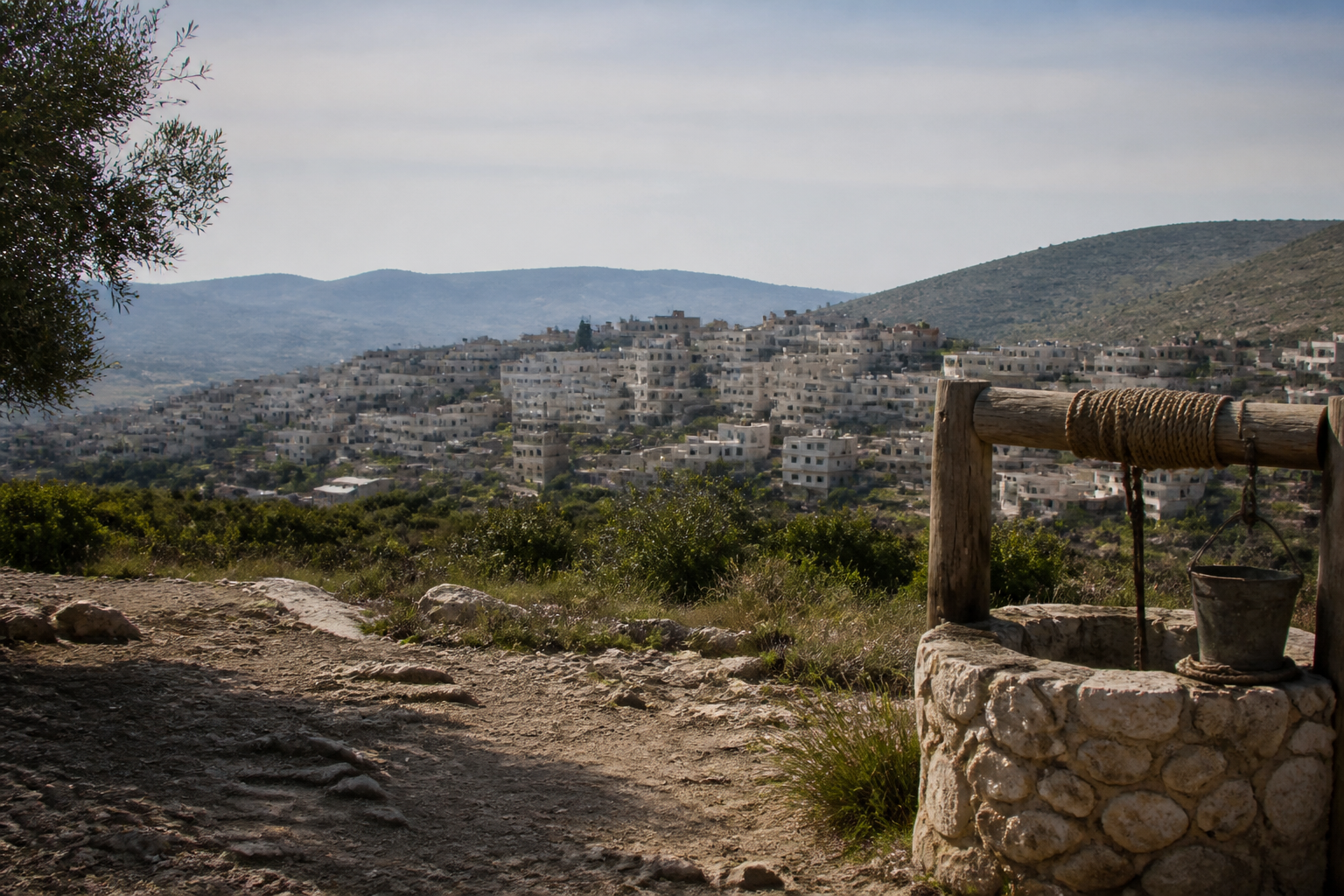
The passages give Samaria a geography of movement and connection: borders traversed (Luke 17:11), a necessary pass-through (John 4:4), a named city near a remembered piece of land (John 4:5), and roads along which messengers pass declaring news that produces “great joy” (Acts 15:3). In Acts especially, the name evokes a widening landscape—regions linked to Jerusalem by travel, hearing, sending, and shared peace (Acts 8:14; 9:31)—so that Samaria is pictured not as an isolated label on a map but as a lived territory where people receive words, communities grow, and journeys continue.
Sources: Lexical data from Strong’s Exhaustive Concordance and the Translators Brief Lexicon of Extended Strongs for Greek (STEPBible, CC BY). Occurrence data from the Translators Amalgamated Greek New Testament (STEPBible, CC BY). Scripture quotations from the World English Bible (public domain).