Exploring the Meaning of Saino in Greek
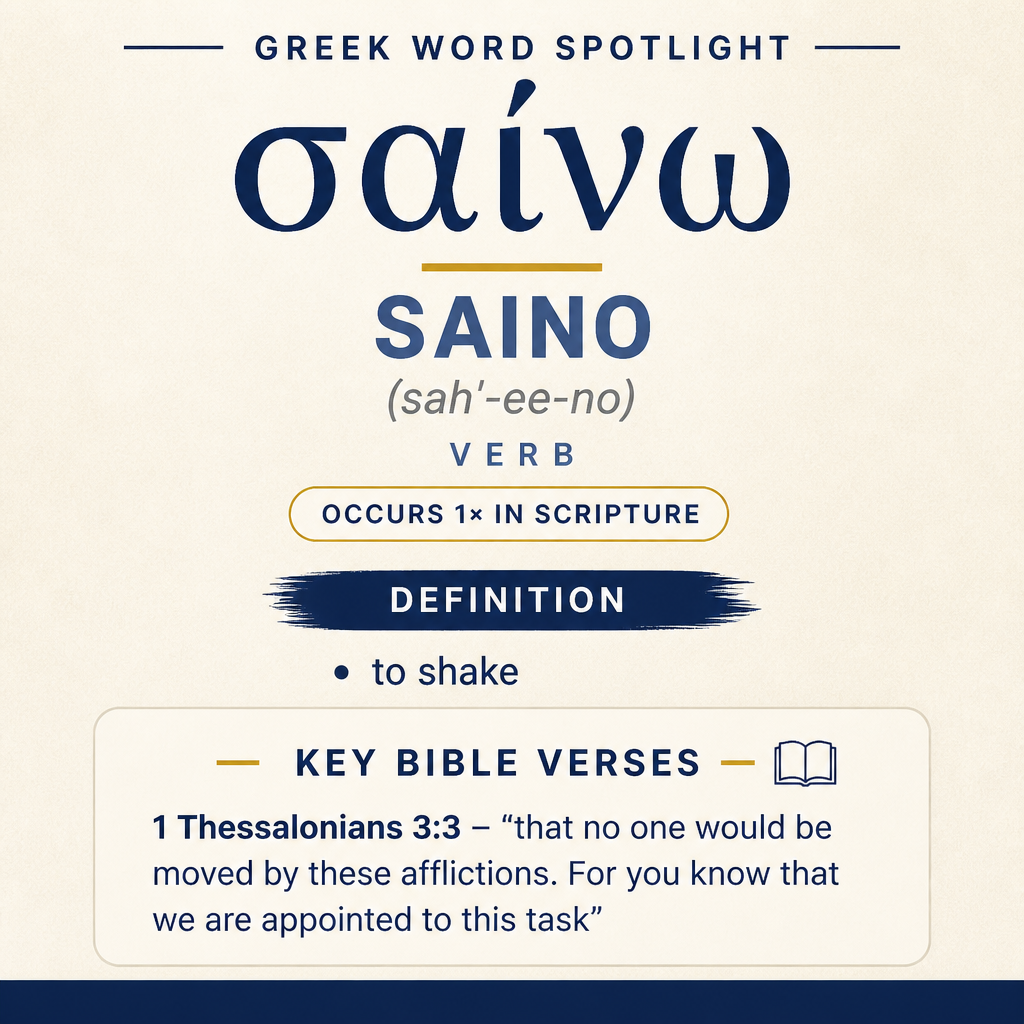
σαίνω means “to shake” and appears once in Scripture, in 1 Thessalonians 3:3.
Biblical Usage
It occurs one time in Scripture. In 1 Thessalonians 3:3 it is used in the context of being moved by afflictions.
Learn More →Verse Context
1 Thessalonians 3:3 reads, “that no one would be moved by these afflictions.” The verse adds, “For you know that we are appointed to this task.”
Learn More →σαίνω means “to shake” and appears once in the New Testament, in Paul’s exhortation to the Thessalonian believers as he speaks about the pressures of affliction.
Root and Related Words
σαίνω (Saino) is derived from seio (σείω), “to shake” (Strong’s G4579). The relationship points to a shared picture of agitation or disturbance expressed through the same basic action.

Occurrences
“that no one would be moved by these afflictions. For you know that we are appointed to this task.” (1 Thessalonians 3:3)
In this sentence Paul frames a pastoral concern: afflictions are present, and his aim is that “no one would be moved” by them. Within the flow of the line, σαίνω contributes the concrete imagery of an external force producing motion. The clause does not treat affliction as a mere idea to be evaluated but as a pressure capable of producing a reaction—something that can unsettle, jolt, or displace a person from where they were. The choice of a verb of “shaking” fits the way he puts the experience into physical terms: circumstances that strike the community could cause believers to shift position.

The immediate context in the same verse clarifies that this “moving” is not random. Paul adds, “For you know that we are appointed to this task.” In other words, the afflictions are not presented as a surprise intrusion but as part of a known calling. Against that backdrop, the verb’s force lands as a contrast: even when distress exerts a destabilizing push—when it tries to “shake” people—the Thessalonians are to remain unshifted because they recognize the appointment involved. The verse therefore sets two realities side by side: the capacity of afflictions to shake, and the community’s prior knowledge that frames those afflictions as something expected within their mission.
Sense and Usage
The single attested use shows how the basic idea “to shake” naturally extends into the social and spiritual sphere without leaving its core picture. Paul does not describe a gentle influence; he uses a word that evokes a force sufficient to put something in motion. In 1 Thessalonians 3:3 the “shaking” is directed toward persons (“no one”), and the agent is “these afflictions.” The line presents affliction as an active pressure that can induce movement—an experience that threatens stability.
The verse also shows that this “shaking” is not portrayed as inevitable. The stated purpose (“that no one would be moved”) implies that remaining unshaken is a realistic outcome, not a denial of suffering. The community is pictured as exposed to blows that could rattle them, yet capable of holding steady. Paul’s added explanation (“For you know…”) places the remedy for being shaken within shared understanding: knowledge of appointment does not remove affliction, but it addresses the kind of movement affliction can produce. The verb thus helps the reader feel the difference between being under strain and being displaced by strain.
Because σαίνω is used here with an explicit cause (“these afflictions”), its sense is shaped by the relationship between external circumstances and internal response. The verse’s language allows the “shaking” to be conceived as either a momentary jolt or an ongoing agitation, but in either case the central idea remains motion produced by impact. Paul’s concern is not merely emotional discomfort; it is movement—being shifted from one’s place—prompted by hardship. Even in its lone appearance, the verb supplies a vivid, bodily metaphor that makes the danger of affliction tangible.
Imagery
The imagery behind σαίνω in 1 Thessalonians 3:3 is physical and immediate: pressure that rattles what it hits. Paul places that image in the midst of real “afflictions” and sets his hope against it—“that no one would be moved.” The verse leaves the reader with a picture of stability tested by repeated impacts, and of a community meant to remain in place even when hardship tries to shake it.
Sources: Lexical data from Strong’s Exhaustive Concordance and the Translators Brief Lexicon of Extended Strongs for Greek (STEPBible, CC BY). Occurrence data from the Translators Amalgamated Greek New Testament (STEPBible, CC BY). Scripture quotations from the World English Bible (public domain).