
Exploring the Meaning of Sabachthani in Greek
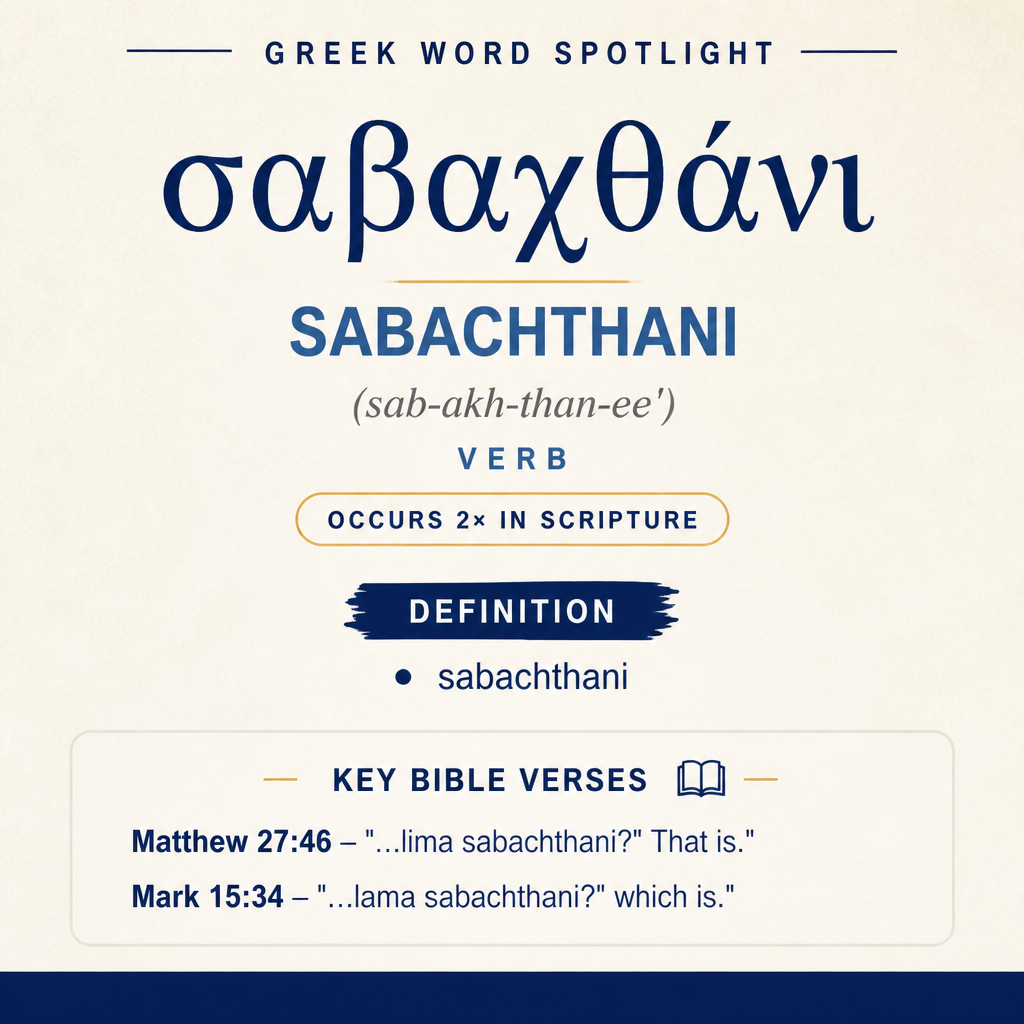
σαβαχθάνι (“Sabachthani”) appears in Matthew 27:46 and Mark 15:34 in Jesus’ cry, “Eli/Eloi, Eli/Eloi, lama/lima sabachthani?”
Meaning
The definition given is “sabachthani.” It occurs within Jesus’ quoted words in the Gospels.
Learn More →Gospel Occurrences
It appears 2 times in Scripture: Matthew 27:46 and Mark 15:34. Both are recorded at the ninth hour as a loud cry of Jesus.
Learn More →Quoted Cry
In Matthew 27:46 the phrase is “Eli, Eli, lima sabachthani?” In Mark 15:34 it is “Eloi, Eloi, lama sabachthani?”
Learn More →σαβαχθάνι is the cry-word sabachthani, heard in the direct speech of Jesus at the ninth hour in the Passion narratives of Matthew and Mark. In both places it stands inside a longer utterance that each Gospel immediately interprets for the reader.
Occurrences
“About the ninth hour Jesus cried with a loud voice, saying, “Eli, Eli, lima sabachthani?” That is, “My God, my God, why have you forsaken me?”” (Matthew 27:46)
Here sabachthani is embedded in a solemn, doubled address (“Eli, Eli”) followed by a question introduced by “why.” The verse frames the word as part of a loud cry (“cried with a loud voice”), placing it among the sharpest, most public sounds of the scene. Matthew does not leave the utterance opaque: he immediately supplies an interpretive rendering, “My God, my God, why have you forsaken me?” In this setting, sabachthani functions as the verbal hinge of the question—standing at the point where the speaker describes what has happened to him in relation to “My God.” Its placement makes the cry less a general lament and more a direct appeal, addressed upward, and shaped as a demand for an explanation within a relationship already claimed (“My God”).
Matthew’s punctuation and framing also show how the word is heard: it is not presented as a calm statement but as an urgent outcry timed precisely (“about the ninth hour”). The narrative does not treat it as incidental speech; it is highlighted both by volume (“loud voice”) and by immediate translation (“That is…”). Within that brief space, sabachthani carries the weight of the moment’s relational rupture as the utterance itself depicts it, and Matthew’s interpretive line guides readers to hear the word as integral to the question of forsakenness.
“At the ninth hour Jesus cried with a loud voice, saying, “Eloi, Eloi, lama sabachthani?” which is, being interpreted, “My God, my God, why have you forsaken me?”” (Mark 15:34)
Mark places sabachthani in an almost identical narrative frame: it is voiced “at the ninth hour,” it is shouted (“cried with a loud voice”), and it is immediately interpreted for the reader. Mark’s version begins with “Eloi, Eloi” and uses “lama,” but the word in question remains the same and sits in the same rhetorical slot—at the heart of the why-question. Mark’s added phrasing, “which is, being interpreted,” emphasizes the act of explanation as a bridge between the quoted utterance and the Gospel’s readership. That bridge makes sabachthani the crucial term that requires interpretation in order for the full force of the cry to be understood.
Within Mark’s sentence, the structure of the cry is clear: address (“My God, my God”) plus question (“why…?”) plus the verb-like element that names the experience (“have you forsaken me?”). Sabachthani therefore contributes the decisive content that transforms the addressed lament into a specific accusation or complaint framed as a question. Like Matthew, Mark highlights its intensity by noting the volume, and he anchors it in time with a precise hour. The word thus appears not as a passing detail but as the verbal center of a climactic spoken moment, presented as needing interpretation and receiving it immediately.

Sense and Usage
The definition attached to σαβαχθάνι is simply sabachthani, and the two Gospel occurrences show how that cry-word operates in context rather than through an abstract explanation. In both Matthew 27:46 and Mark 15:34, sabachthani is not used as a standalone term; it appears within a fixed-sounding cluster of repeated address and an interrogative clause. That consistency gives the word a stable profile: it belongs to an utterance that is (1) directed to God, (2) doubled for emphasis (“My God, my God”), and (3) shaped as a “why” question. Whatever else a reader might infer, these verses themselves present sabachthani as the key element within the question that is then rendered in plain language as “why have you forsaken me?”
The narrative handling of the term is itself part of its usage. Both evangelists preserve the foreign-sounding form in quotation marks and then provide a direct interpretive gloss. That editorial move makes the word function on two levels at once: first as the remembered sound of the cry (the form that is “said” aloud), and second as a carrier of meaning that the narrator ensures the reader grasps. In other words, the Gospels treat sabachthani as important enough to keep in its original-sounding form but also important enough not to leave unexplained.
These contexts also show how sabachthani participates in the portrayal of emotion and intensity. Both verses explicitly describe the speech as a cry “with a loud voice,” and both situate it at the same time marker, “the ninth hour.” The word therefore belongs to an utterance delivered at a decisive point in the narrative, voiced audibly and forcefully. The interpretive line (“That is…” / “which is, being interpreted…”) tells the reader that the content of the cry is not merely that Jesus is praying, but that he is articulating the experience named in the translation: “forsaken me.” In these two places, sabachthani is the linguistic trigger for that stated experience to be heard as the heart of the cry.
Because the two occurrences align so closely, the semantic profile within these passages is narrow and concentrated. The word’s contribution is not spread across varied settings; it is bound to one repeated scene type: an anguished address to God expressed as a question and then interpreted as the language of forsakenness. The repetition across two independent narratives strengthens the impression that the form was memorable and that the interpretive rendering was considered essential for understanding what was cried out.
Imagery and Rhetoric
The imagery carried by sabachthani in these passages is auditory and relational: a loud cry and a strained address. The doubled invocation (“My God, my God”) creates the sense of insistence and personal appeal, while the “why” introduces a demand for meaning in suffering. When each Gospel immediately gives the interpretation, the reader is guided to hear the cry not as a vague exclamation but as an explicit articulation of being “forsaken.” In both Matthew 27:46 and Mark 15:34, sabachthani stands at the point where lament becomes a named experience voiced directly to God and pressed as a question.
Sources: Lexical data from Strong’s Exhaustive Concordance and the Translators Brief Lexicon of Extended Strongs for Greek (STEPBible, CC BY). Occurrence data from the Translators Amalgamated Greek New Testament (STEPBible, CC BY). Scripture quotations from the World English Bible (public domain).




