Exploring the Meaning of Pterna in Greek
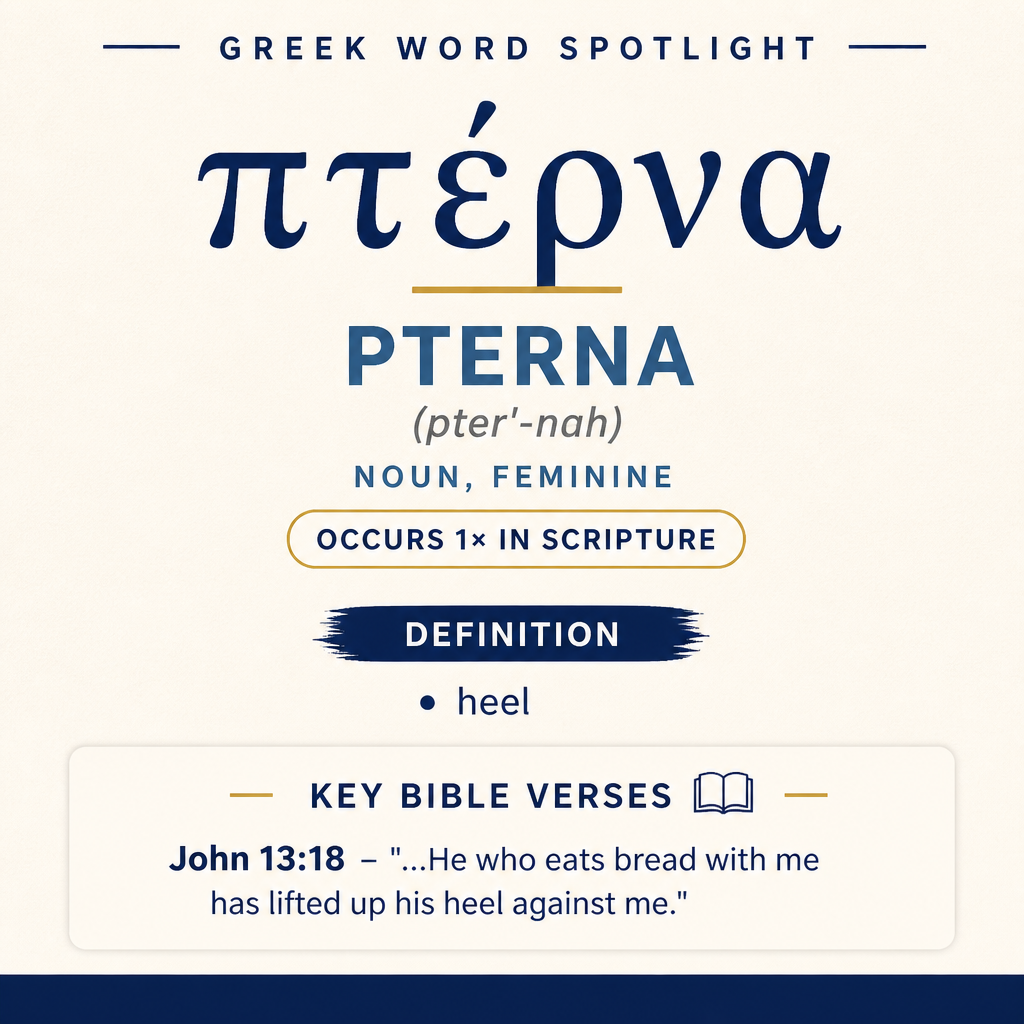
πτέρνα means “heel” and appears once in Scripture, in John 13:18.
Scripture Occurrence
This word occurs 1 time in Scripture. Its single occurrence is in John 13:18.
Learn More →Verse Context
In John 13:18, Jesus speaks of Scripture being fulfilled in connection with one who eats bread.
Learn More →πτέρνα names the “heel,” the back part of the foot that bears weight and can be lifted, set down, or turned in movement. In Scripture it appears in Jesus’ words at the table, in a line of quotation that frames betrayal as an action performed “against” him.
Occurrences
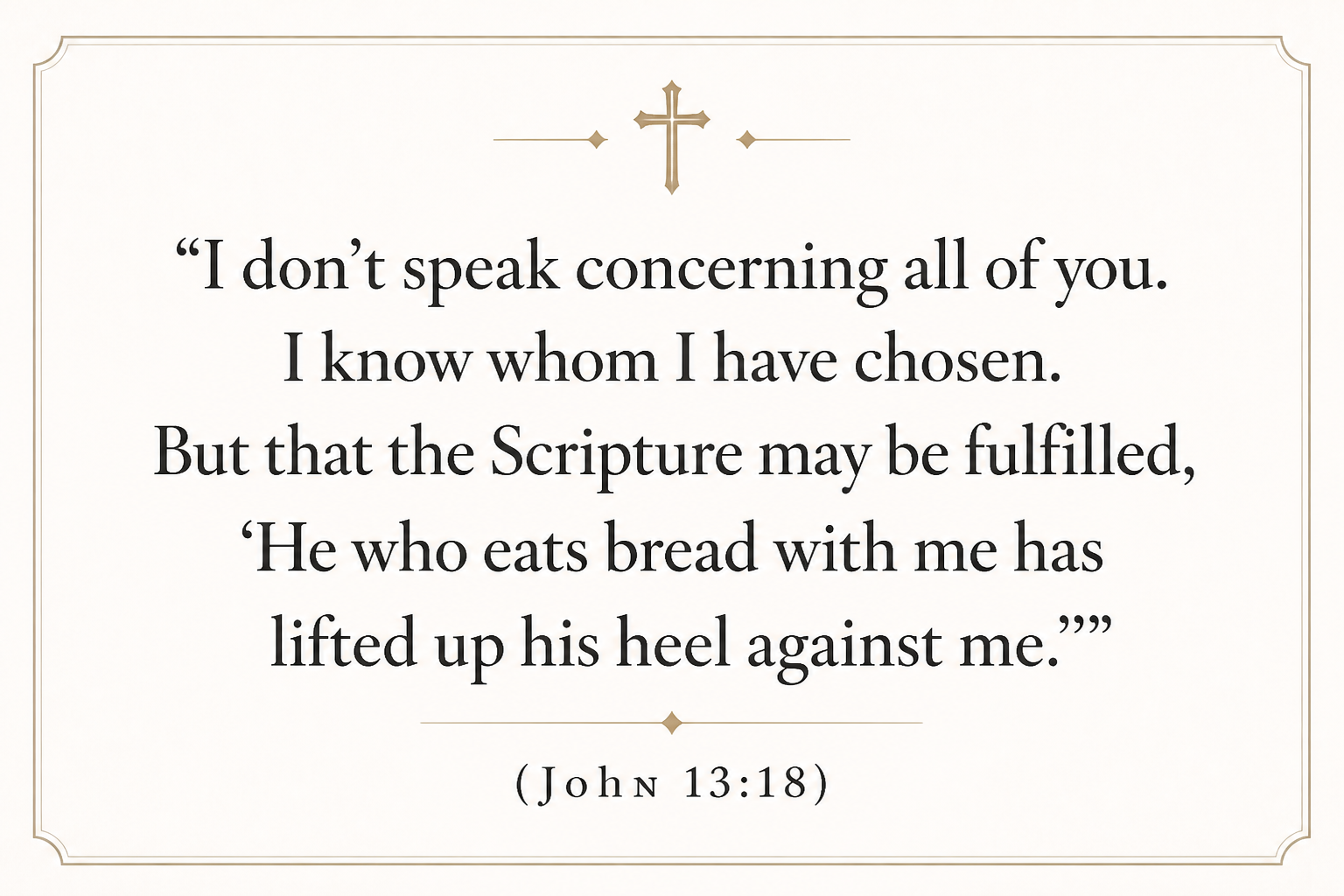
“I don’t speak concerning all of you. I know whom I have chosen. But that the Scripture may be fulfilled, ‘He who eats bread with me has lifted up his heel against me.’” (John 13:18)
Here πτέρνα occurs within a vivid, bodily picture: a man who is close enough to “eat bread with me” is also described as one who “has lifted up his heel against me.” The “heel” functions as the key concrete feature in the quoted sentence. It takes an intimate setting—shared bread, shared space—and introduces a sudden posture shift that signals hostility. The action is not expressed with a general word for attack; instead, the sentence focuses on a specific body part and a specific movement of that part, giving the betrayal a physical shape. In the flow of the verse, the “heel” image stands at the hinge between Jesus’ knowledge (“I know whom I have chosen”) and the fulfillment of Scripture (“that the Scripture may be fulfilled”), so that the gesture becomes a recognizable marker by which the situation is interpreted. The heel is thus not a neutral anatomical reference; in this utterance it becomes the striking feature that turns companionship (“eats bread with me”) into opposition (“against me”).

Sense and Usage
Because πτέρνα denotes the heel, it naturally evokes the part of the foot most associated with stance and the initiation of motion. A heel can be set firmly when one stands, and it can be raised when a person shifts weight to move forward or to strike. John 13:18 draws on that ordinary bodily reality: the quoted line does not describe a distant enemy, but someone who is near enough to share bread, yet who changes posture toward aggression. The heel is not the whole body, but it is enough to portray the person’s intention; the sentence compresses the act of betrayal into the simplest imaginable sign—a lifted heel—so that the act is grasped as a deliberate turn from fellowship to opposition.
The expression also works spatially. The “heel” is located at the back of the foot, and to lift it is to ready the foot for movement. That makes the image especially suited to depict treachery that arises from within a close circle: the betrayer is not portrayed as coming from afar with weapons, but as already present at the meal, performing a motion that can be made in immediate proximity. The physical specificity strengthens the moral contrast embedded in the verse: “He who eats bread with me” describes a relationship of proximity and shared provision, while “has lifted up his heel against me” depicts a body turning that same proximity into threat. πτέρνα serves the sentence by anchoring betrayal in the concrete realities of the table scene—feet, posture, and the possibility of harm in close quarters.
Even within this single occurrence, the word’s contribution is more than descriptive detail. A “heel” is a small part of the body, and focusing on it narrows the reader’s attention to one sharp action rather than a long narrative of conflict. The quoted line therefore functions like a snapshot: bread is being eaten, and in that same setting a heel is lifted. The compactness of the image allows the verse to speak with a certain inevitability: Jesus’ awareness of his chosen ones, and the mention of fulfilled Scripture, frame the heel-lifting not as random violence but as an act that fits a known pattern of opposition arising in the place of closeness. πτέρνα is the concrete term that makes that opposition memorable.
Imagery
John 13:18 places πτέρνα at the intersection of table fellowship and hostility. The word brings the scene down to the level of the body: shared bread on the one hand, and a lifted heel on the other. That contrast gives the line its force—betrayal is not presented as an abstract idea but as a bodily motion performed within the space of communion.
Sources: Lexical data from Strong’s Exhaustive Concordance and the Translators Brief Lexicon of Extended Strongs for Greek (STEPBible, CC BY). Occurrence data from the Translators Amalgamated Greek New Testament (STEPBible, CC BY). Scripture quotations from the World English Bible (public domain).