Exploring the Meaning of Psuchikos in Greek
ψυχικός means “natural” and appears six times in Scripture in 1 Corinthians 2:14; 15:44; 15:46; James 3:15; and Jude 1:19.
Key Occurrences
It occurs in 1 Corinthians 2:14; 15:44; and 15:46, and also in James 3:15 and Jude 1:19.
Learn More →Usage Contexts
In 1 Corinthians 15:44–46 it contrasts a “natural body” with a “spiritual body.” In 1 Corinthians 2:14 the “natural man” does not receive the things of God’s Spirit.
Learn More →ψυχικός describes what is “natural,” and it appears where writers contrast what is natural with what is spiritual, or where they classify certain people and their outlook. In the passages where it occurs, it marks a mode of life and perception that stands over against God’s Spirit.
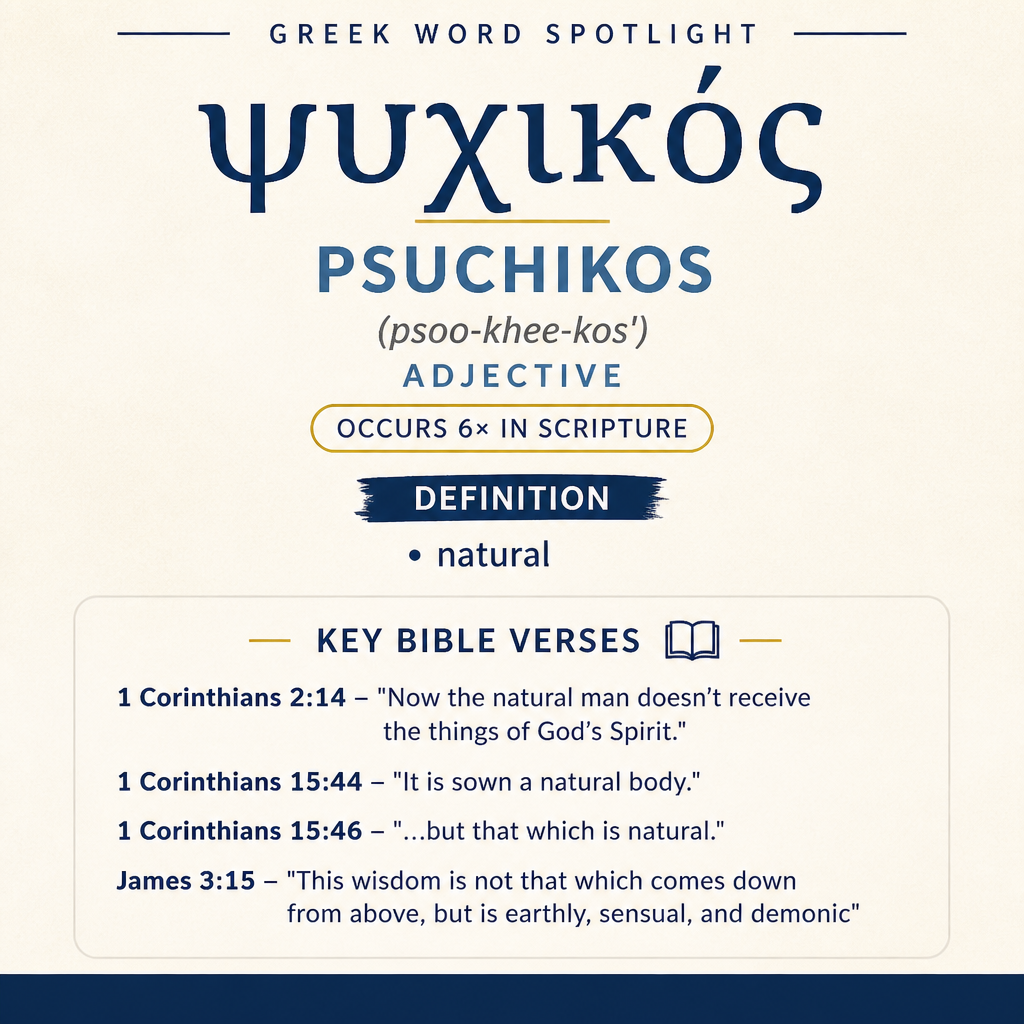
Occurrences
“Now the natural man doesn’t receive the things of God’s Spirit, for they are foolishness to him, and he can’t know them, because they are spiritually discerned.” (1 Corinthians 2:14)
Here ψυχικός identifies “the natural man” as a person characterized by a particular limitation: he “doesn’t receive the things of God’s Spirit.” The verse frames the issue in terms of reception and knowledge. What belongs to “God’s Spirit” is judged “foolishness,” and the inability is not merely reluctance but incapacity: “he can’t know them.” The decisive line is the final clause—“because they are spiritually discerned”—which sets ψυχικός in direct contrast with discernment that is spiritual. In this scene, “natural” marks a human stance that remains on its own level, unable to process what requires the Spirit’s discernment.

“It is sown a natural body; it is raised a spiritual body. There is a natural body and there is also a spiritual body.” (1 Corinthians 15:44)
In this verse ψυχικός qualifies “body” twice, and it does so within a tightly balanced pair: “sown” versus “raised,” “natural body” versus “spiritual body.” The term contributes to an argument about continuity and change: what is “sown” is described as natural, and what is “raised” is described as spiritual. The repetition—“There is a natural body and there is also a spiritual body”—insists that the category “natural” has real standing within the discussion. ψυχικός therefore functions as a descriptor for embodied existence in one phase of existence (“sown”), while holding open the contrasting descriptor for the next phase (“raised”).
“However that which is spiritual isn’t first, but that which is natural, then that which is spiritual.” (1 Corinthians 15:46)
ψυχικός here is part of a sequence: “isn’t first… but… then….” The verse uses temporal or logical ordering to place “the natural” prior to “the spiritual.” The word thus contributes not only to a contrast but also to an order of appearance. By pairing ψυχικός with “first” and “then,” the sentence portrays the natural as the initial stage, not the final one, and it sets expectations about progression: what is natural comes before what is spiritual.
“This wisdom is not that which comes down from above, but is earthly, sensual, and demonic.” (James 3:15)
In James, ψυχικός is rendered “sensual,” and it appears as one element in a threefold description of a certain kind of “wisdom.” The verse begins by denying its origin—“not that which comes down from above”—and then classifies it by its character: “earthly, sensual, and demonic.” ψυχικός thus contributes to a portrayal of wisdom that is bounded to a natural sphere of operation and evaluation. Within this list, it functions as a middle descriptor linking “earthly” and “demonic,” helping to mark this wisdom as the opposite of what is “from above.”
“These are those who cause divisions and are sensual, not having the Spirit.” (Jude 1:19)
Jude uses ψυχικός (“sensual”) to label certain people by their effects and by what they lack. They “cause divisions,” and their sensual/natural character is tied to a defining absence: “not having the Spirit.” The term here is not abstract; it is used to explain concrete community outcomes—division—by connecting behavior (“cause divisions”) with spiritual condition (“not having the Spirit”). ψυχικός therefore marks a kind of person whose life is described without reference to the Spirit’s presence, and whose actions disrupt fellowship.

Sense and Usage
Across these occurrences, “natural” functions as a boundary-marker: it distinguishes a realm of life, perception, and existence that does not reach into what is “of God’s Spirit” or “spiritual.” In 1 Corinthians 2:14 the contrast is epistemic and receptive: the “natural man” is defined by inability to receive and know “the things of God’s Spirit,” since such things require spiritual discernment. ψυχικός therefore signals a way of being human that remains confined to what is natural, with the immediate consequence that spiritual realities are treated as “foolishness” and remain inaccessible.
In 1 Corinthians 15:44 and 15:46, “natural” is applied to “body” and to what comes “first.” This use places ψυχικός within a framework of stages: there is a “natural body” associated with what is “sown,” and there is an ordering in which the natural precedes the spiritual. The term is not used there to deny value to embodied life; rather, it names one kind of embodiment as distinct from another, and it helps articulate how a transition can be described without collapsing the two into sameness. By speaking of both a “natural body” and a “spiritual body,” the passage treats “natural” as a meaningful category that belongs to the discussion of what humans are and what they become.
James 3:15 and Jude 1:19 employ ψυχικός as a diagnostic label. In James it qualifies “wisdom,” distinguishing a kind of wisdom by its origin (“not… from above”) and by its character (“earthly, sensual, and demonic”). The word participates in a critique: wisdom can be evaluated by where it comes from and what it produces, and ψυχικός helps place a certain “wisdom” firmly outside the sphere of what is from above. In Jude the term categorizes people who “cause divisions,” and the diagnosis becomes explicit in the phrase “not having the Spirit.” There the natural/sensual quality is not merely descriptive; it is explanatory, connecting a spiritual lack to relational fracture in the community.
Taken together, ψυχικός consistently stands at the dividing line between natural life on one side and the Spirit on the other. Sometimes the dividing line is expressed in terms of understanding (not receiving, not knowing), sometimes in terms of ontology and sequence (natural body first; spiritual body after), and sometimes in terms of moral and communal consequences (a wisdom not from above; people who cause divisions and do not have the Spirit). In each setting, the term identifies what belongs to the natural sphere and thereby sharpens the contrast with what is spiritual.
Imagery and Contrast
The passages supply two main pictures for ψυχικός. One is the contrast between perception that calls spiritual things “foolishness” and perception that discerns spiritually (1 Corinthians 2:14). The other is agricultural and bodily: what is “sown” as a “natural body” and what is “raised” as a “spiritual body,” with the natural coming first in the sequence (1 Corinthians 15:44, 15:46). Alongside these, James and Jude attach the term to wisdom and to divisive people, setting “sensual”/natural over against what “comes down from above” and against “having the Spirit” (James 3:15; Jude 1:19). These recurring contrasts make ψυχικός a compact way to name what remains on the natural level when the Spirit is the distinguishing factor.
Sources: Lexical data from Strong’s Exhaustive Concordance and the Translators Brief Lexicon of Extended Strongs for Greek (STEPBible, CC BY). Occurrence data from the Translators Amalgamated Greek New Testament (STEPBible, CC BY). Scripture quotations from the World English Bible (public domain).