
Exploring the Meaning of Psichion in Greek
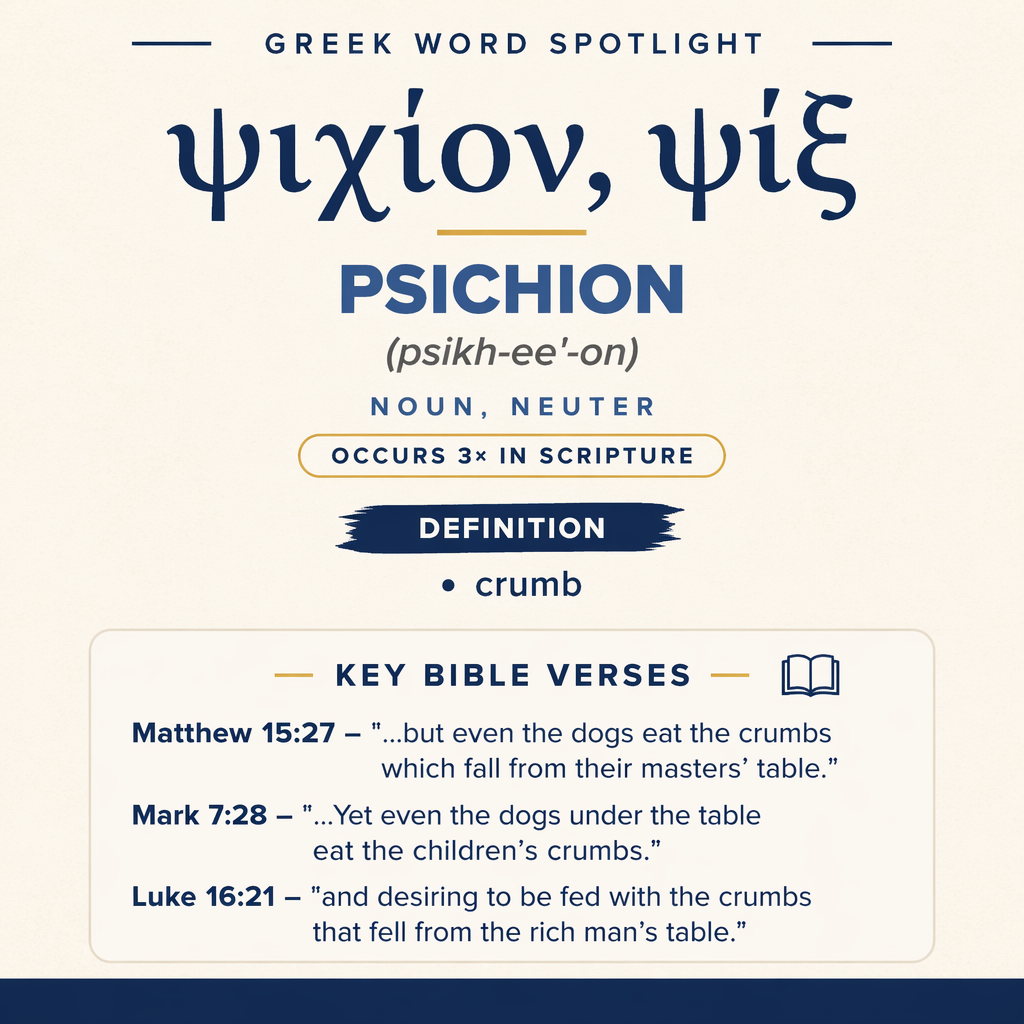
Psichion means “crumb” and appears three times in Scripture: Matthew 15:27, Mark 7:28, and Luke 16:21.
Gospel Occurrences
It occurs in Matthew 15:27 and Mark 7:28 in the saying about dogs eating crumbs from a table.
Learn More →Luke Usage
In Luke 16:21, it describes crumbs falling from the rich man’s table that Lazarus desired to eat.
Learn More →ψιχίον, ψίξ refers to a “crumb,” a small broken piece of food associated with eating at a table. In the Gospels it appears in two brief exchanges about dogs eating what falls under a table and in one depiction of a hungry man longing for what falls from a rich man’s table.
Root and Related Words
ψιχίον, ψίξ is connected (in Strong’s) with the verb psallō (ψάλλω, Strong’s G5567), “to sing praise.”

Occurrences
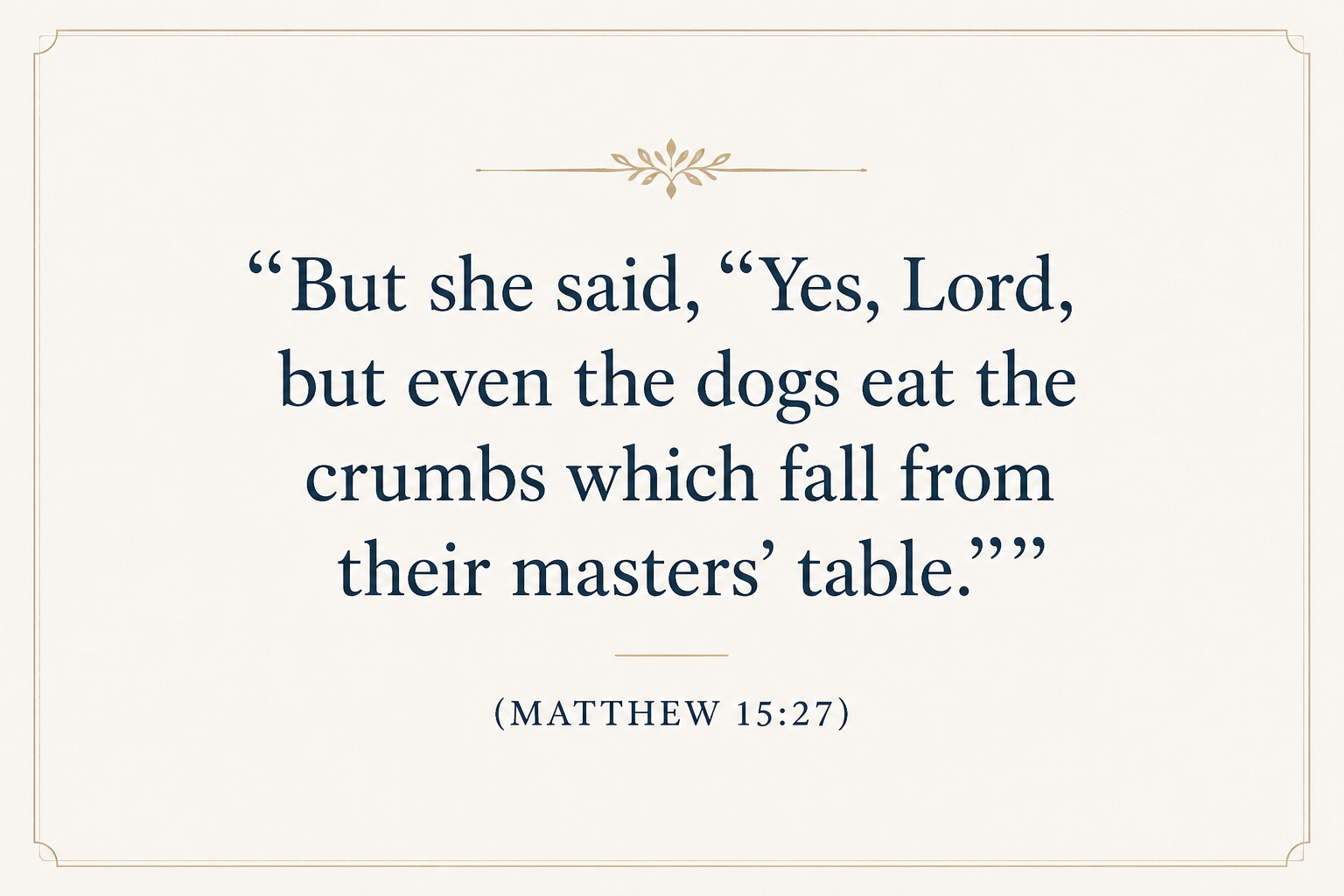
“But she said, “Yes, Lord, but even the dogs eat the crumbs which fall from their masters’ table.”” (Matthew 15:27)
Here ψιχίον, ψίξ belongs to an image of overflow and hierarchy at a meal. The woman agrees with the ordering implied by “masters’ table,” yet she appeals to what still results from that arrangement: “crumbs which fall.” The word highlights how little is being requested—food fragments that are not served as a portion but drop as a byproduct of eating. By pairing “dogs” with “crumbs,” the saying frames the request in terms of what is beneath the table and beneath the masters, yet still genuinely nourishing as food. The “crumbs” are not earned by a seat at the table; they are received from what falls, underscoring the distinction between belonging at the table and being sustained from what comes from it.
“But she answered him, “Yes, Lord. Yet even the dogs under the table eat the children’s crumbs.”” (Mark 7:28)
This occurrence keeps the same domestic scene but sharpens its internal contrasts. The location is explicit: “dogs under the table,” and the crumbs are identified as “the children’s crumbs.” ψιχίον, ψίξ thus functions as the point where two spaces meet—the top of the table where children eat and the underside where dogs are. The crumbs mark what passes from the children’s place to the dogs’ place without the table itself being rearranged. The wording makes the crumbs belong first to “the children” (their meal, their table), but also portrays them as something that can be eaten by those below. In this context ψιχίον, ψίξ carries the idea of a tiny remainder that still counts as real food, a small share that can be received without displacing the children’s portion.
“and desiring to be fed with the crumbs that fell from the rich man’s table. Yes, even the dogs came and licked his sores.” (Luke 16:21)
In Luke the “crumbs” image is placed in a scene of deprivation and social distance. ψιχίον, ψίξ is what the needy man longs for—he is “desiring to be fed” not with a meal, but with “the crumbs that fell from the rich man’s table.” The table belongs to the “rich man,” and the crumbs are described as already fallen, so the food pictured is not offered directly; it lies as what drops away from the rich man’s eating. The word therefore intensifies the portrayal of hunger: the desired food is not a dish but fragments. The following line (“Yes, even the dogs came and licked his sores.”) places dogs in the scene again, but now their action is not eating crumbs; it is coming to the man himself. Against that backdrop, ψιχίον, ψίξ underscores how the man’s need is oriented toward the rich man’s table while his immediate company is the dogs, and the crumbs become a concrete measure of the gap between abundance at the table and want outside it.
Sense and Usage
Across these passages, ψιχίον, ψίξ consistently names food in its smallest, leftover form: what “fall[s]” or has “fell” from a table. The word’s force comes from how it ties nourishment to what is minimal and incidental. A crumb is edible, but it is not a serving; it is the kind of food that exists when someone else has already had a meal. In Matthew and Mark, crumbs under a table become a persuasive image: even in a household structured by masters and children, there is still an expectation that what drops can be eaten by dogs. The word therefore supports an argument from the nature of a table scene—crumbs are the ordinary overflow of eating, and the lowly may live from that overflow.
In Luke, the same table-and-falling imagery is used to describe severe need. The craving is not for the rich man’s food generally but specifically for the crumbs that have already dropped. ψιχίон, ψίξ thus functions as a narrative detail that communicates hunger without additional explanation: the smaller the food desired, the greater the deprivation implied. Yet in all three occurrences the crumb remains connected to the table. Even when the eater is “under the table” (Mark) or outside the rich man’s comfort (Luke), the crumb still bears the imprint of the place it came from—masters’ table, children’s table, rich man’s table—so that a small piece of food becomes a way of describing relationships of place, belonging, and dependence.
Imagery
ψιχίον, ψίξ repeatedly paints a downward motion: food falls from above to below. In Matthew and Mark, that downward path links the “table” to the “dogs,” presenting the underside of the household meal as a space where life can still be sustained. In Luke, crumbs falling from a “rich man’s table” become the object of a desperate desire, and the scene’s mention of dogs intensifies the sense of lowliness attached to what falls. The crumb, though small, carries the full weight of the table scene—abundance above, need below, and the stark difference between being served and living off what drops.
Sources: Lexical data from Strong’s Exhaustive Concordance and the Translators Brief Lexicon of Extended Strongs for Greek (STEPBible, CC BY). Occurrence data from the Translators Amalgamated Greek New Testament (STEPBible, CC BY). Scripture quotations from the World English Bible (public domain).





