Exploring the Meaning of Pseudologos in Greek
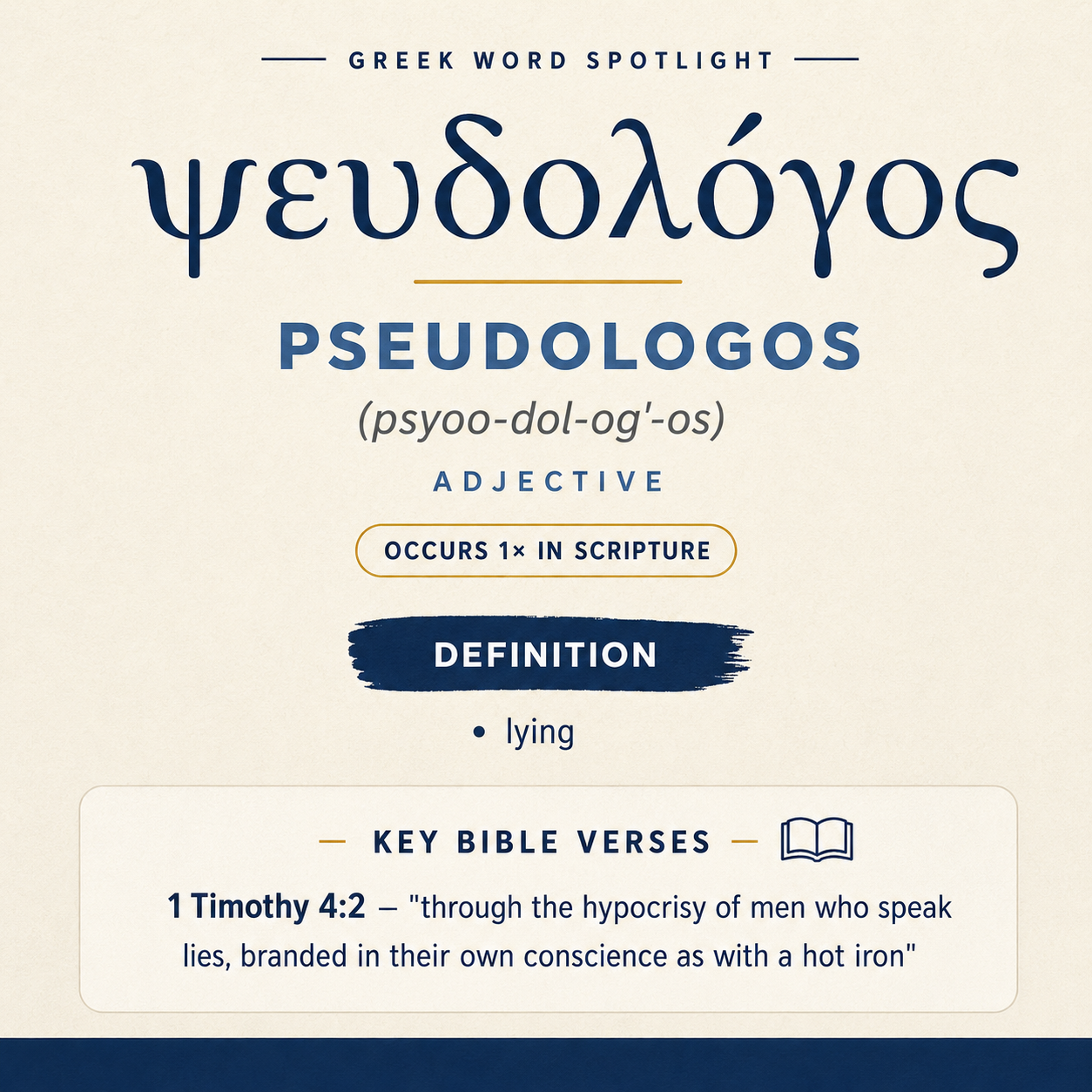
ψευδολόγος means “lying” and appears once in Scripture, in 1 Timothy 4:2.
Scripture Occurrence
This word occurs 1 time in Scripture. Its single reference is 1 Timothy 4:2.
Learn More →ψευδολόγος describes what is “lying,” and it appears in a warning about deceptive teaching and moral damage in 1 Timothy 4:2. In that setting it characterizes speech that is false, and it is linked to hypocrisy and a seared conscience.
Root and Related Words
ψευδολόγος is associated with λέγω (lego), “to say” (Strong’s G3004), and ψευδής (pseudes), “false” (Strong’s G5571). Taken together, these related forms connect the word to the realm of speaking and to the quality of falsity in what is spoken.

Occurrences
“through the hypocrisy of men who speak lies, branded in their own conscience as with a hot iron,” (1 Timothy 4:2)
In this line the word functions as a moral descriptor within a chain of closely linked faults. The immediate frame is “hypocrisy,” so the lying speech is not presented as an isolated slip but as part of a posture that masks what is true. The people in view are described by what they do—“speak lies”—and the statement tightens the focus by turning from outward words to inward condition: they are “branded in their own conscience as with a hot iron.” Within that progression, ψευδολόγος marks speech that is false in a way that coheres with a deeper corruption; the lie is not merely informationally wrong but belongs to the broader picture of pretense and moral insensitivity described in the verse.
The phrasing also places lying speech as a conduit (“through the hypocrisy…”) by which harm spreads. The verse does not linger on the content of what is said; it highlights the character of the speakers and the moral mechanism at work. In this context ψευδολόγος contributes to an argument about how deception operates: false speech rides on hypocrisy and is accompanied by an impaired conscience, pictured as something cauterized and numbed by branding. The effect is that the lie becomes an identifying feature of the speaker’s pattern of life, not a momentary tactic.
Sense and Usage
The definition “lying” is expressed here in a distinctly ethical register. It is applied to people (“men who speak lies”) and so functions as a characterizing label rather than a neutral description of an incorrect statement. In 1 Timothy 4:2, lying is placed alongside hypocrisy and a conscience marked by burning, which frames it as deliberate and hardened: the speech is false, and it issues from (and reinforces) a state in which moral sensitivity has been damaged.
Because the verse describes lying as something “spoken,” ψευδολόγος is anchored in verbal action—what comes out in public utterance. Yet the verse keeps pulling the reader inward: the hypocrisy suggests a gap between appearance and reality, and the “branded… conscience” depicts an internal faculty that has been scarred. The term therefore carries a relational and communal weight in this usage: lies are not treated as private thoughts but as speech that affects others, and the moral imagery implies that repeated falsehood can be bound up with an entrenched condition of the inner life.
The verse’s structure also shows how “lying” can be used to diagnose a larger spiritual pathology without expanding the word beyond its definition. ψευδολόγος does the work of naming the falsity of speech, while the surrounding phrases specify its context: hypocrisy as the mode, and a branded conscience as the inner result. In this way the word’s sense is sharpened not by adding new meanings, but by placing “lying” within a network of closely associated moral realities that explain its seriousness and persistence.
Imagery
The strongest image attached to ψευδολόγος in this passage is the conscience “branded… as with a hot iron” (1 Timothy 4:2). Against that stark picture, lying speech is portrayed as something that corresponds to lasting marks rather than passing shadows: the words are false, and the inner person is depicted as scarred. The image pushes the reader to see a connection between what is said outwardly (“speak lies”) and an inward condition that has become calloused, giving the term a grave, sobering tone in its lone attestation.
Sources: Lexical data from Strong’s Exhaustive Concordance and the Translators Brief Lexicon of Extended Strongs for Greek (STEPBible, CC BY). Occurrence data from the Translators Amalgamated Greek New Testament (STEPBible, CC BY). Scripture quotations from the World English Bible (public domain).