
Exploring the Meaning of Psalmos in Greek
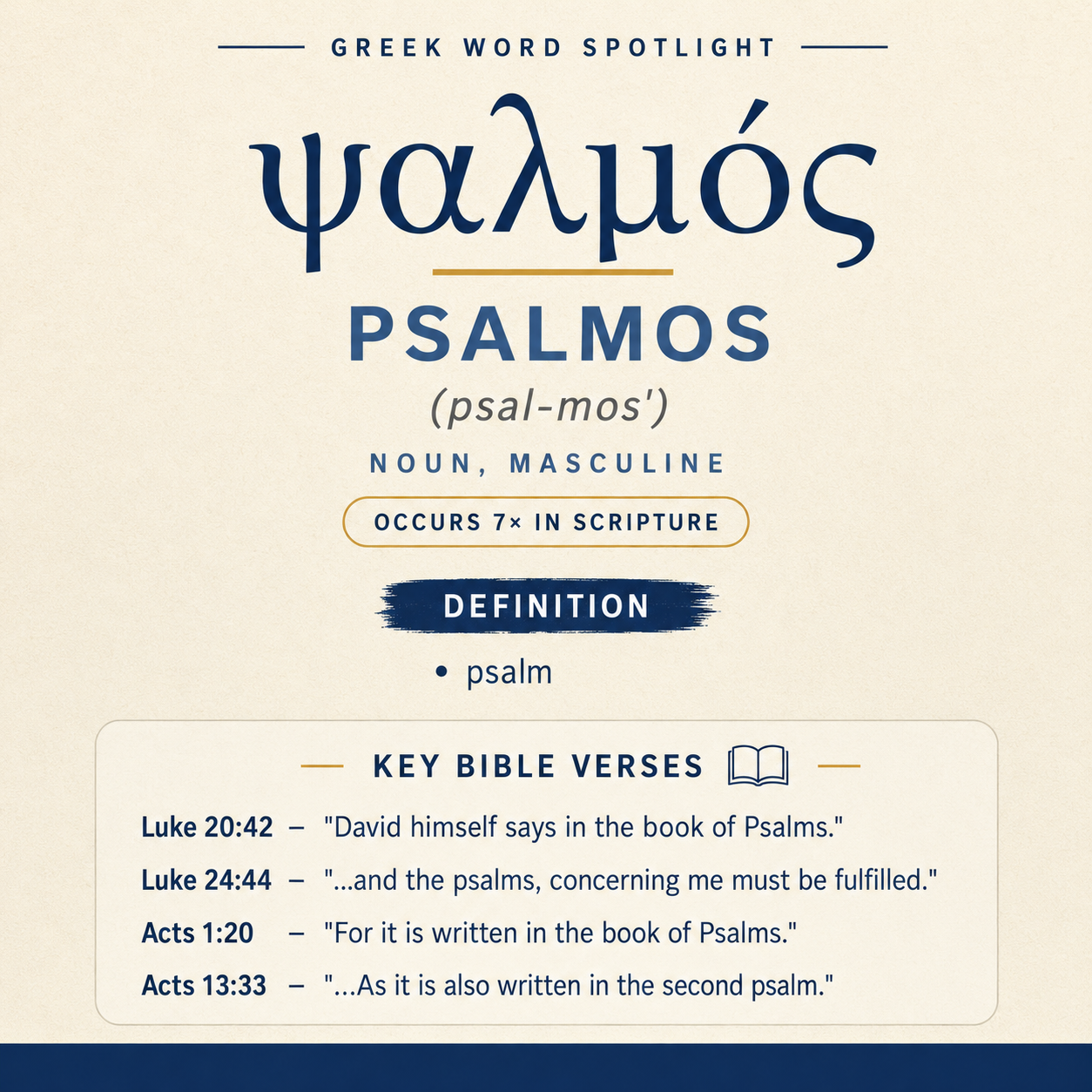
ψαλμός (Psalmos) means “psalm” and appears 7 times in Scripture, including Luke, Acts, 1 Corinthians, Ephesians, and Colossians.
Core Meaning
ψαλμός is defined as “psalm.” It appears in references to the book of Psalms and in instructions for Christian gatherings.
Learn More →Book of Psalms
Luke 20:42 and Acts 1:20 explicitly mention “the book of Psalms.” Acts 13:33 cites what is written “in the second psalm.”
Learn More →Church Practice
1 Corinthians 14:26 describes each one bringing “a psalm” when believers gather. Ephesians 5:19 and Colossians 3:16 call believers to speak to one another with psalms, hymns, and spiritual songs.
Learn More →Psalmos means “psalm.” In the New Testament passages where it appears, it can name the biblical collection called “the book of Psalms,” point to a specific psalm within that collection, and describe a psalm as something voiced in gathered worship alongside other forms of instruction and song.
Occurrences
Luke 20:42 — “David himself says in the book of Psalms, ‘The Lord said to my Lord, “Sit at my right hand,”
Here psalmos is part of a fixed designation: “the book of Psalms.” The line that follows is treated as a citation from that recognized book, and the wording “David himself says” frames the psalm as David’s speech preserved in Scripture. In this setting, the term functions as a locator for authoritative wording used in argument, not as a description of congregational singing.
Luke 24:44 — “He said to them, “This is what I told you, while I was still with you, that all things which are written in the law of Moses, the prophets, and the psalms, concerning me must be fulfilled.”
In this threefold list, “the psalms” stands as one major division of sacred writings alongside “the law of Moses” and “the prophets.” The term therefore labels a body of texts with prophetic or interpretive weight “concerning me,” and its placement in the list emphasizes that these writings participate in the same overarching necessity: “must be fulfilled.” The contribution of psalmos is to name that recognized scriptural corpus as part of the unified witness.
Acts 1:20 — “For it is written in the book of Psalms, ‘Let his habitation be made desolate. Let no one dwell in it;’ and, ‘Let another take his office.’”
Again psalmos appears in “the book of Psalms,” serving as the stated source for what is “written.” The passage strings together two quotations introduced with the same formula, treating the Psalms as a repository of written lines that can be applied to a concrete situation (“habitation,” “office”). In this scene the term carries the force of documentary authority: what the community is doing is anchored in words already inscribed in that book.
Acts 13:33 — “that God has fulfilled this to us, their children, in that he raised up Jesus. As it is also written in the second psalm, ‘You are my Son. Today I have become your father.’”
Here psalmos is singular and numbered: “the second psalm.” The singular form points to an individual composition within the larger collection, and the numbering signals that the Psalm-book is arranged in a way that allows a precise citation. The quoted line is introduced as written testimony supporting the proclamation that God “raised up Jesus,” so the term helps frame a particular psalm as a textual witness enlisted to interpret an event of fulfillment.
1 Corinthians 14:26 — “What is it then, brothers? When you come together, each one of you has a psalm, has a teaching, has a revelation, has another language, or has an interpretation. Let all things be done to build each other up.”
In this gathering scene, psalmos names something a participant may “have” when the church assembles. It is placed in a list with “a teaching,” “a revelation,” “another language,” and “an interpretation,” all of which are portrayed as contributions offered in the meeting. The final aim governs the whole list: “Let all things be done to build each other up.” In this context a “psalm” is treated as a concrete, shareable element of corporate edification—one kind of utterance among several that must serve the common good.
Ephesians 5:19 — “speaking to one another in psalms, hymns, and spiritual songs; singing and making melody in your heart to the Lord;”
Here psalmos appears in the plural, coordinated with “hymns” and “spiritual songs.” The verse presents these as modes of mutual address (“speaking to one another”) and as acts directed to God (“to the Lord”). The combination of “speaking,” “singing,” and “making melody” portrays psalms not merely as texts but as voiced, musical communication that shapes community life and devotion.
Colossians 3:16 — “Let the word of Christ dwell in you richly; in all wisdom teaching and admonishing one another with psalms, hymns, and spiritual songs, singing with grace in your heart to the Lord.”
As in Ephesians, psalmos is plural and grouped with “hymns” and “spiritual songs,” but the surrounding verbs add a didactic frame: “teaching and admonishing one another.” Psalms are instruments through which “the word of Christ” is made plentiful in the community (“dwell in you richly”) and through which wisdom is exercised. The verse also maintains the inward-and-Godward orientation (“in your heart to the Lord”), tying the practice of psalms to both communal formation and heartfelt worship.
Sense and Usage
Across these passages, “psalm” operates in two closely related spheres: Scripture and song. In Luke and Acts, the term most often points to the recognized scriptural collection—“the book of Psalms”—and to particular units within it (“the second psalm”). In those scenes, a psalm is a stable written source that can be cited with introductory formulas such as “David himself says” and “it is written,” and its lines are treated as determinative for interpretation and decision. The use of “book” language foregrounds fixity and public accessibility: psalms are not merely remembered sayings but inscribed texts that can be quoted in the present.
At the same time, the plural uses in Ephesians and Colossians bring “psalms” into the lived practice of Christian assembly and mutual ministry. The verbs are communal and active—“speaking to one another,” “teaching and admonishing one another,” “singing”—so psalms become a means of communication within the body. They are not isolated performances but participatory speech aimed at building, instructing, and warning. The repeated inward phrasing (“in your heart to the Lord”) shows that, even when psalms function horizontally in the community, their direction remains Godward.
1 Corinthians 14:26 places “a psalm” alongside other contributions that can occur “when you come together.” This setting clarifies that a psalm, in this usage, is something deliverable in the meeting—an identifiable item comparable to “a teaching” or “an interpretation.” Yet it is constrained by the same pastoral principle that governs all contributions: “Let all things be done to build each other up.” Thus, within gathered worship, a psalm is evaluated by its constructive effect, not merely by its artistry or spontaneity.
Taken together, these texts show how “psalm” can name both the authoritative written compositions of the Psalter and the community’s voiced use of psalmody. The scriptural citations in Luke and Acts highlight the Psalms as a treasury of words that continue to speak into new circumstances; the church-instruction passages present psalms as a vehicle for wisdom, mutual exhortation, and worshipful address. The two uses reinforce one another: the same body of sacred “psalms” that can be cited as written testimony can also be sung and spoken as a means of shaping the community’s faith and practice.
Imagery
The quoted contexts repeatedly pair psalms with speech and song: words “written” in a “book,” words “said” by David, words “speaking to one another,” and words “singing… to the Lord.” The image that emerges is of crafted, preserved language that is both quoted and voiced—capable of functioning as a fixed citation in public reasoning and as a living form of address that teaches, admonishes, and gives melody to worship.
Sources: Lexical data from Strong’s Exhaustive Concordance and the Translators Brief Lexicon of Extended Strongs for Greek (STEPBible, CC BY). Occurrence data from the Translators Amalgamated Greek New Testament (STEPBible, CC BY). Scripture quotations from the World English Bible (public domain).





