
Exploring the Meaning of Propheteia in Greek
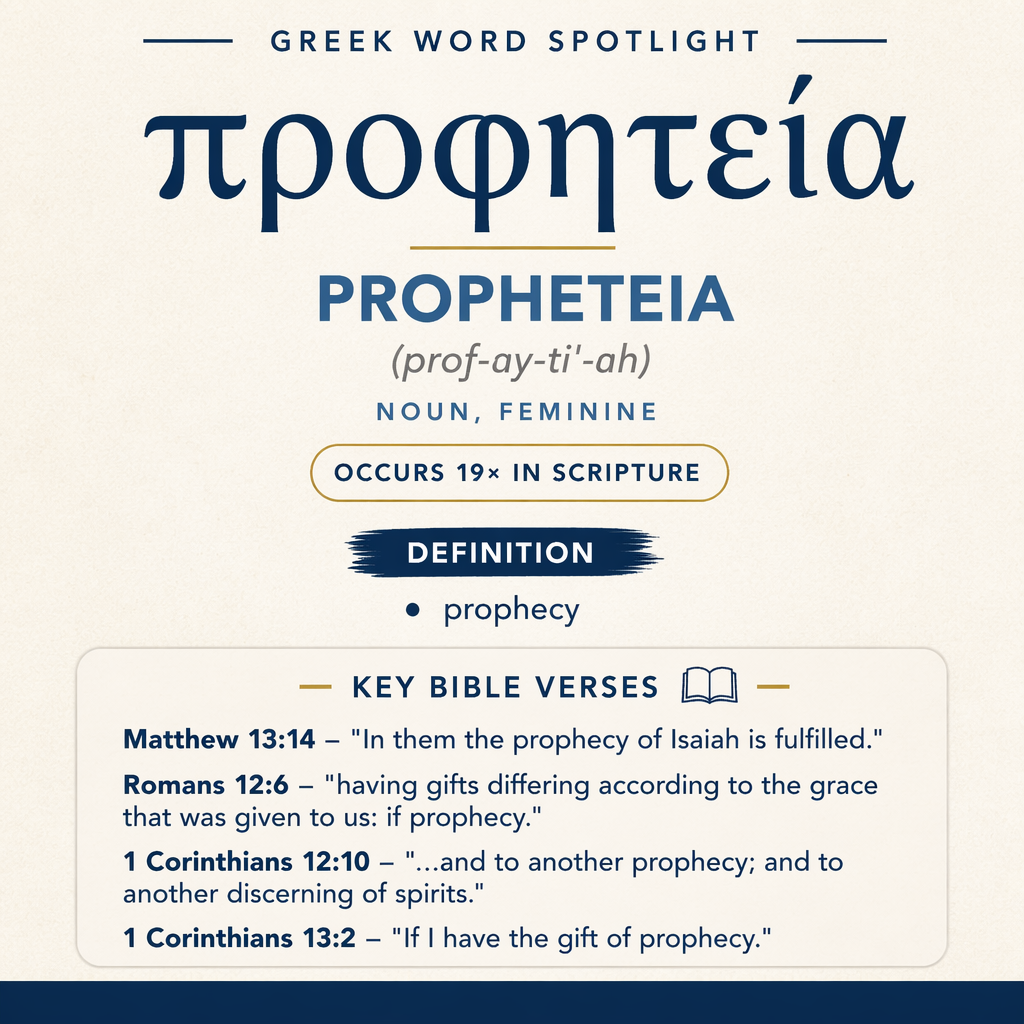
προφητεία means “prophecy” and occurs 19 times in Scripture, including Matthew 13:14, Romans 12:6, 1 Corinthians 12–14, and 1 Thessalonians 5:20.
Scripture Occurrences
It appears 19 times in Scripture. Sample references include Matthew 13:14 and 1 Thessalonians 5:20.
Learn More →Context Examples
In Romans 12:6 it is listed among gifts given by grace. In 1 Corinthians 13:8, prophecies are said to be done away with.
Learn More →προφητεία means “prophecy,” appearing in the Gospels as a fulfilled Scripture and in the epistles as both a spiritual gift and the prophetic character of Scripture itself. The passages below show prophecy functioning in public teaching, congregational life, personal commissioning, and the handling of written Scripture.
Occurrences
Matthew 13:14 — “In them the prophecy of Isaiah is fulfilled, which says, ‘By hearing you will hear, and will in no way understand; Seeing you will see, and will in no way perceive:”
Here προφητεία is tied to Isaiah and is explicitly described as “fulfilled.” In this scene, prophecy is not merely a spoken phenomenon in the present moment but a prior divine message whose meaning comes to completion in the response of Jesus’ hearers: hearing without understanding and seeing without perceiving.

Romans 12:6 — “having gifts differing according to the grace that was given to us: if prophecy, let’s prophesy according to the proportion of our faith;”
Prophecy is listed as one “gift” among differing gifts, framed as an expression of “grace.” The verse links the practice of prophesying to a measured exercise—“according to the proportion of our faith”—so prophecy is portrayed as something to be exercised responsibly within the life of the community.
1 Corinthians 12:10 — “and to another workings of miracles; and to another prophecy; and to another discerning of spirits; to another different kinds of languages; and to another the interpretation of languages.”
In this catalog of Spirit-enabled activities, prophecy sits alongside miracles, discerning spirits, and various kinds of languages with interpretation. The placement highlights prophecy as one distinguishable endowment, neither identical with miracles nor reducible to tongues, but part of a varied distribution across “another…another.”
1 Corinthians 13:2 — “If I have the gift of prophecy, and know all mysteries and all knowledge; and if I have all faith, so as to remove mountains, but don’t have love, I am nothing.”
Prophecy is presented as a “gift” that could coexist with extraordinary knowing—“all mysteries and all knowledge”—and even mountain-moving faith. Yet the sentence subordinates even such impressive spiritual capacity to love: prophecy, however elevated, does not itself constitute personal worth apart from love.
1 Corinthians 13:8 — “Love never fails. But where there are prophecies, they will be done away with. Where there are various languages, they will cease. Where there is knowledge, it will be done away with.”
Prophecies are placed in a category of gifts that have an endpoint: “they will be done away with.” The contrast with love (“never fails”) positions prophecy as real and valuable but temporary in function, belonging to an order of partial, time-bound means rather than the enduring core virtue.
1 Corinthians 14:6 — “But now, brothers, if I come to you speaking with other languages, what would I profit you, unless I speak to you either by way of revelation, or of knowledge, or of prophesying, or of teaching?”
Prophecy here is described in terms of communicative benefit: it is one mode of speech that “profits” the church, set with revelation, knowledge, and teaching. Within the argument, prophesying represents intelligible, edifying address, contrasted with speech “with other languages” that may not help unless accompanied by content that builds understanding.
1 Corinthians 14:22 — “Therefore other languages are for a sign, not to those who believe, but to the unbelieving; but prophesying is for a sign, not to the unbelieving, but to those who believe.”
Prophesying is characterized as a “sign” with a particular audience orientation: “to those who believe.” The verse draws a deliberate contrast with “other languages,” marking prophecy as having its sign-value primarily within the believing community, functioning in a way that corresponds to their status as believers.
1 Thessalonians 5:20 — “Don’t despise prophecies.”
This brief command assumes prophecy is present and accessible within the church’s experience—something that could be dismissed or treated lightly. By forbidding contempt, the line assigns prophecy a dignified place in communal discernment and practice, calling for receptivity rather than scorn.
1 Timothy 1:18 — “I commit this instruction to you, my child Timothy, according to the prophecies which were given to you before, that by them you may wage the good warfare,”
Prophecies are linked to Timothy personally—“given to you before”—and are treated as a basis “according to” which instruction is committed. They function as a motivating and guiding backdrop for perseverance: “that by them you may wage the good warfare.”
1 Timothy 4:14 — “Don’t neglect the gift that is in you, which was given to you by prophecy, with the laying on of the hands of the elders.”
Prophecy is connected to the bestowal of a “gift” in Timothy, coordinated with an act of recognition and appointment: “with the laying on of the hands of the elders.” In this setting, prophecy is portrayed as participating in the mediated acknowledgment of ministry, marking the gift’s reception as something publicly recognized and spiritually grounded.
2 Peter 1:20 — “knowing this first, that no prophecy of Scripture is of private interpretation.”
Prophecy is now explicitly “of Scripture,” shifting the focus from congregational gifting to written sacred text. The statement governs how such prophecy is to be handled: it does not belong to “private interpretation,” implying that Scripture’s prophetic character carries an interpretive constraint and calls for humility before its given meaning.
2 Peter 1:21 — “For no prophecy ever came by the will of man: but holy men of God spoke, being moved by the Holy Spirit.”
This verse explains the origin of prophecy in terms of agency: it does not arise “by the will of man.” Instead, prophecy is linked to human speakers (“holy men of God spoke”) under divine impetus (“being moved by the Holy Spirit”), locating prophecy’s source in the Spirit’s movement rather than human initiative.

Sense and Usage
Across these passages, προφητεία occupies two closely connected domains: prophecy as a present gift in the church and prophecy as a defining feature of Scripture. In Romans and Corinthians, prophecy belongs to the sphere of “gifts,” distributed among believers and intended to serve the body through intelligible, profitable speech. The framing repeatedly emphasizes its communal purpose. Romans 12:6 ties prophesying to a measured exercise “according to the proportion of our faith,” implying that prophecy is practiced within moral and spiritual limits rather than as uncontrolled display. First Corinthians 14 further portrays it as speech that can “profit” the gathered church when it is comprehensible and aligned with revelation, knowledge, and teaching.
In 1 Corinthians 12–14, prophecy is also defined by contrasts. It is distinguished from “workings of miracles,” from “different kinds of languages,” and from “the interpretation of languages” (12:10), so it stands as its own kind of Spirit-enabled utterance. It is then relativized by love (13:2): even the “gift of prophecy” does not make a person anything without love. Finally, it is set within an eschatological horizon (13:8): prophecies belong to what will be “done away with,” in contrast to love’s permanence. These statements do not demean prophecy; they locate it as a genuine divine provision for the church’s present condition—real, powerful, and yet not ultimate.
The Thessalonian command, “Don’t despise prophecies” (1 Thessalonians 5:20), shows the social vulnerability of prophecy in a community: it can be undervalued, treated as inconvenient, or dismissed. The imperative places prophecy among the things a church must not treat with contempt, reinforcing that prophecy is meant to be heard with seriousness in congregational life.
The Pastoral Epistles passages attach prophecy to personal vocation and ongoing faithfulness. In 1 Timothy 1:18, “the prophecies which were given to you before” function as a past spiritual marker shaping present responsibility; they become a resource “by” which Timothy is to “wage the good warfare.” In 1 Timothy 4:14, prophecy is associated with the gifting of Timothy in a context that includes “the laying on of the hands of the elders.” Prophecy here is not portrayed as an isolated experience but as intertwined with recognized leadership and the church’s communal act of affirmation.
Second Peter grounds prophecy in the origin and interpretation of Scripture. “No prophecy of Scripture is of private interpretation” (2 Peter 1:20) treats prophetic Scripture as something whose meaning is not at the disposal of an individual reader’s private control. The very next verse gives the rationale in origin: “no prophecy ever came by the will of man” (2 Peter 1:21). Prophecy is presented as Spirit-moved human speech, so its authority and character are derived from the Holy Spirit’s impetus rather than human decision. This provides an internal logic: if prophecy does not originate in human will, it should not be handled as though its meaning can be privately authored.
Matthew 13:14 shows how prophecy relates to fulfillment. The “prophecy of Isaiah” is said to be “fulfilled” in a concrete historical situation of hearing and seeing without true understanding. Here prophecy is not abstract prediction but a divine message whose truth is confirmed when the described response appears in lived reality. That fulfillment theme complements Peter’s emphasis on origin: prophecy comes from God’s Spirit and is validated as God’s word when its declared reality unfolds.
Imagery and Emphasis
The passages present prophecy with two dominant images: speech given and speech received. On the giving side, “holy men of God spoke, being moved by the Holy Spirit” (2 Peter 1:21) pictures prophecy as spoken utterance carried along by divine impulse. On the receiving side, communities are warned not to “despise prophecies” (1 Thessalonians 5:20) and are shown prophecy’s intended audience (“to those who believe,” 1 Corinthians 14:22). Between these poles stands the church’s task of using prophecy for profit and edification (1 Corinthians 14:6) while holding it within love’s priority (1 Corinthians 13:2) and within the recognition that prophecies, unlike love, belong to a passing mode of God’s present help (1 Corinthians 13:8).
Sources: Lexical data from Strong’s Exhaustive Concordance and the Translators Brief Lexicon of Extended Strongs for Greek (STEPBible, CC BY). Occurrence data from the Translators Amalgamated Greek New Testament (STEPBible, CC BY). Scripture quotations from the World English Bible (public domain).





