Exploring the Meaning of Proimos in Greek
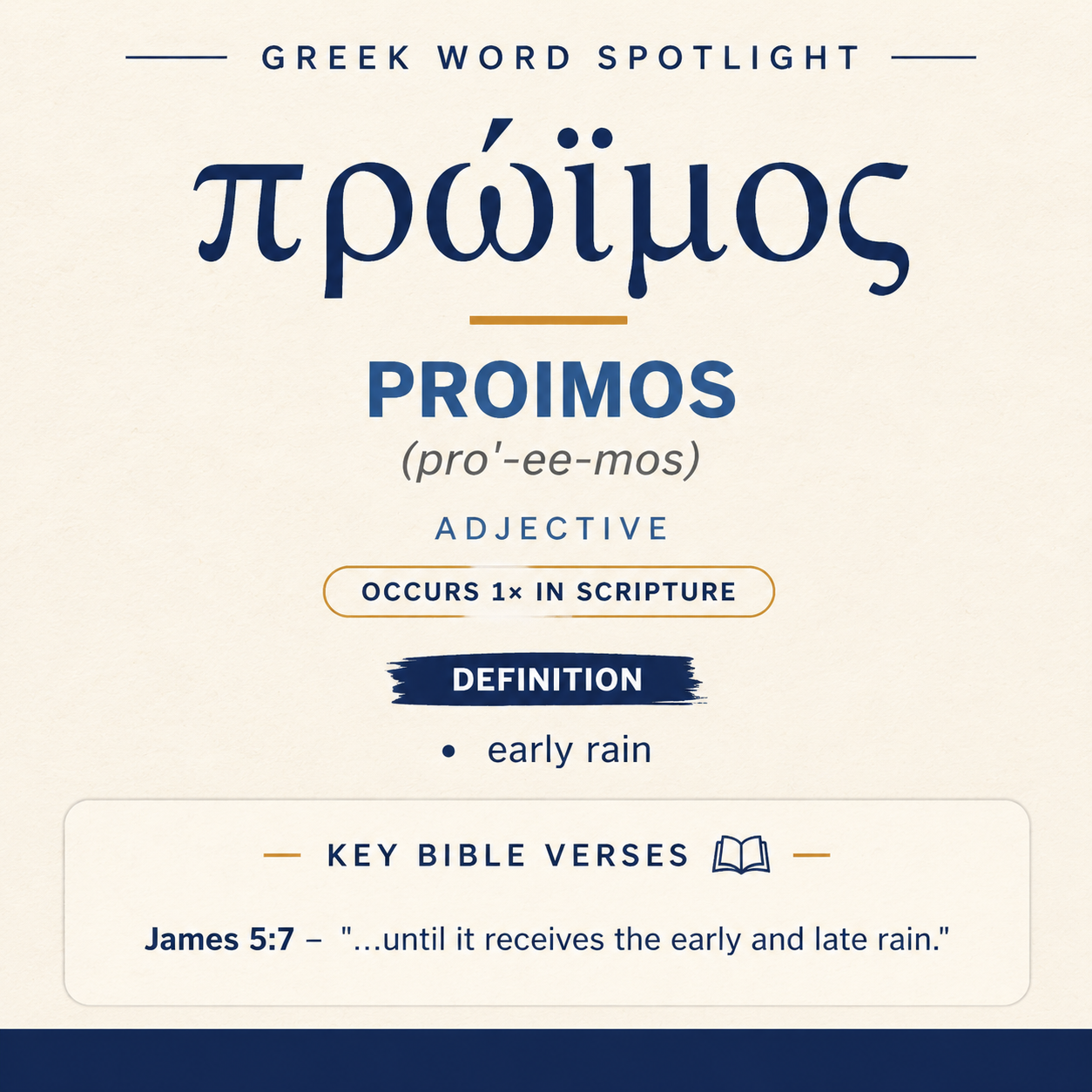
πρώϊμος means “early rain” and appears once in Scripture, in James 5:7.
Scripture Occurrence
This word occurs 1 time in Scripture. Its occurrence is in James 5:7.
Learn More →Verse Context
In James 5:7, it appears within an exhortation to patience until the Lord’s coming. The verse uses a farmer waiting for precious fruit.
Learn More →πρώϊμος means “early rain,” and it appears in a single New Testament passage where James draws on farming experience to picture patient waiting for a harvest. The word functions as part of a paired expression, “early and late rain,” that frames the season-long process by which the earth yields “precious fruit.”
Root and Related Words
πρώϊμος is related to proi (πρωΐ), “early” (Strong’s G4404). The relationship ties the adjective to the idea of earliness, shaping how its rain-imagery is heard in context.

Occurrences
“Be patient therefore, brothers, until the coming of the Lord. Behold, the farmer waits for the precious fruit of the earth, being patient over it, until it receives the early and late rain.” (James 5:7)
In James 5:7, πρώϊμος appears in a concrete agricultural picture: a farmer waits for “the precious fruit of the earth” and practices patience “until it receives the early and late rain.” Here “early rain” is not an isolated weather detail but one half of a two-part pattern that marks the span of growth from beginning to completion. The sentence sets up a timeline: patience continues “until” a specific condition is met—receipt of the rains that belong to the season of fruitfulness. By naming the “early rain” explicitly, James anchors his exhortation in the start of that cycle: the farmer does not merely want rain at some point, but awaits the ordered sequence that makes fruit possible.
The imagery works because the farmer’s waiting is purposeful and restrained. The farmer “waits,” is “patient,” and remains “patient over it”—the repetition of patient posture in the verse is matched by the implied interval between early rain and late rain. πρώϊμος contributes the sense that there is a proper beginning to the process, a first rain that comes before the rest, and that the farmer’s patience must be long enough to cover the whole course. In the flow of the sentence, “early” stands closest to the fruit’s initial dependence: the earth must “receive” what it needs; the farmer cannot force it. The word therefore supports James’s call to patience by pointing to an agricultural reality where outcomes are precious but delayed, and delay is normal rather than exceptional.
Sense and Usage
As “early rain,” πρώϊμος carries seasonal and developmental force. Rain in James 5:7 is not treated as a generic symbol of blessing; it is presented as a necessary stage that precedes the later stage (“late rain”) and together they form the conditions under which fruit becomes “precious” and worth waiting for. The adjective places the reader at the front end of the process—at the point when the farmer has begun to hope for fruit but has not yet seen it. That placement is crucial for James’s exhortation, because he addresses people who must learn to wait “until the coming of the Lord.” The temporal structure of the verse (patient “until… until…”) is mirrored by the agricultural structure (waiting until the rains arrive in their order). The “early rain” thus functions as a marker of the initial, expected provision that starts the season’s advance toward harvest.
The way πρώϊμος is paired with “late” also shapes its nuance: it is not merely “earlier than something else,” but “early” as part of a recognized sequence. In James’s phrasing, the earth “receives” both, and the farmer’s patience extends across the interval between them. The term therefore carries the idea of an early installment in a process that is not finished at its first moment. In ordinary farming experience, early rain would be welcomed as a sign that the season has begun properly, but it would not yet be the yield itself. That distinction matches James’s emphasis: the farmer’s goal is “fruit,” and the rains are the means—received in due order—that sustain the long wait.
Because πρώϊμος occurs here in a direct comparison, its sense is tightly connected to patience that is disciplined by realities outside human control. The farmer does not treat time as empty; time is filled with necessary stages, and the “early rain” is one of those stages. James’s instruction assumes a patient posture that is informed rather than passive: the farmer waits with an understanding that fruit arrives through a sequence, and so patience is not resignation but steadfast endurance across the period between first rain and final ripeness. πρώϊμος helps to name the beginning of that sequence, making the illustration more vivid and specific.
Imagery
In James 5:7, “early rain” evokes the moment when dry ground first receives the moisture that begins the season of growth. The picture is earthy and tactile: “the precious fruit of the earth” depends on the earth’s receiving what it needs, and the farmer’s waiting takes its shape from that dependence. πρώϊμος, set alongside “late rain,” frames patience as living through the whole span from the first rainfall to the completion of the crop, until what is hoped for becomes something the earth actually yields.
Sources: Lexical data from Strong’s Exhaustive Concordance and the Translators Brief Lexicon of Extended Strongs for Greek (STEPBible, CC BY). Occurrence data from the Translators Amalgamated Greek New Testament (STEPBible, CC BY). Scripture quotations from the World English Bible (public domain).