Exploring the Meaning of Priscilla in Greek
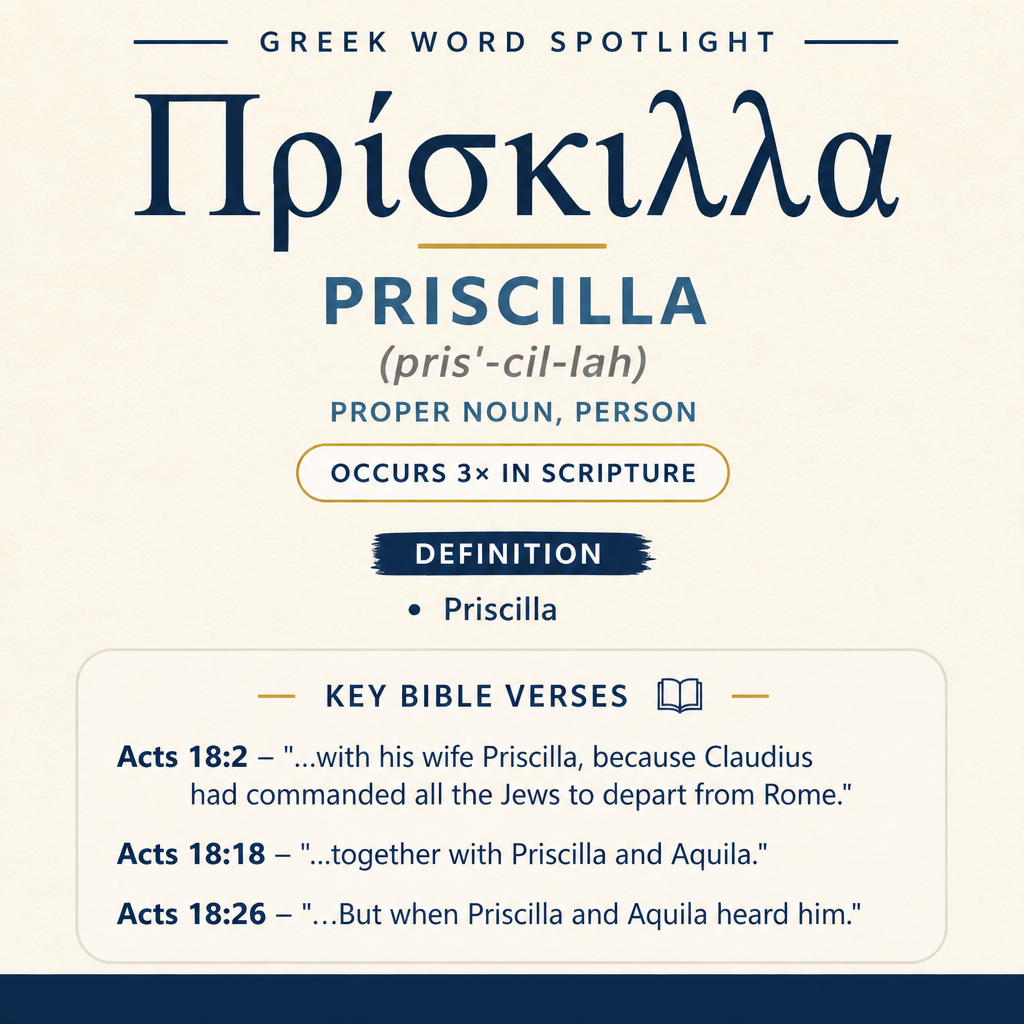
Πρίσκιλλα (Priscilla) means “Priscilla” and appears three times in Scripture: Acts 18:2, 18:18, and 18:26.
Scripture Occurrences
This name occurs 3 times in Scripture. All three references are in Acts 18 (vv. 2, 18, 26).
Learn More →Context in Acts
In Acts 18:2, Priscilla is mentioned as the wife of Aquila. In Acts 18:26, Priscilla and Aquila take someone aside and explain further.
Learn More →Priscilla is a personal name appearing in the narrative of Paul’s ministry at Corinth and beyond, where she is repeatedly mentioned alongside Aquila. In these passages, the name marks her presence in travel, hospitality, and instruction within the life of the early church.
Root and Related Words
Priscilla is related to the name Priska (Πρίσκα), “Prisca” (Strong’s G4251).
Occurrences
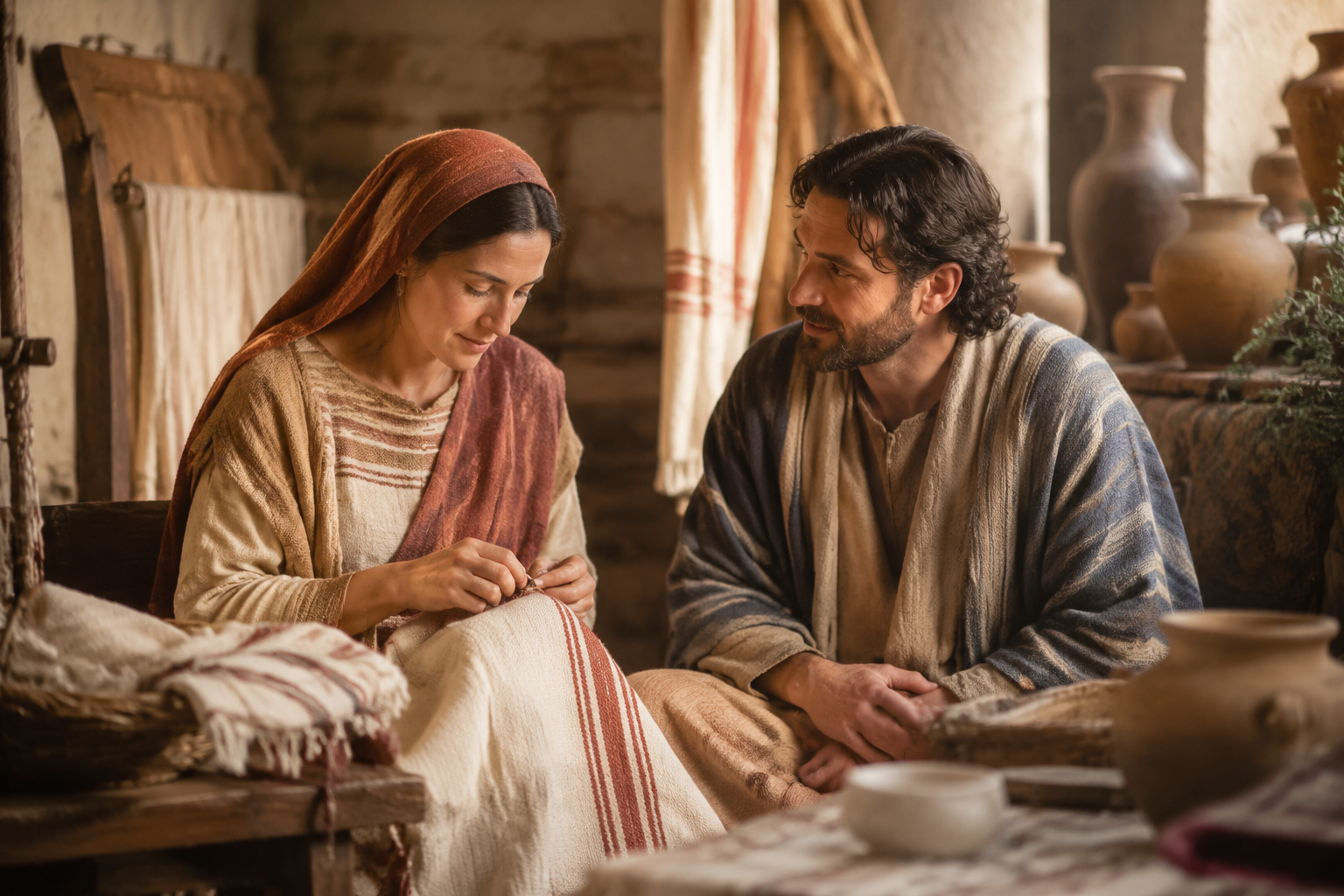
He found a certain Jew named Aquila, a man of Pontus by race, who had recently come from Italy, with his wife Priscilla, because Claudius had commanded all the Jews to depart from Rome. He came to them, (Acts 18:2)
Here the name occurs in a tightly drawn introduction that situates a new relationship in Paul’s ministry. Priscilla is identified in the same breath as Aquila—“with his wife Priscilla”—so the name functions as part of a household unit that Paul encounters. The wording also places her within a larger movement of displaced Jews: they had “recently come from Italy,” and their relocation is linked to a public decree that “commanded all the Jews to depart from Rome.” In this scene, “Priscilla” anchors a concrete, domestic reality: a married couple on the move, now present in the place where Paul “came to them,” setting up the personal connection that follows in the narrative.
Paul, having stayed after this many more days, took his leave of the brothers, and sailed from there for Syria, together with Priscilla and Aquila. He shaved his head in Cenchreae, for he had a vow. (Acts 18:18)
In this travel notice, “Priscilla” appears as part of Paul’s immediate company: he “sailed from there for Syria, together with Priscilla and Aquila.” The name therefore marks companionship and shared movement rather than mere acquaintance. Luke’s wording makes Priscilla and Aquila the named companions attached to Paul’s departure from a community of “the brothers,” indicating that the journey includes both a separation from one set of relationships and a continuation of another. The verse also includes a vivid, localized detail—“He shaved his head in Cenchreae, for he had a vow”—which frames the departure as purposeful and religiously marked; within that same frame, Priscilla’s name contributes to the portrayal of a mission that is carried out in company, not in isolation.
He began to speak boldly in the synagogue. But when Priscilla and Aquila heard him, they took him aside, and explained to him the way of God more accurately. (Acts 18:26)
In this episode, the name occurs in a moment of discernment and corrective teaching. The setting is public—someone “began to speak boldly in the synagogue”—yet Priscilla (again paired with Aquila) responds by shifting the interaction to a more private mode: “they took him aside.” The name therefore identifies one of the agents who initiates that change of setting and tone. The action attributed to them is instructional and clarifying: they “explained to him the way of God more accurately.” Within the verse’s movement from bold public speech to careful private explanation, “Priscilla” stands for active participation in communicating and refining Christian teaching in a way aimed at accuracy.
Sense and Usage
Across these three texts, the name Priscilla functions as more than a bare identifier; it consistently locates a particular woman within recurring patterns of shared life and ministry. First, the name is introduced through marriage and migration (“with his wife Priscilla… had recently come from Italy”), giving the reader a social placement for her: she belongs to a household that has undergone forced relocation and is now accessible to Paul (“He came to them”). Second, the name appears in a setting of deliberate travel (“sailed… together with Priscilla and Aquila”), presenting her not as a stationary figure but as someone whose movements intersect with the movement of the apostolic mission. Third, in the synagogue scene, the name is linked to action that is both responsive and constructive: hearing, taking someone aside, and explaining “more accurately.”
Two features of usage stand out within these verses. (1) Priscilla is consistently named alongside Aquila, and in each case the pair acts as a unit: encountered together, traveling together, and teaching together. The repeated coupling gives the name a relational contour; readers meet Priscilla in the context of a partnership that is visible in public narrative events. (2) The name appears at points where the narrative pivots—Paul’s first connection with the couple after their arrival from Italy, Paul’s departure on a new leg of travel, and a moment where public proclamation is refined through private instruction. In this way, “Priscilla” becomes attached, in these passages, to turning points in connections, journeys, and the communication of “the way of God.”
Imagery in Context
The passages that name Priscilla carry concrete imagery of movement and setting: departure from Rome, arrival from Italy, sailing toward Syria, and a synagogue where speech is heard and evaluated. Within that sequence, the name is repeatedly set in scenes of transition—people departing and coming, companions sailing, listeners stepping aside to explain. Priscilla’s name thus appears where the story’s faith is shown in motion: households relocated, coworkers traveling, and instruction offered so that the message is rendered “more accurately.”
Sources: Lexical data from Strong’s Exhaustive Concordance and the Translators Brief Lexicon of Extended Strongs for Greek (STEPBible, CC BY). Occurrence data from the Translators Amalgamated Greek New Testament (STEPBible, CC BY). Scripture quotations from the World English Bible (public domain).