
Exploring the Meaning of Presbuteros in Greek
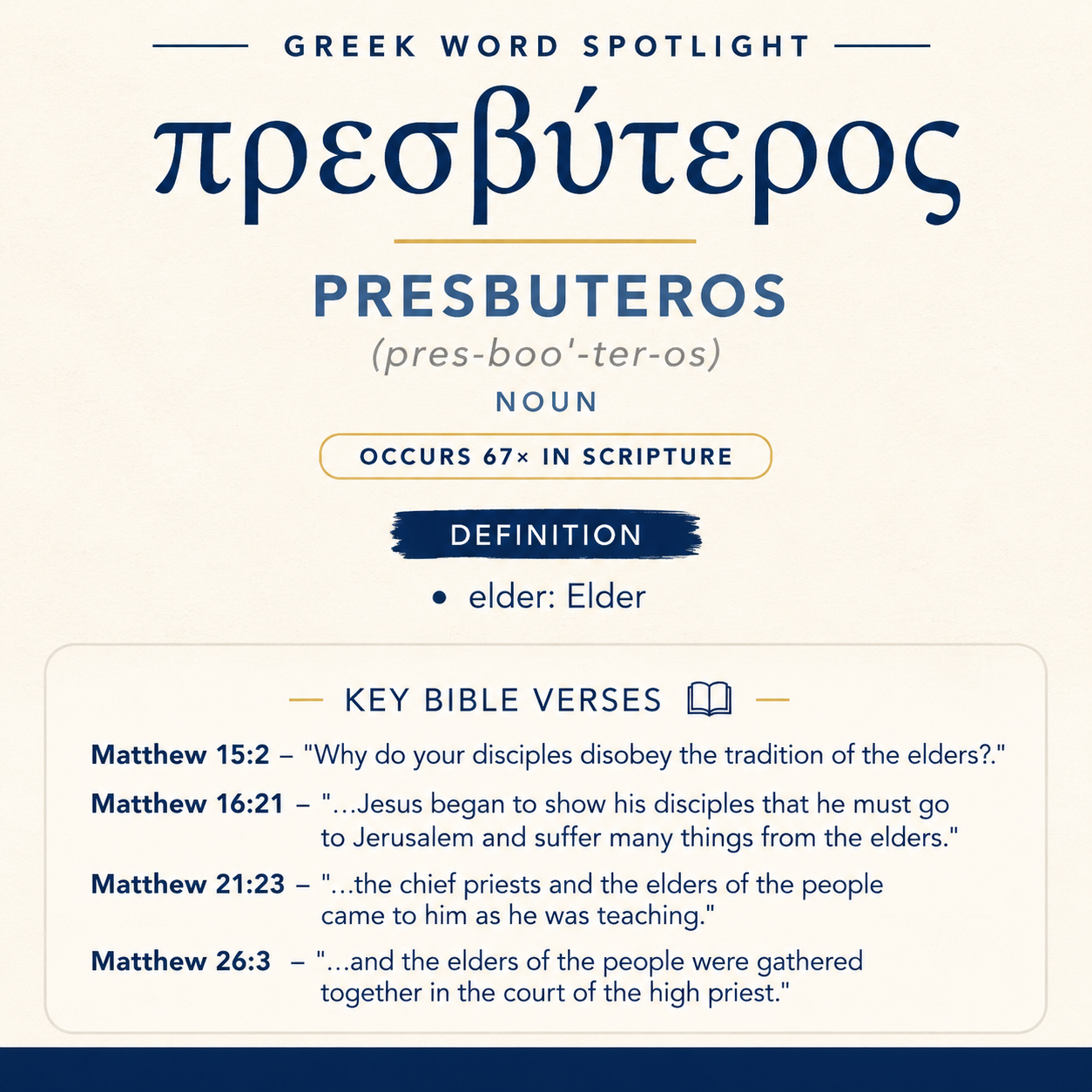
πρεσβύτερος (Presbuteros) means “elder” and occurs 67 times in Scripture, including Matthew 15:2; 16:21; 21:23; 26:3; 26:47; 26:57; 26:59; 27:1.
Matthew References
In Matthew, πρεσβύτερος appears in 15:2; 16:21; 21:23; 26:3; 26:47; 26:57; 26:59; 27:1. These verses reference “the elders” in multiple contexts.
Learn More →Scene Contexts
Matthew 15:2 mentions “the tradition of the elders.” Several later passages place “the elders” alongside chief priests and scribes in gatherings and counsel (Matthew 26:3; 26:57; 27:1).
Learn More →πρεσβύτερος means “elder.” In the passages quoted here, it appears both in disputes about “the tradition of the elders” and in the coordinated actions of elders alongside other leadership groups during Jesus’ final days.
Occurrences
“Why do your disciples disobey the tradition of the elders? For they don’t wash their hands when they eat bread.” (Matthew 15:2)
Here “elders” designates an authoritative source behind a “tradition” that is expected to govern conduct at the table. The question assumes that the elders’ tradition carries enough weight that failing to keep it counts as “disobey[ing],” and the concrete example given—handwashing before eating—shows this authority applied to ordinary practice.
From that time, Jesus began to show his disciples that he must go to Jerusalem and suffer many things from the elders, chief priests, and scribes, and be killed, and the third day be raised up. (Matthew 16:21)
In this forecast of suffering, “elders” stands as one element in a triad—“elders, chief priests, and scribes”—associated with opposition that results in Jesus suffering “many things” and being “killed.” The word contributes to the picture of leadership acting in concert: not a lone accuser but a set of recognized groups whose combined action defines what awaits Jesus in Jerusalem.
When he had come into the temple, the chief priests and the elders of the people came to him as he was teaching, and said, “By what authority do you do these things? Who gave you this authority?” (Matthew 21:23)
“The elders of the people” are paired with “the chief priests” and portrayed as challengers of Jesus’ legitimacy in the temple setting. Their question—twice framed around “authority”—positions them as guardians of authorized teaching and practice, pressing for the source behind Jesus’ actions while he is “teaching.” The phrase “of the people” ties their standing to communal representation rather than a private capacity.
Then the chief priests, the scribes, and the elders of the people were gathered together in the court of the high priest, who was called Caiaphas. (Matthew 26:3)
In this assembly scene, elders appear as part of a gathered leadership body meeting at a specific location: “the court of the high priest.” The word contributes to the sense of an official gathering—elders are present not as bystanders but as participants in a meeting that is anchored in the high priest’s sphere.
While he was still speaking, behold, Judas, one of the twelve, came, and with him a great multitude with swords and clubs, from the chief priests and elders of the people. (Matthew 26:47)
Here “elders of the people” are identified as one of the sources behind the armed crowd: the multitude comes “from the chief priests and elders.” The term thus functions to assign agency and backing: the crowd is not merely spontaneous; it is connected to recognized leadership whose involvement explains the crowd’s organization and purpose.
Those who had taken Jesus led him away to Caiaphas the high priest, where the scribes and the elders were gathered together. (Matthew 26:57)
As Jesus is led to Caiaphas, “the scribes and the elders” are already assembled. The word helps depict the setting as prepared and institutional: elders are not arriving after the fact but are “gathered together” at the destination, ready for what will occur there.
Now the chief priests, the elders, and the whole council sought false testimony against Jesus, that they might put him to death; (Matthew 26:59)
In this verse, “elders” again stand alongside “chief priests” and now “the whole council.” Their action is described as an active search—“sought false testimony”—and the stated aim is lethal: “that they might put him to death.” The term therefore participates in a depiction of deliberative leadership engaged in a coordinated effort with a defined objective.
Now when morning had come, all the chief priests and the elders of the people took counsel against Jesus to put him to death: (Matthew 27:1)
“The elders of the people” are presented as taking counsel with “all the chief priests,” and the counsel is explicitly “against Jesus.” The phrase “when morning had come” frames this as a formal continuation into daylight, and the elders’ role is that of decision-makers: they “took counsel” toward a concrete outcome.
Then Judas, who betrayed him, when he saw that Jesus was condemned, felt remorse, and brought back the thirty pieces of silver to the chief priests and elders, (Matthew 27:3)
Here elders appear as recipients of Judas’s attempt to return the betrayal money. By pairing “chief priests and elders” as those to whom the silver is brought back, the verse portrays elders as involved in the transaction’s official side—people to whom such money can be returned as part of addressing what has been done, especially after Jesus is “condemned.”
When he was accused by the chief priests and elders, he answered nothing. (Matthew 27:12)
“Elders” are named among the accusers, with the accusation framed as a joint action: “by the chief priests and elders.” Against their accusations, Jesus’ response is silence—“he answered nothing”—which gives the elders’ accusatory role sharp contrast: they speak charges; he does not reply.
Now the chief priests and the elders persuaded the multitudes to ask for Barabbas, and destroy Jesus. (Matthew 27:20)
In this crowd scene, elders are agents of persuasion. The verb “persuaded” assigns them influence over “the multitudes,” directing public demand toward a specific choice: “ask for Barabbas” and “destroy Jesus.” The word thus contributes to the portrait of elders as capable of shaping mass opinion and steering outcomes through influence, not only through councils and courts.
Likewise the chief priests also mocking, with the scribes, the Pharisees, and the elders, said, (Matthew 27:41)
Here elders are included among a broader set of mockers: “the scribes, the Pharisees, and the elders,” with “the chief priests” leading the action. The term adds to the depiction of unified derision across multiple leadership groups; elders participate not only in planning and accusation but also in public scorn.

Sense and Usage
Across these passages, πρεσβύτερος functions as a title for persons recognized as “elders,” and the narratives treat that status as socially weighty. In Matthew 15:2, elders stand behind a “tradition” that can be invoked as a binding standard of behavior, showing the word’s association with established authority exercised through custom. In Matthew 21:23, elders appear in a direct challenge about “authority,” aligning the title with the right to question and evaluate teaching in a public, sacred setting (“the temple”).
As the story moves into Jesus’ arrest and trial, elders repeatedly appear as part of formal and informal coalitions. They are shown gathering with other groups (Matthew 26:3; 26:57), seeking testimony with a deadly goal (Matthew 26:59), and taking counsel (Matthew 27:1). In these scenes, the word carries the sense of belonging to a leadership class involved in decision-making and collective action. Their authority is not portrayed as merely advisory; it is active, organizing, and outcome-driven.
The same leadership presence extends beyond meetings into public events. Elders are connected to the “great multitude with swords and clubs” that arrives with Judas (Matthew 26:47), tying their role to the mobilization of force. They also serve as those to whom Judas returns the silver (Matthew 27:3), placing them at the administrative center of the betrayal’s aftermath. Finally, they are depicted shaping the crowd’s will (“persuaded the multitudes,” Matthew 27:20) and joining in mocking speech (Matthew 27:41), showing that “elders” in these passages can be public actors as well as council members. Taken together, the usage presents elders as influential figures whose recognized standing enables them to sponsor traditions, interrogate authority, convene with other leaders, and sway communal behavior.
Imagery in Context
The word’s imagery is largely communal and institutional: elders appear in gatherings, courts, and councils, and they stand as a named group whose presence signals organized authority. Even when the setting shifts from a court to a crowd, the term continues to evoke coordinated leadership—people whose recognized role allows them to assemble others, direct proceedings, and lend weight to decisions and actions described in the narrative.
Sources: Lexical data from Strong’s Exhaustive Concordance and the Translators Brief Lexicon of Extended Strongs for Greek (STEPBible, CC BY). Occurrence data from the Translators Amalgamated Greek New Testament (STEPBible, CC BY). Scripture quotations from the World English Bible (public domain).




