
Exploring the Meaning of Polusplagchnos in Greek
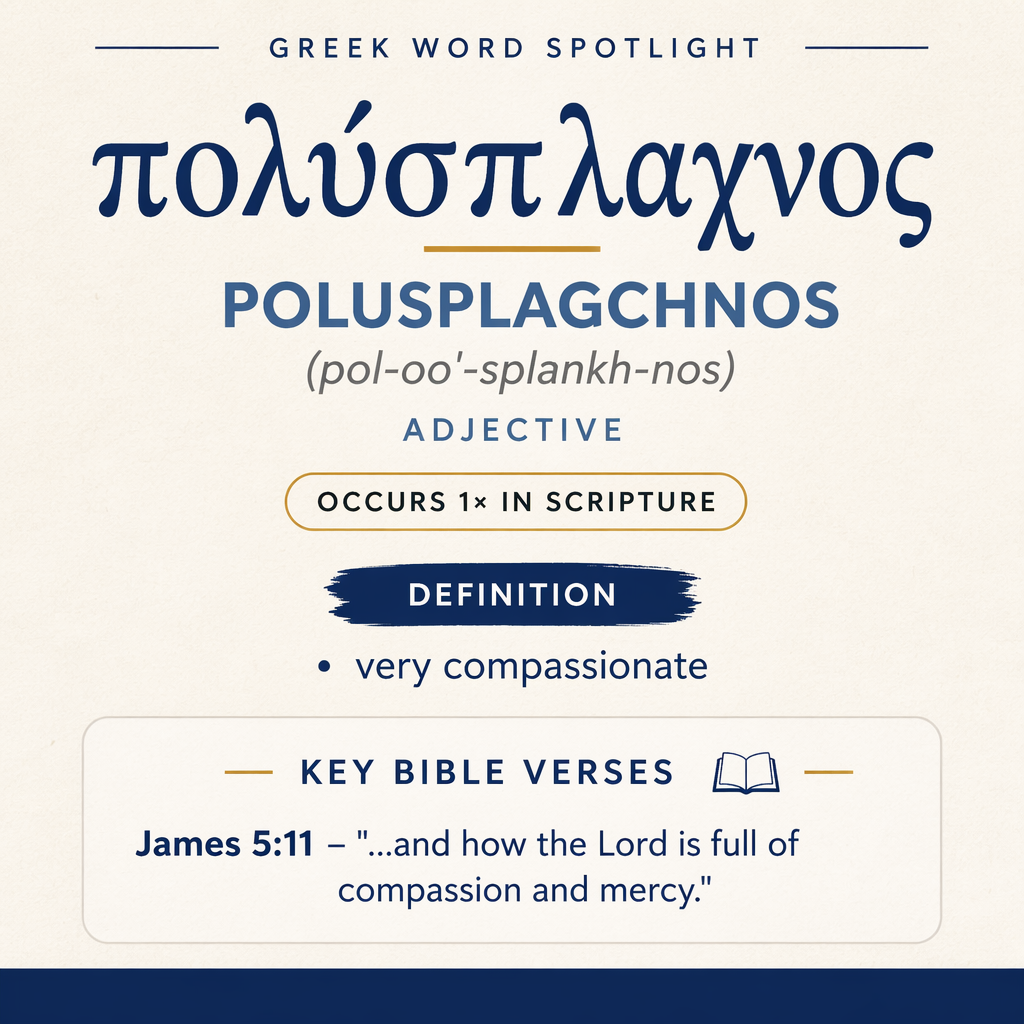
πολύσπλαγχνος means “very compassionate” and appears once in Scripture, in James 5:11.
Scripture Occurrence
This word occurs 1 time in Scripture. Its single occurrence is in James 5:11.
Learn More →James 5:11 Context
In James 5:11, it appears in a statement about endurance and the Lord.
Learn More →πολύσπλαγχνος means “very compassionate” and appears in the exhortation of James about endurance and the character of the Lord. Its single New Testament use ties compassion to the way the Lord brings an ordeal to its outcome.
Root and Related Words
πολύσπλαγχνος is formed from πολύς (polys), “much,” and σπλάγχνον (splanchnon), “affection/entrails.” The first element supplies the idea of abundance (“much”), while the second provides a term associated with affection, expressed with imagery rooted in the inward parts (“entrails”). Together they create an adjective that portrays compassion as plentiful rather than sparse.

Occurrences
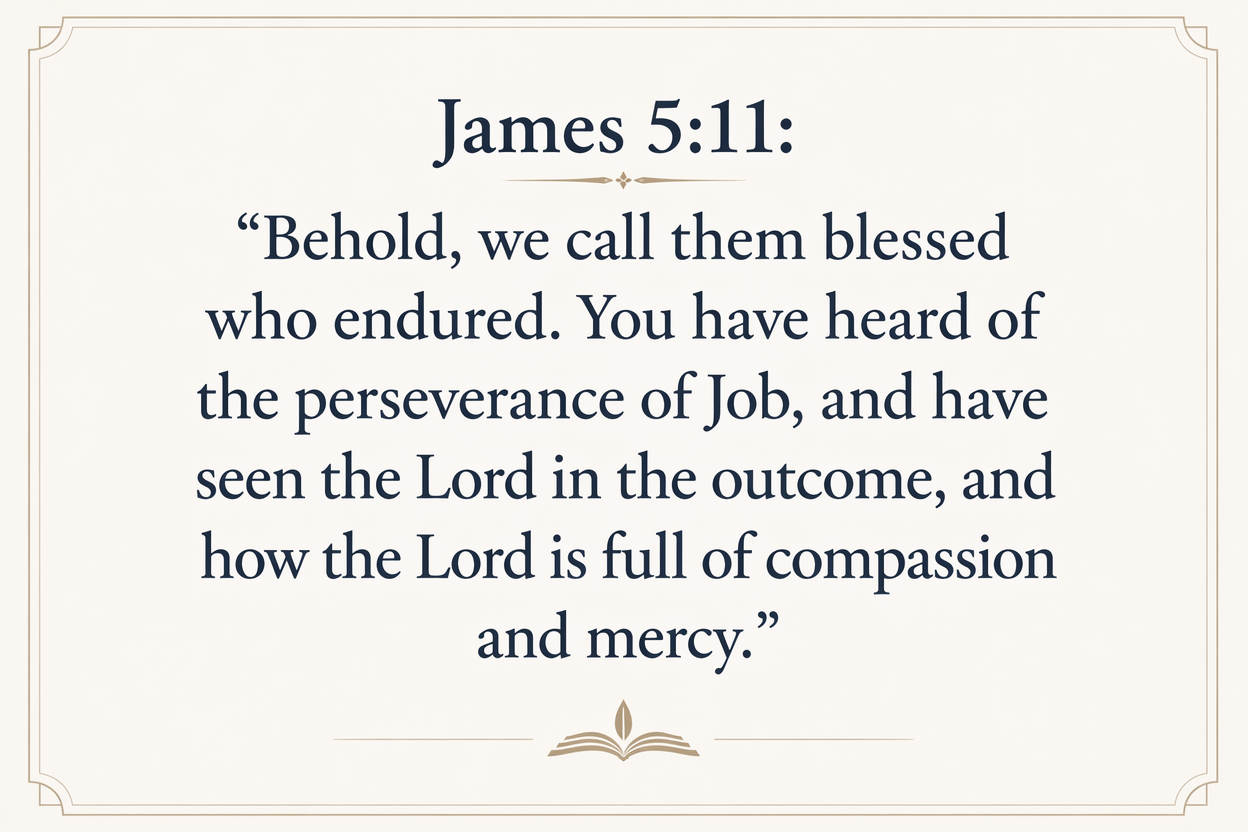
James 5:11: “Behold, we call them blessed who endured. You have heard of the perseverance of Job, and have seen the Lord in the outcome, and how the Lord is full of compassion and mercy.”
In this sentence, πολύσπλαγχνος belongs to a cluster of ideas meant to steady readers who are facing strain: blessing is attached to endurance, Job stands as a known example of perseverance, and the “outcome” is presented as a place where the Lord’s character becomes visible. The word comes at the end of the argument, where James points beyond the endurance itself to what can be “seen” about the Lord when a hard story reaches its end.
The verse frames compassion as something exhibited in the Lord’s dealings, not merely a feeling held at a distance from suffering. James uses Job’s perseverance as the point of reference, but the focus of πολύσπλαγχνος is the Lord: “how the Lord is full of compassion and mercy.” The adjective strengthens that description by portraying compassion as abundant. The statement is not simply that the Lord has compassion, but that the Lord is “full of” it, fitting the form of a word built from “much” plus a term linked with affection. The result is a depiction of compassion that is ample enough to define the Lord’s manner of acting in the “outcome.”
Within the verse’s logic, compassion is not contrasted with endurance as if one cancels the other. Instead, endurance is affirmed as blessed, while compassion is affirmed as the Lord’s posture that stands behind the outcome believers can observe. πολύσπλαγχνος therefore contributes a particular emphasis: whatever perseverance requires, it does not imply a cold or grudging Lord. The Lord who brings an ordeal to its outcome is characterized as richly compassionate, and that characterization functions as reassurance for those called to endure.
Sense and Usage
The sense “very compassionate” in James 5:11 operates as a description of the Lord’s disposition as it is recognized in retrospect—“you… have seen the Lord in the outcome.” Compassion here is not argued abstractly; it is inferred from what the Lord does when a trial runs its course. The word’s compounded shape (from “much” and a term tied to affection) suits the phrasing “full of compassion,” since both convey quantity and fullness rather than a minimal measure.
Because this is the word’s only New Testament appearance, its semantic profile is established by its immediate pairing: “full of compassion and mercy.” In that coordination, πολύσπλαγχνος highlights compassion as one facet of a broader moral beauty in the Lord. The verse does not parse distinctions between the two terms; it places them together as complementary descriptions of the Lord’s character. The contribution of πολύσπλαγχνος is its intensity: compassion is presented as abundant and defining, not occasional.
The immediate context also shapes how “very compassionate” should be heard. James is addressing the evaluation of suffering: endurance is called blessed, Job’s perseverance is held up as a known account, and the Lord’s character is pointed to as something “seen” in the end. Within that flow, compassion is tied to the way believers interpret an ordeal’s end. The adjective therefore functions as a lens: it invites the reader to regard the Lord’s dealings, even in prolonged hardship, as consistent with deep compassion.
Finally, the imagery carried by the related term σπλάγχνον (“affection/entrails”) colors the force of the adjective without changing its defined sense. By drawing on a term associated with inward affection, πολύσπλαγχνος portrays compassion as something that belongs to the Lord’s inner disposition, not merely an external response. Joined to πολύς (“much”), that inward affection is represented as abundant—compassion that is plentiful enough to be spoken of as fullness.
Imagery
James speaks of compassion in a way that can be “seen… in the outcome,” suggesting that the Lord’s abundant compassion becomes perceptible through how a hard account resolves. The word’s formation from “much” and a term linked to inward affection supports the picture of compassion as deep-seated and overflowing, matching the verse’s claim that the Lord is “full of compassion and mercy.”
Sources: Lexical data from Strong’s Exhaustive Concordance and the Translators Brief Lexicon of Extended Strongs for Greek (STEPBible, CC BY). Occurrence data from the Translators Amalgamated Greek New Testament (STEPBible, CC BY). Scripture quotations from the World English Bible (public domain).




