
Exploring the Meaning of Politeuomai in Greek
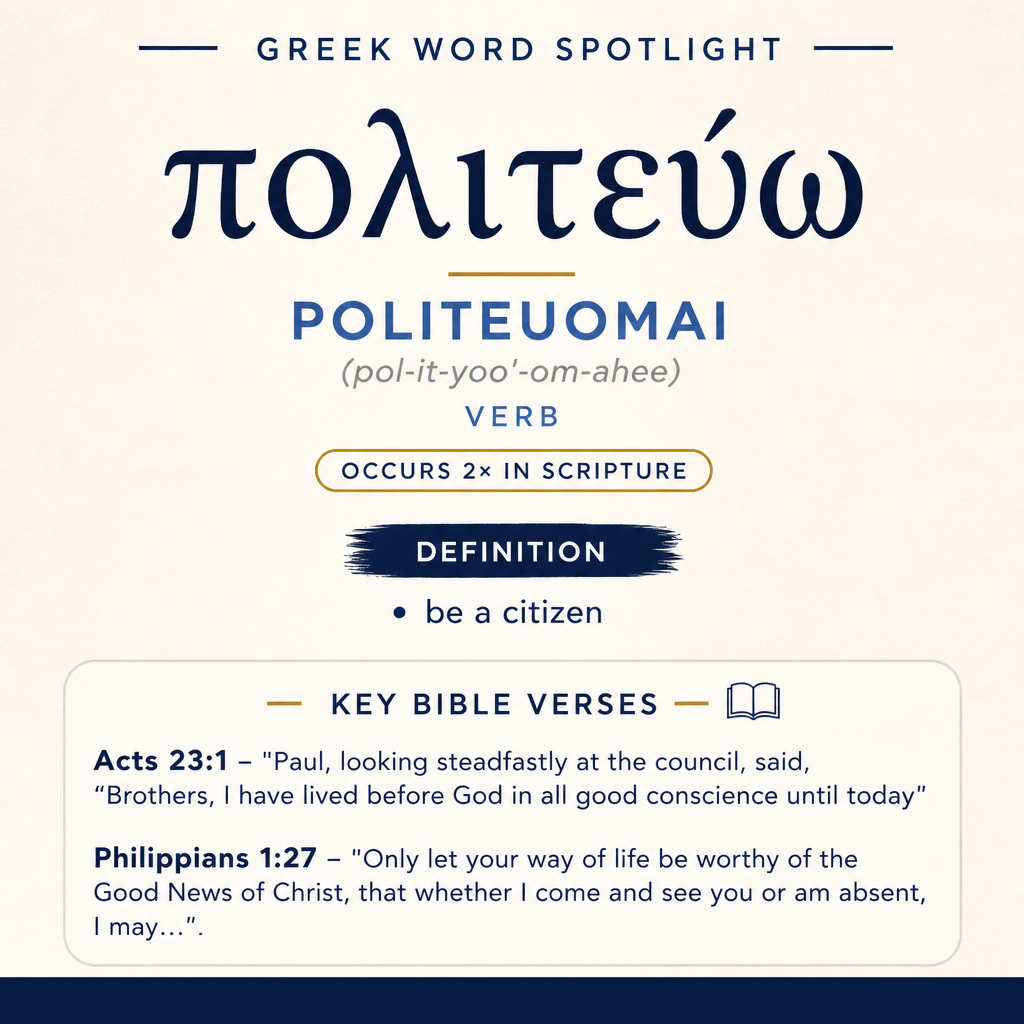
πολιτεύω means “be a citizen” and appears twice in Scripture: Acts 23:1 and Philippians 1:27.
Scripture Occurrences
This verb occurs 2 times in Scripture: Acts 23:1 and Philippians 1:27.
Learn More →Verse Contexts
In Acts 23:1 Paul says he has lived before God in all good conscience until today. In Philippians 1:27 it is tied to a way of life worthy of the Good News of Christ.
Learn More →πολιτεύω expresses the idea of being a citizen, and it appears in the New Testament in Acts 23:1 and Philippians 1:27. In each setting, the term frames a person’s life in terms of citizenship-language—either as a personal claim made before a governing body or as a communal exhortation addressed to a church.
Root and Related Words
πολιτεύω is connected with the noun politēs (πολίτης), “citizen” (Strong’s G4177). This relationship situates the verb within the vocabulary of civic identity and belonging, where “citizen” language naturally extends to how one lives and is recognized within a community.

Occurrences
Acts 23:1: Paul, looking steadfastly at the council, said, “Brothers, I have lived before God in all good conscience until today.”
In Acts 23:1 the verb is placed on Paul’s lips in a formal setting: he is facing “the council,” fixing his gaze on them, and offering a direct statement about his life “until today.” The content of the statement is moral and relational—“before God” and “in all good conscience.” By using πολιτεύω here, Paul casts his manner of life in terms that fit a public accounting: he is not merely describing private feelings or a recent choice, but presenting the whole of his lived conduct as something that can be spoken of coherently and evaluated. The appeal is not to popular opinion or shifting standards, but to a conscience he describes as good, anchored “before God.” In this scene, the citizen-language of the verb highlights that life can be spoken of as a settled course that stands up under scrutiny, even when that scrutiny comes from an authoritative council.

The surrounding details in the verse intensify that public dimension. Paul does not speak from the sidelines; he addresses them as “Brothers,” a term that both acknowledges shared identity and heightens the seriousness of his claim. The council functions as a forum where actions and loyalties are weighed. Against that backdrop, πολιτεύω helps portray Paul’s life as a kind of civic record—a consistent pattern of conduct—presented with the confidence of someone who can say it has been carried out “in all good conscience.”
Philippians 1:27: Only let your way of life be worthy of the Good News of Christ, that whether I come and see you or am absent, I may hear of your state, that you stand firm in one spirit, with one soul striving for the faith of the Good News;
In Philippians 1:27 the verb is used in a direct exhortation addressed to a community. The sentence begins with a narrowing word—“Only”—marking what follows as a central concern. The verb stands behind “your way of life,” and the immediate qualifier is “worthy of the Good News of Christ.” Here, citizenship-language is applied not to a courtroom defense but to the shared conduct of believers whose life together should match the message they confess.
The verse ties this “way of life” to Paul’s ongoing relationship with the Philippians and to how they will be known when he is not present: “that whether I come and see you or am absent, I may hear of your state.” πολιτεύω thus reaches beyond isolated actions to a recognizable condition or report—something that can be “heard of” as their “state.” The expected report is defined with three coordinated descriptions: “that you stand firm in one spirit,” “with one soul,” and “striving for the faith of the Good News.” The verb’s contribution is to frame these qualities as the visible outworking of a life lived as citizens: stability (“stand firm”), unity (“one spirit … one soul”), and purposeful effort (“striving”). The point is not merely personal morality but a coherent communal stance that can be described even in Paul’s absence.
Because the goal is that their conduct be “worthy,” πολιτεύω in this context functions as a bridge between identity and behavior. The Good News is named twice in the verse (“the Good News of Christ” and “the Good News”), and the verb gathers the response to that message into a single category: a manner of life whose public shape corresponds to the Good News they uphold. In a letter context where Paul may or may not visit, the verb also hints that such a way of life is meant to be sustained without reliance on direct oversight; it should be consistent enough that reports about them match the exhortation.
Sense and Usage
Across its two uses, πολιτεύω depicts life as something lived in a citizenly mode—conduct that belongs to, and is accountable within, a larger order. In Acts 23:1 the emphasis falls on personal integrity under examination: Paul describes his life “before God” and locates its consistency in “all good conscience.” In Philippians 1:27 the emphasis shifts to corporate witness and steadfastness: the community’s manner of life is to be “worthy of the Good News of Christ,” marked by unity and coordinated striving. The shared thread is that the verb treats life not as a series of disconnected moments but as a comprehensive pattern that can be assessed: in one case by a council as Paul speaks; in the other by what Paul can “hear” about the church’s “state.”
The two scenes also show how the citizen sense can operate with different reference points. In Acts, the accountability is stated explicitly in Godward terms—“before God”—and the internal moral register of “conscience” is prominent. In Philippians, accountability is expressed through the standard of worthiness “of the Good News of Christ,” and the internal cohesion of the group (“one spirit … one soul”) is prominent. In both, the verb helps portray conduct as belonging to an identity that carries obligations: one does not merely claim alignment with God or the Good News; one lives in a way that can be described, examined, and recognized as fitting.
Because πολιτεύω can be used both for an individual’s personal testimony (Paul’s “I have lived”) and for a community’s shared conduct (“your way of life”), it naturally spans private and public dimensions. “Good conscience” suggests inward sincerity, yet it is voiced outwardly before the council. “Stand firm … striving” suggests outward action, yet it is grounded in inward unity of spirit and soul. The word, therefore, is well suited to contexts where the question is not only what someone believes or claims, but what kind of life is being lived in the open—life that bears the marks of citizenship.
Implied Imagery
Both passages carry the imagery of public standing. Acts 23:1 pictures a person fixed in place before an official body—“looking steadfastly at the council”—and then making a statement that amounts to a lifelong record “until today.” Philippians 1:27 pictures a community whose public posture can be reported from afar: they are to “stand firm” and to be seen striving together. πολιτεύω supports that shared imagery by treating life as something that takes a stand, holds its ground, and can be spoken of as a recognizable state.
Sources: Lexical data from Strong’s Exhaustive Concordance and the Translators Brief Lexicon of Extended Strongs for Greek (STEPBible, CC BY). Occurrence data from the Translators Amalgamated Greek New Testament (STEPBible, CC BY). Scripture quotations from the World English Bible (public domain).




