Exploring the Meaning of Phoneuo in Greek
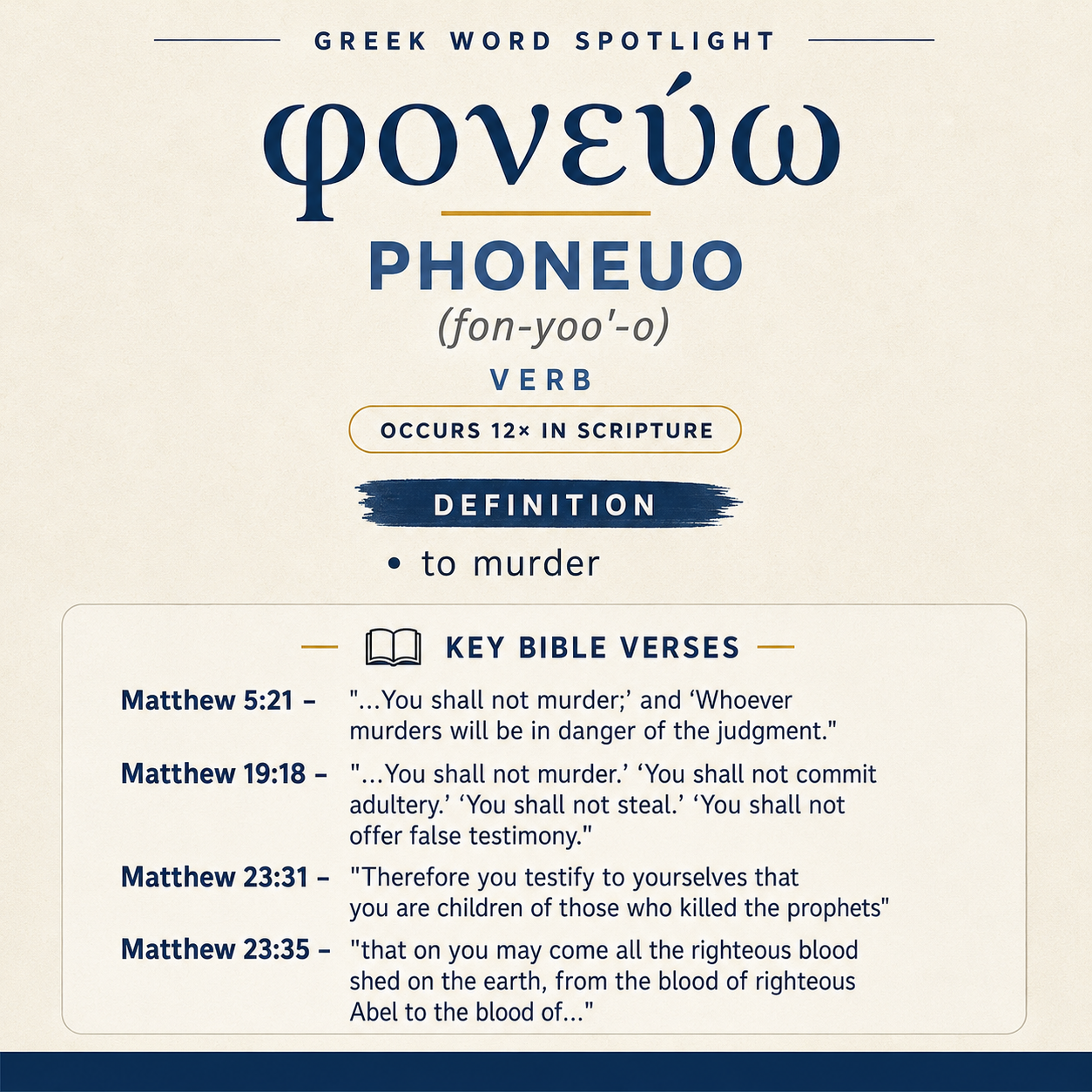
φονεύω means “to murder” and occurs 12 times in Scripture, including Matthew, Mark, Luke, Romans, and James.
Commandment Context
It appears in direct command form: “You shall not murder,” in Matthew 5:21; Matthew 19:18; Mark 10:19; Luke 18:20; Romans 13:9; and James 2:11.
Learn More →Narrative Use
It is also used for killing, including references to those who killed the prophets (Matthew 23:31) and to righteous bloodshed (Matthew 23:35).
Learn More →φονεύω names the act of murder in settings where Scripture’s commands are cited, guilt is exposed, and violent wrongdoing is condemned. It appears in Jesus’ teaching and disputes in Matthew, in a commandment list in Mark and Luke, in Paul’s summary of ethical commands in Romans, and in James’s sharp rebukes of destructive desire and injustice.
Occurrences
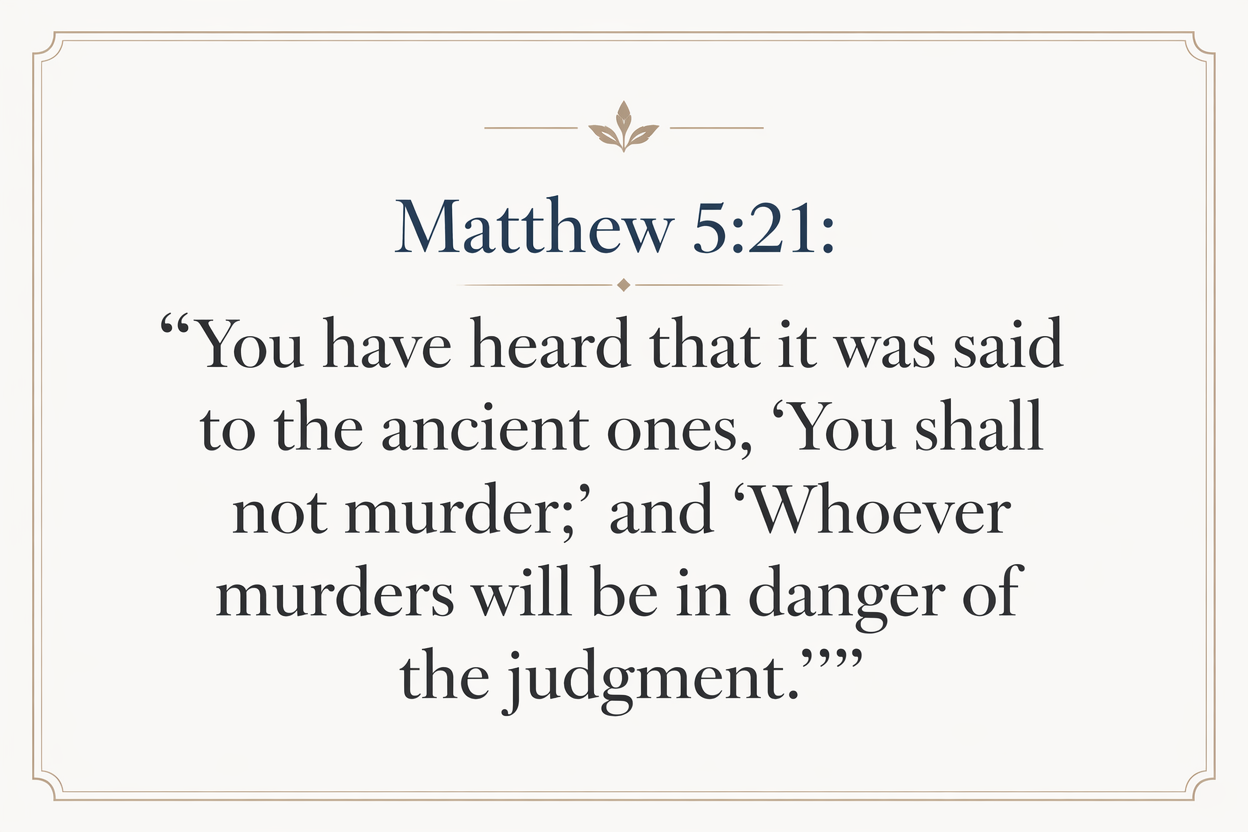
Matthew 5:21: “You have heard that it was said to the ancient ones, ‘You shall not murder;’ and ‘Whoever murders will be in danger of the judgment.’”
Here φονεύω is presented as a prohibited act and as a basis for accountability: the wording pairs the prohibition (“You shall not murder;”) with a stated consequence (“will be in danger of the judgment”). In this scene the verb carries legal and moral weight—murder is not only wrong but exposes the doer to judgment.
Matthew 19:18: He said to him, “Which ones?” Jesus said, “ ‘You shall not murder.’ ‘You shall not commit adultery.’ ‘You shall not steal.’ ‘You shall not offer false testimony.’”
In this exchange φονεύω is embedded in a list of recognizable commands. Its force is categorical: murder is named alongside other concrete violations (“commit adultery,” “steal,” “offer false testimony”), marking it as a clear boundary in conduct rather than an abstract ideal.
Matthew 23:31: Therefore you testify to yourselves that you are children of those who killed the prophets.
φονεύω is used to characterize what earlier generations did to “the prophets.” The verb functions rhetorically: it identifies a legacy of violence and makes that violence part of the hearers’ own self-testimony (“you testify to yourselves”). The focus is not on an isolated crime but on a lineage marked by murderous treatment of God’s messengers.
Matthew 23:35: that on you may come all the righteous blood shed on the earth, from the blood of righteous Abel to the blood of Zachariah son of Barachiah, whom you killed between the sanctuary and the altar.
Here φονεύω is tied to “righteous blood shed,” with an example framed as a sacred-space atrocity: “whom you killed between the sanctuary and the altar.” The verb gives the sentence its sharp edge—killing is the concrete deed that produces “blood” and grounds the charge of culpability in a specific, violent act located in a place associated with worship.
Mark 10:19: You know the commandments: ‘Do not murder,’ ‘Do not commit adultery,’ ‘Do not steal,’ ‘Do not give false testimony,’ ‘Do not defraud,’ ‘Honor your father and mother.’ ”
In Mark, φονεύω appears as one item in a sequence introduced as known commands (“You know the commandments”). Murder is treated as an obvious moral prohibition, placed among actions that harm others and undermine communal life (“steal,” “defraud,” “give false testimony”), so that the verb’s contribution is to name the most extreme form of harm in the list.
Luke 18:20: You know the commandments: ‘Don’t commit adultery,’ ‘Don’t murder,’ ‘Don’t steal,’ ‘Don’t give false testimony,’ ‘Honor your father and your mother.’ ”
Luke similarly places φονεύω among familiar commandments. The negative imperative form (“Don’t murder”) gives the verb direct applicational force: it is not merely recited as a traditional phrase, but addressed as a present obligation within a set of ethical directives.
Romans 13:9: For the commandments, “You shall not commit adultery,” “You shall not murder,” “You shall not steal,” “You shall not covet,” and whatever other commandments there are, are all summed up in this saying, namely, “You shall love your neighbor as yourself.”
In Romans, φονεύω is one of the commands explicitly gathered into a larger ethical summary. The verb serves as an example of a concrete wrong that stands in tension with “love your neighbor as yourself.” The point is not a new definition of murder, but the way the prohibition participates in a unified moral direction: love is presented as the heading under which such prohibitions belong.
James 2:11: For he who said, “Do not commit adultery,” also said, “Do not commit murder.” Now if you do not commit adultery, but murder, you have become a transgressor of the law.
James uses φονεύω to argue about the integrity of obedience. Murder is set as the decisive counterexample: refraining from one sin (“do not commit adultery”) does not offset committing another (“but murder”). The verb therefore functions as a clear instance of lawbreaking that exposes selective morality; it is a violation that renders a person “a transgressor of the law.”
James 4:2: You lust, and don’t have. You murder and covet, and can’t obtain. You fight and make war. You don’t have, because you don’t ask.
Here φονεύω is joined to a chain of disordered desires and conflicts. The verse stacks verbs that intensify one another: “lust,” “murder,” “covet,” “fight,” “make war.” Murder is portrayed as one outcome within a broader pattern where craving and frustrated acquisition (“can’t obtain”) erupt into violence. In this scene, φονεύω contributes to the depiction of desire’s destructive trajectory.
James 5:6: You have condemned and you have murdered the righteous one. He doesn’t resist you.
In James 5:6, φονεύω stands beside “condemned,” making murder the climax of oppression: legal or social condemnation is coupled with lethal action. The object, “the righteous one,” frames the act as especially unjust, and the final clause (“He doesn’t resist you”) heightens the moral ugliness of murder by depicting the victim as non-resisting.

Sense and Usage
Across these passages φονεύω operates in two principal discourse roles. First, it appears as a fixed prohibition within a recognizable set of commandments (Matthew 5:21; Matthew 19:18; Mark 10:19; Luke 18:20; Romans 13:9; James 2:11). In these contexts the verb functions as a boundary-marker: it identifies an action that must not be done, often in company with other prohibitions that protect persons and relationships. The repeated placement of φονεύω among commands highlights murder as a paradigmatic violation against one’s neighbor, and this is made explicit when Romans gathers such prohibitions under the summarizing call to neighbor-love.
Second, φονεύω appears as an accusation describing actual violent wrongdoing (Matthew 23:31; Matthew 23:35; James 4:2; James 5:6). In Matthew 23 the verb is tied to the killing of God’s prophetic witnesses and to the shedding of “righteous blood,” with a pointed example situated “between the sanctuary and the altar.” The word thus carries forensic and moral indictment, not only narrating an act but attaching responsibility and highlighting the gravity of violence in a sacred setting. In James the verb serves ethical confrontation: murder is linked with lust, coveting, fighting, and war (James 4:2), and with condemnation of “the righteous one” (James 5:6). In both cases the verb’s force is intensified by its surrounding verbs—either it is coupled with other sins that display internal corruption, or it is paired with social mechanisms (“condemned”) that enable lethal injustice.
Within the commandment lists, φονεύω often appears in direct speech, framed as something “said” and therefore binding (Matthew 5:21; James 2:11). That framing lets the writers make logical and pastoral points without changing the verb’s core sense: Jesus’ citations place murder among known commands; Paul uses it as an example within a summary; James uses it to show that violating any one command makes a person a transgressor. In the accusatory contexts, the same verb becomes a lens for diagnosing a community’s moral history (Matthew) or its present social sins (James). In every case, the word’s contribution is concrete: it names killing as an act that brings guilt, judgment, and condemnation on the perpetrator or the group charged with it.
Imagery
The passages attach vivid imagery to φονεύω through the language of blood and place. Matthew 23:35 speaks of “righteous blood shed on the earth” and specifies a killing “between the sanctuary and the altar,” pressing the reader to picture murder not as an abstraction but as a violent act with visible consequences and a location laden with worship associations. James 5:6 adds a stark portrait of power imbalance—“He doesn’t resist you”—so that the image of murder includes not only violence but also the vulnerability of the one killed.
Sources: Lexical data from Strong’s Exhaustive Concordance and the Translators Brief Lexicon of Extended Strongs for Greek (STEPBible, CC BY). Occurrence data from the Translators Amalgamated Greek New Testament (STEPBible, CC BY). Scripture quotations from the World English Bible (public domain).