Exploring the Meaning of Phantasma in Greek
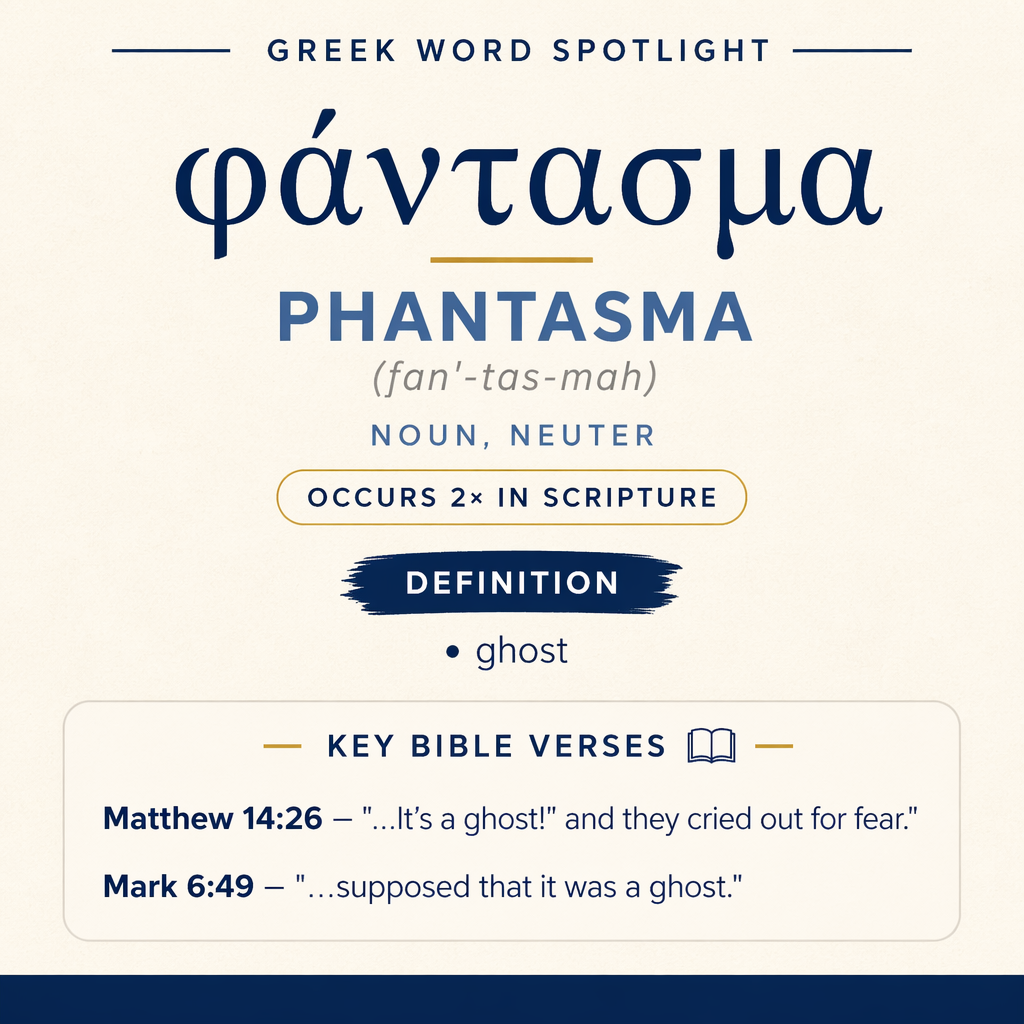
φάντασμα (Phantasma) means “ghost” and appears in Matthew 14:26 and Mark 6:49.
Narrative Setting
In both passages, the disciples see Jesus walking on the sea and cry out in fear, calling him a “ghost.”
Learn More →φάντασμα names a “ghost,” a term used when the disciples react in fear to seeing Jesus walking on the sea. It appears in two parallel Gospel scenes describing their immediate interpretation of what they are seeing.
Root and Related Words
φάντασμα (Phantasma) is related to the verb φαντάζω (phantazō), “to make visible” (Strong’s G5324). The connection highlights the word’s tie to something perceived as an appearance—something that presents itself to sight—within the narrative moments where the term occurs.

Occurrences
“When the disciples saw him walking on the sea, they were troubled, saying, “It’s a ghost!” and they cried out for fear.” (Matthew 14:26)
In this scene the word is placed directly on the disciples’ lips as an exclamation: “It’s a ghost!” The setting is visually striking—“walking on the sea”—and the disciples’ response is described in a chain of reactions: they “saw,” they “were troubled,” they spoke their conclusion, and they “cried out for fear.” φάντασμα functions here as the label that gathers up their confusion and alarm into a single interpretation of the figure before them. The term does not merely identify what they think they see; it explains why their emotional state escalates: the cry is “for fear,” and their trouble is tied to calling the sight a “ghost.” As used in the sentence, φάντασμα expresses the disciples’ attempt to make sense of an extraordinary event by classifying it as something frightening and uncanny within their worldview.
“but they, when they saw him walking on the sea, supposed that it was a ghost, and cried out;” (Mark 6:49)
Mark’s wording frames φάντασμα as the content of an assumption: they “supposed that it was a ghost.” The verb “supposed” presents their use of the term as a conclusion drawn from what they “saw,” rather than as a calm description. The verse then links that supposition to a bodily, audible response: “and cried out.” Even without expanding the scene beyond this line, the structure is clear: perception leads to interpretation, and interpretation triggers distress. φάντασμα is the interpretive category that stands between sight (“saw him walking on the sea”) and panic (“cried out”). In Mark’s phrasing, the word highlights not only fear but also misrecognition: the one walking on the sea is “him,” yet the disciples’ immediate mental category is “ghost.”
Sense and Usage
Across these two occurrences, φάντασμα is consistently used as a fear-laden identification of an unexpected figure seen in an extraordinary setting. In both accounts, the disciples are confronted with a visual phenomenon that does not fit ordinary expectations—someone “walking on the sea.” Their response is not presented as reflective or investigative; it is immediate, vocal, and distressed. The word “ghost” therefore functions as a name for what they think the appearance must be, and it is tightly bound to their emotional turmoil (“troubled,” “cried out for fear,” “cried out”).
The narrative placement of φάντασμα shows how the term operates in spoken and reported thought. In Matthew it is quoted speech (“saying, ‘It’s a ghost!’”), giving the word a sharp, startled force, as though it bursts out of them in the moment. In Mark it is the narrator’s summary of their perception (“supposed that it was a ghost”), which still conveys immediacy but frames the term as their internal conclusion made visible through their cry. Both forms of presentation keep the reader’s attention on the gap between what is happening—Jesus is walking on the sea—and what the disciples initially think is happening.
Because φάντασμα is used precisely at the point of misinterpretation, its sense in these texts is not an abstract discussion of spirits but a concrete, situational label invoked to account for a frightening sight. The disciples do not use the term in a detached way; the term is woven into their fear response. In this way, the word contributes to the drama of recognition: the disciples’ first explanation is “ghost,” and their fear is narrated as a natural outcome of accepting that explanation. The word thus marks the moment when an astonishing event is first filtered through a category that intensifies dread.
The repetition of the same term in both Gospels also shows its stability within this kind of scene: when faced with an inexplicable figure at sea, the disciples’ shared, immediate descriptor is φάντασμα. The word’s usage is therefore closely tied to a nighttime-like atmosphere of uncertainty suggested by the combination of distance, water, and an unexpected moving figure, even though the verses themselves focus chiefly on sight and reaction. The term captures the experience of seeing something real but interpreting it as something fearful and unreal.
Imagery
In both passages, φάντασμα carries the imagery of an alarming appearance set against the sea: the disciples see a figure “walking on the sea,” and the word “ghost” crystallizes their terror into a single cry. The term evokes the moment when the boundary between what is seen and what is understood feels unstable, and the disciples’ fear-filled interpretation becomes the immediate meaning they attach to the sight before them.
Sources: Lexical data from Strong’s Exhaustive Concordance and the Translators Brief Lexicon of Extended Strongs for Greek (STEPBible, CC BY). Occurrence data from the Translators Amalgamated Greek New Testament (STEPBible, CC BY). Scripture quotations from the World English Bible (public domain).