
Exploring the Meaning of Peritemno in Greek
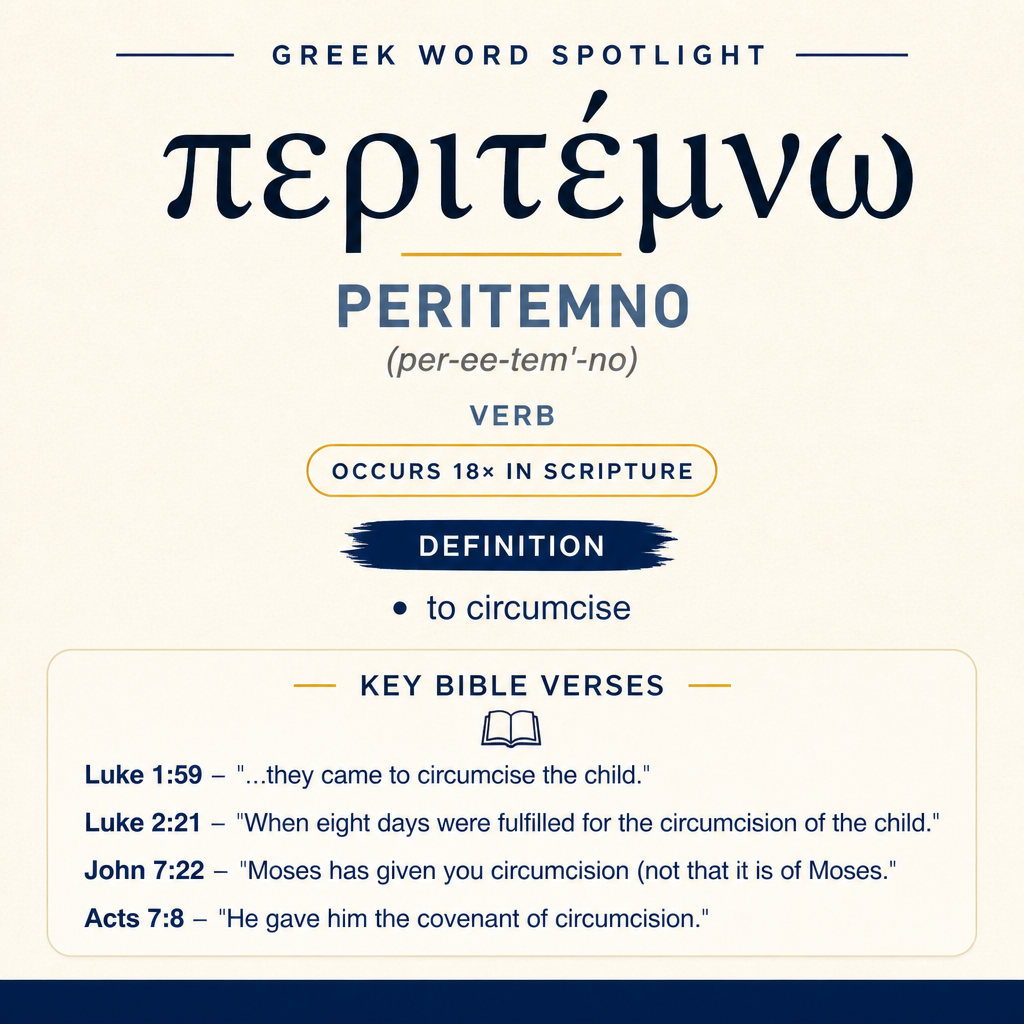
περιτέμνω means “to circumcise” and occurs 18 times in Scripture, including Luke 1:59, Luke 2:21, John 7:22, and multiple places in Acts.
Core Meaning
περιτέμνω means “to circumcise.” It refers to performing circumcision, as in Luke 1:59 and Acts 16:3.
Learn More →Gospel Contexts
In Luke 1:59, it describes circumcising the child on the eighth day. In Luke 2:21, it appears with the circumcision of the child Jesus.
Learn More →Acts Debates
Acts 15:1 and 15:5 use it in disputes about whether believers must be circumcised. Acts 7:8 links it with the covenant of circumcision and Abraham circumcising Isaac.
Learn More →περιτέμνω names the act of circumcising, appearing in narrative scenes of newborn naming, in Jesus’ legal argument about Sabbath practice, in Stephen’s recounting of covenant history, and in the church’s disputes about whether Gentile believers must undergo the rite. Across these settings it functions both as a literal procedure performed on particular persons and as a boundary-marker invoked in debates about identity and salvation.
Occurrences
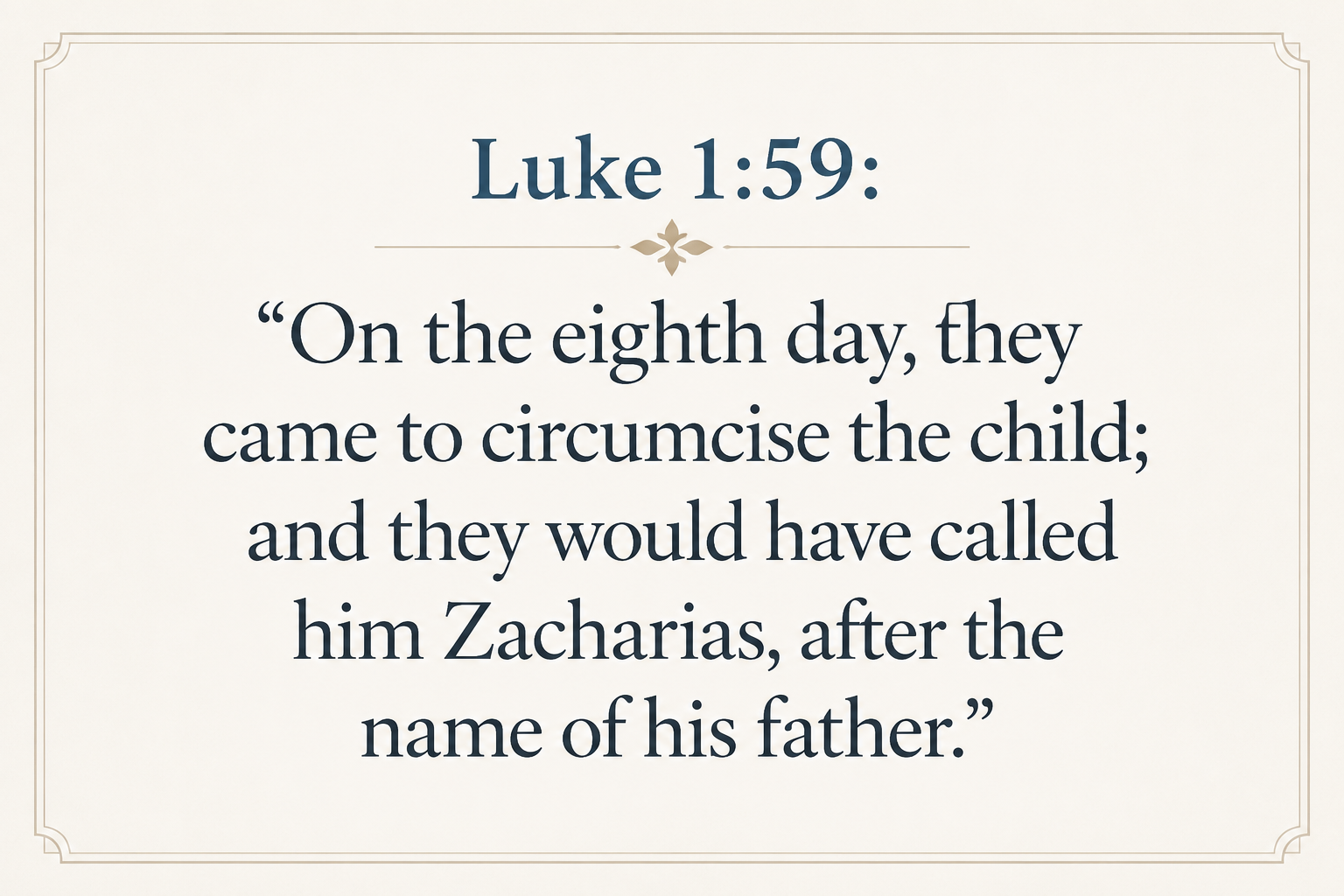
Luke 1:59: “On the eighth day, they came to circumcise the child; and they would have called him Zacharias, after the name of his father.”
Here περιτέμνω situates the family’s action on “the eighth day,” tying the rite to an expected timetable and placing it alongside the child’s naming. The verb frames circumcision as a communal, scheduled event (“they came”) and as part of how the child is formally received and identified within his family setting.
Luke 2:21: “When eight days were fulfilled for the circumcision of the child, his name was called Jesus, which was given by the angel before he was conceived in the womb.”
In this scene the act of circumcising is again anchored to the completion of eight days, but the verse also highlights the naming of Jesus as already determined. The verb marks the fulfillment of a customary requirement (“were fulfilled for the circumcision”), while the naming clause makes clear that this rite coincides with, but does not generate, the child’s name.
John 7:22: “Moses has given you circumcision (not that it is of Moses, but of the fathers), and on the Sabbath you circumcise a boy.”
περιτέμνω is used for a concrete action performed “on the Sabbath,” and the sentence turns that practice into a premise for reasoning. The act is treated as something routinely carried out even when Sabbath observance might seem to restrict work, and it is also linked to inherited tradition (“of the fathers”), giving the verb a place in an argument about what people already accept and do.
Acts 7:8: “He gave him the covenant of circumcision. So Abraham became the father of Isaac, and circumcised him the eighth day. Isaac became the father of Jacob, and Jacob became the father of the twelve patriarchs.”
In Stephen’s speech the verb is embedded in a chain of patriarchal generations. Circumcising Isaac “the eighth day” is portrayed as Abraham’s concrete response within “the covenant of circumcision,” and the verb functions as a historical hinge connecting covenant language with a particular performed act that belongs to the family line leading to “the twelve patriarchs.”
Acts 15:1: “Some men came down from Judea and taught the brothers, “Unless you are circumcised after the custom of Moses, you can’t be saved.””
Here περιτέμνω appears in direct speech as a demanded condition, presented negatively (“Unless…”) and tied to “the custom of Moses.” The verb is not describing someone carrying out the procedure in the moment; instead it is used as a criterion for who can be “saved,” placing the act at the center of a sharp boundary claim.
Acts 15:5: “But some of the sect of the Pharisees who believed rose up, saying, “It is necessary to circumcise them, and to command them to keep the law of Moses.””
The verb is paired with another demand (“to command them to keep the law of Moses”), making circumcising the opening step in a program of obligation. The wording “It is necessary” casts the act as required for “them” (the debated group), and the verb therefore serves as a test case for how far Mosaic requirements are to be applied.
Acts 15:24: “Because we have heard that some who went out from us have troubled you with words, unsettling your souls, saying, ‘You must be circumcised and keep the law,’ to whom we gave no commandment;”
περιτέμνω is quoted as part of a disturbing message attributed to unauthorized teachers. The verb stands as one of two imposed requirements (“be circumcised and keep the law”), and its effect in the verse is pastoral and communal: the claim has “troubled” and “unsettling” consequences, and the letter distances the community’s leadership from that mandate.
Acts 16:3: “Paul wanted to have him go out with him, and he took and circumcised him because of the Jews who were in those parts; for they all knew that his father was a Greek.”
In this narrative the verb returns to a literal, performed action carried out by Paul (“he took and circumcised him”). The stated reason is social and missional within the local context: “because of the Jews who were in those parts,” with the additional detail that Timothy’s paternal background was commonly known. The verb thus operates as a practical step taken for relational and public reasons, not as a stated condition of salvation in the verse.
Acts 21:21: “They have been informed about you, that you teach all the Jews who are among the Gentiles to forsake Moses, telling them not to circumcise their children and not to walk after the customs.”
περιτέμνω appears in a report of what others believe Paul teaches, and it is specifically aimed at “their children.” The verb is coupled with another negative claim (“not to walk after the customs”), so the act of circumcising functions as one visible expression of loyalty to Moses and ancestral practice. The verse shows how the verb can become a shorthand accusation about abandoning inherited ways.
1 Corinthians 7:18: “Was anyone called having been circumcised? Let him not become uncircumcised. Has anyone been called in uncircumcision? Let him not be circumcised.”
Here the verb is used in exhortation aimed at preserving one’s condition at the time of calling. Circumcising is treated as an action one might be tempted to pursue (“Let him not be circumcised”) and is placed parallel to the opposite movement of trying to reverse one’s prior state. The verse uses the verb to address social and religious pressure without narrating an actual ceremony.
Galatians 2:3: “But not even Titus, who was with me, being a Greek, was compelled to be circumcised.”
περιτέμνω is used passively (“to be circumcised”) and placed under the theme of compulsion. Titus’s identity (“being a Greek”) heightens the force of the statement: the act is precisely the kind of requirement some might press upon him, yet in this episode it is denied the status of an enforced demand.
Galatians 5:2: “Behold, I, Paul, tell you that if you receive circumcision, Christ will profit you nothing.”
The verb (expressed here through the idea of receiving the rite) is framed as a decisive choice with theological consequences. The conditional “if you receive circumcision” makes the act the pivot of Paul’s warning, and the stark result clause (“Christ will profit you nothing”) shows how the action can be treated as more than a physical procedure—namely as an adopted stance with implications for one’s relation to Christ as Paul presents it.

Sense and Usage
Across these passages, περιτέμνω operates in three main ways. First, it describes a scheduled, embodied rite performed on infants, closely linked with the eighth day and with public naming (Luke 1:59; Luke 2:21; Acts 7:8). In these scenes the act is not discussed abstractly; it is something families or patriarchs do at a particular time, in a recognizable social setting.
Second, the verb is used as a point of legal and customary reasoning. In John 7:22 circumcising on the Sabbath serves as a widely accepted practice that undergirds an argument about consistency in applying religious obligations. Likewise in Acts 21:21 the presence or absence of circumcising children functions as a visible indicator of whether one is “walk[ing] after the customs,” making the act a public sign of adherence within the community’s contested perceptions.
Third, the verb becomes a contested requirement in early Christian debates about Gentile believers and the conditions of belonging. Acts 15 presents circumcising as a demanded necessity (“Unless you are circumcised… you can’t be saved”; “It is necessary to circumcise them”), and the same demand is later described as an unauthorized burden that “troubled” and “unsettling” effects (Acts 15:24). In Paul’s letters, the act is discussed in terms of pressure, compulsion, and choice: believers are instructed not to seek a change of status through the rite (1 Corinthians 7:18), Titus is specifically noted as not being forced into it (Galatians 2:3), and receiving it is treated as a step carrying serious consequences for one’s stance toward Christ (Galatians 5:2). Acts 16:3 shows that even within this contested environment, circumcising can be undertaken for contextual reasons tied to local Jewish knowledge and expectations, illustrating how the same action could be framed differently depending on the pastoral and communal situation described.
Imagery in Context
The verb’s imagery is concrete: an eighth-day rite performed on a child, a community gathering for naming, and a bodily action that can be done even “on the Sabbath.” At the same time, these texts show how a physical act can carry communal weight—becoming a marker invoked in arguments, accusations, and warnings, and even a flashpoint capable of “troubl[ing]” and “unsettling” a church when treated as a necessary requirement.
Sources: Lexical data from Strong’s Exhaustive Concordance and the Translators Brief Lexicon of Extended Strongs for Greek (STEPBible, CC BY). Occurrence data from the Translators Amalgamated Greek New Testament (STEPBible, CC BY). Scripture quotations from the World English Bible (public domain).




