
Exploring the Meaning of Pentekoste in Greek
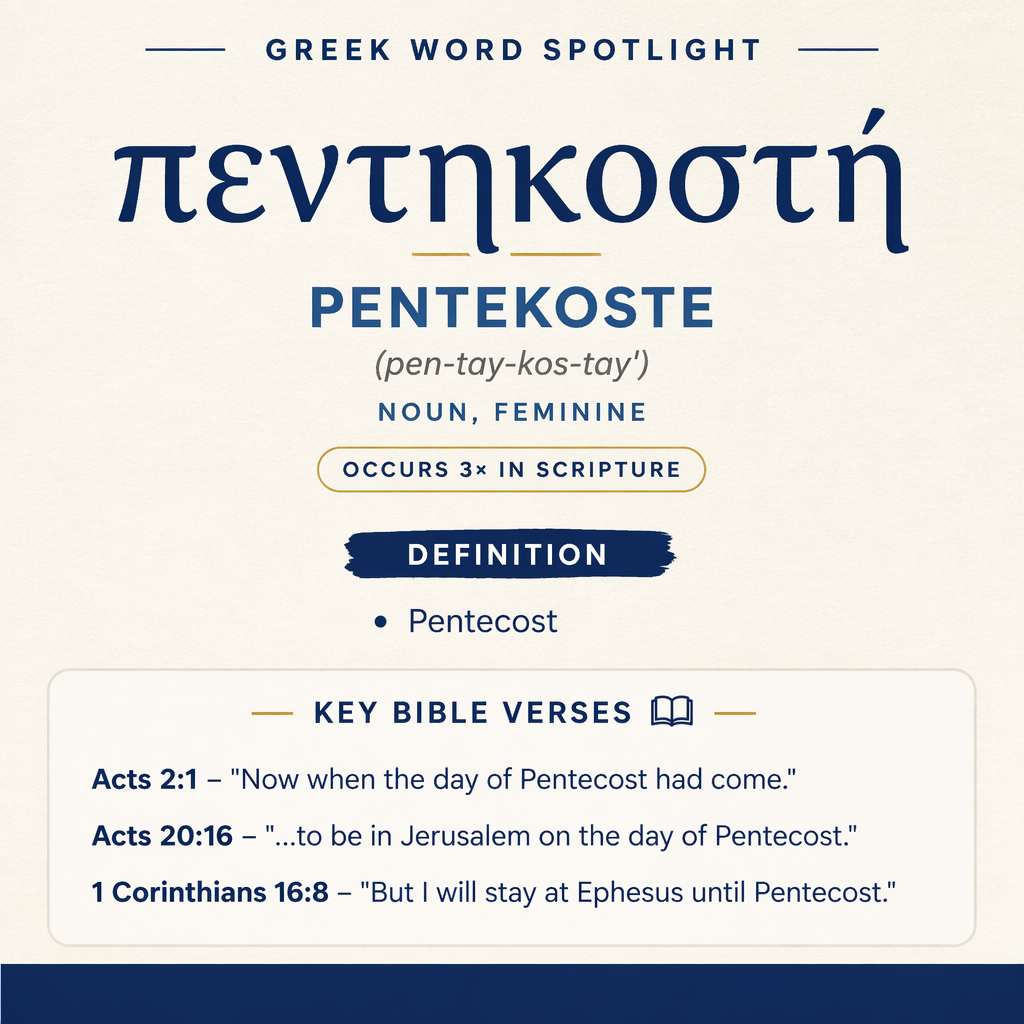
πεντηκοστή (Pentekoste) means “Pentecost” and appears three times: Acts 2:1, Acts 20:16, and 1 Corinthians 16:8.
Acts References
It appears in Acts 2:1 and Acts 20:16. Acts 2:1 notes the day of Pentecost had come.
Learn More →Paul’s Timing
It appears in 1 Corinthians 16:8, where Paul plans to stay at Ephesus until Pentecost.
Learn More →Pentēkostē denotes “Pentecost,” a calendrical marker that locates events and travel plans in Acts and Paul’s correspondence. In its three New Testament occurrences, it functions as a named day that anchors communal gathering, personal urgency, and a ministry timetable.
Root and Related Words
Pentēkostē is derived from pentēkonta (πεντήκοντα), meaning “fifty” (Strong’s G4004), indicating a designation built on a numbered day.
Occurrences
Acts 2:1: “Now when the day of Pentecost had come, they were all with one accord in one place.”
Here Pentecost is framed explicitly as “the day of Pentecost,” and the sentence places emphasis on arrival: the day “had come.” The word therefore carries the weight of a fixed point on the calendar toward which time has been moving. Within the same clause, that calendrical moment is linked to a communal posture: “they were all with one accord in one place.” Pentecost, in this scene, is not merely a date label; it is the day that coincides with a unified assembly, presenting the occasion as a focal point for being gathered together rather than scattered. The wording ties the temporal marker (“the day”) to spatial concentration (“in one place”) and interpersonal unity (“with one accord”), so the day’s name functions as the hinge on which that collective moment turns.
Acts 20:16: “For Paul had determined to sail past Ephesus, that he might not have to spend time in Asia; for he was hastening, if it were possible for him, to be in Jerusalem on the day of Pentecost.”
In this travel explanation, Pentecost again appears as “the day of Pentecost,” but now it is the target date shaping a sequence of decisions. Paul’s resolve “to sail past Ephesus” is presented as a means to a time-sensitive end: “that he might not have to spend time in Asia.” The reason clause then states the pressure point: “for he was hastening…to be in Jerusalem on the day of Pentecost.” Pentecost functions as a deadline that organizes priorities—what to bypass, where not to linger, and where to arrive. The sentence sets Pentecost in direct relation to Jerusalem, making the day not only a calendar marker but a destination-oriented appointment (“to be in Jerusalem on the day…”). The phrase “if it were possible for him” adds a realistic note of contingency; the day is fixed, but human travel may or may not match it. In this way, Pentecost defines urgency and constrains planning.
1 Corinthians 16:8: “But I will stay at Ephesus until Pentecost,”
In this brief statement, Pentecost is used without the expanded phrase “the day of,” yet it still functions as a temporal boundary. The clause is framed as a firm intention: “I will stay at Ephesus until Pentecost.” Pentecost marks the terminus of a planned period of residence, indicating that the speaker measures time toward a known point. Because the line is a simple scheduling statement, the word’s contribution is primarily practical: it supplies a clear endpoint for staying in one location. Even in its brevity, the construction “until Pentecost” shows that Pentecost can serve as a shared reference point between writer and recipients, sufficient on its own to define a timeline.
Sense and Usage
Across these passages, Pentecost consistently operates as a named time marker—an identifiable day that can be “come,” can be aimed at for arrival, and can define the end of an intended stay. The word’s force is therefore calendrical and orienting: it coordinates people and plans around a specific point in time. In Acts 2:1, Pentecost is the day on which a group is already gathered “with one accord,” so the term frames a communal moment as occurring on a recognized day. In Acts 20:16, Pentecost becomes a motivating constraint on movement, pushing decisions about whether to “spend time” in a region and clarifying why a route is chosen. In 1 Corinthians 16:8, Pentecost serves as a simple boundary for ministry presence, turning a festival-day name into a practical deadline for remaining at Ephesus.
Two recurring features stand out. First, Pentecost is treated as sufficiently definite that it does not require explanation within these contexts; the narrative and letters can assume that naming the day communicates an agreed point in time. Second, the word repeatedly links time to place. Acts 2:1 ties the day to being “in one place,” Acts 20:16 ties the day to being “in Jerusalem,” and 1 Corinthians 16:8 ties the day to remaining “at Ephesus” until it arrives. In each case, Pentecost anchors not only when something happens but where people intend to be when it happens.
Within these three uses, Pentecost also carries a subtle directional pull. In Acts 2:1, time arrives and the community is already positioned, unified and gathered. In Acts 20:16, time approaches and a traveler is moving to meet it, making haste toward Jerusalem. In 1 Corinthians 16:8, time is awaited, and the speaker remains in place until that point. Thus Pentecost can frame three different temporal stances—arrival, pursuit, and waiting—while staying within the same core function of naming the day.
Imagery
The passages associate Pentecost with the image of an appointed day that gathers and directs. Acts 2:1 portrays a community brought together in unity as the day arrives: “all with one accord in one place.” Acts 20:16 portrays a journey narrowed by urgency, with Jerusalem as the intended location “on the day of Pentecost.” 1 Corinthians 16:8 portrays steady presence—remaining “at Ephesus”—measured by an approaching boundary. Together these scenes give Pentecost the feel of a fixed point on the horizon, whether one is already assembled, hastening to arrive, or staying put until the day comes.
Sources: Lexical data from Strong’s Exhaustive Concordance and the Translators Brief Lexicon of Extended Strongs for Greek (STEPBible, CC BY). Occurrence data from the Translators Amalgamated Greek New Testament (STEPBible, CC BY). Scripture quotations from the World English Bible (public domain).




