Exploring the Meaning of Pemptos in Greek
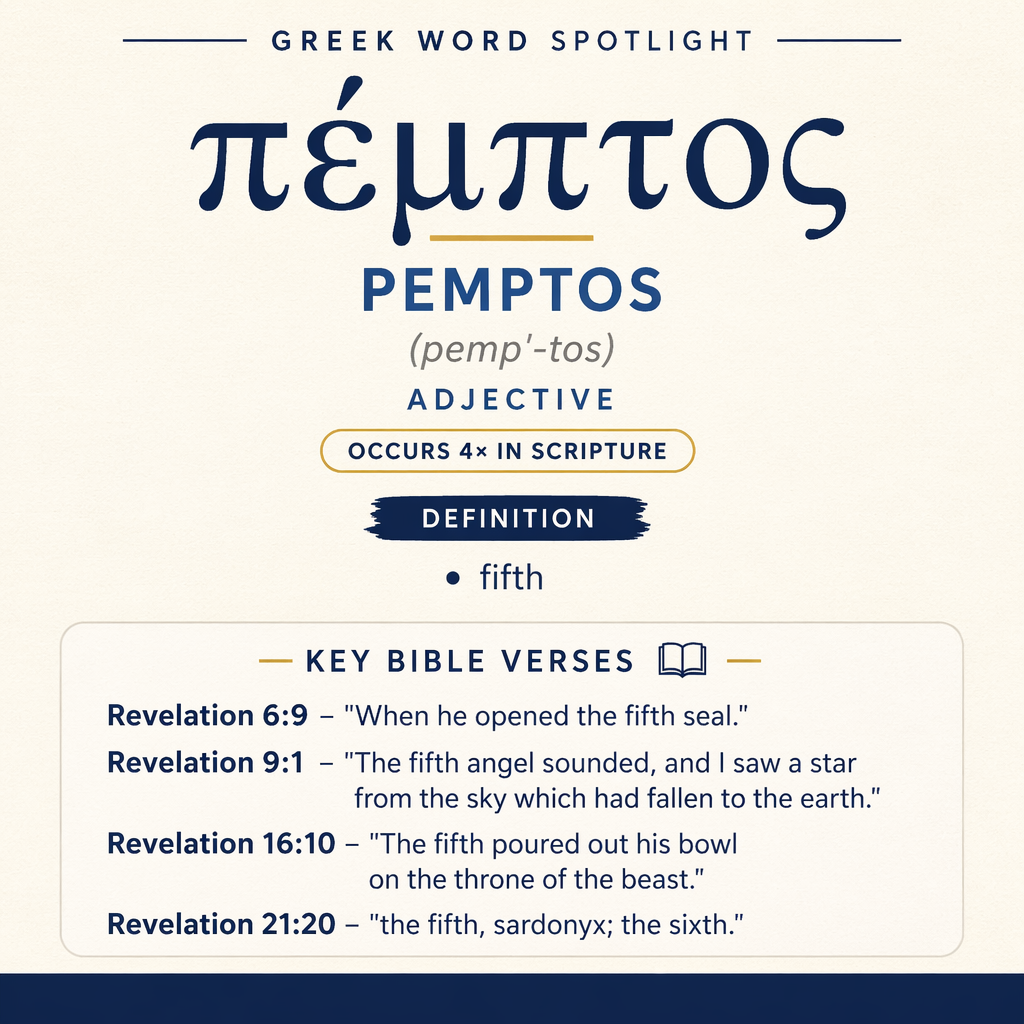
πέμπτος means “fifth” and appears four times in Scripture, all in Revelation (6:9; 9:1; 16:10; 21:20).
Core Meaning
πέμπτος is the Greek word meaning “fifth.” It marks fifth items in a sequence.
Learn More →Revelation Scenes
It describes the fifth seal (Revelation 6:9), the fifth angel (Revelation 9:1), and the fifth bowl poured out (Revelation 16:10).
Learn More →List Position
In Revelation 21:20, πέμπτος identifies the fifth foundation stone: sardonyx.
Learn More →πέμπτος appears as an ordinal adjective meaning “fifth,” marking a specific item in an ordered sequence. In the New Testament it occurs in Revelation, where it pinpoints the fifth seal, the fifth angel, the fifth bowl, and the fifth foundation stone.
Root and Related Words
πέμπτος is related to pente (πέντε), “five” (Strong’s G4002).

Occurrences
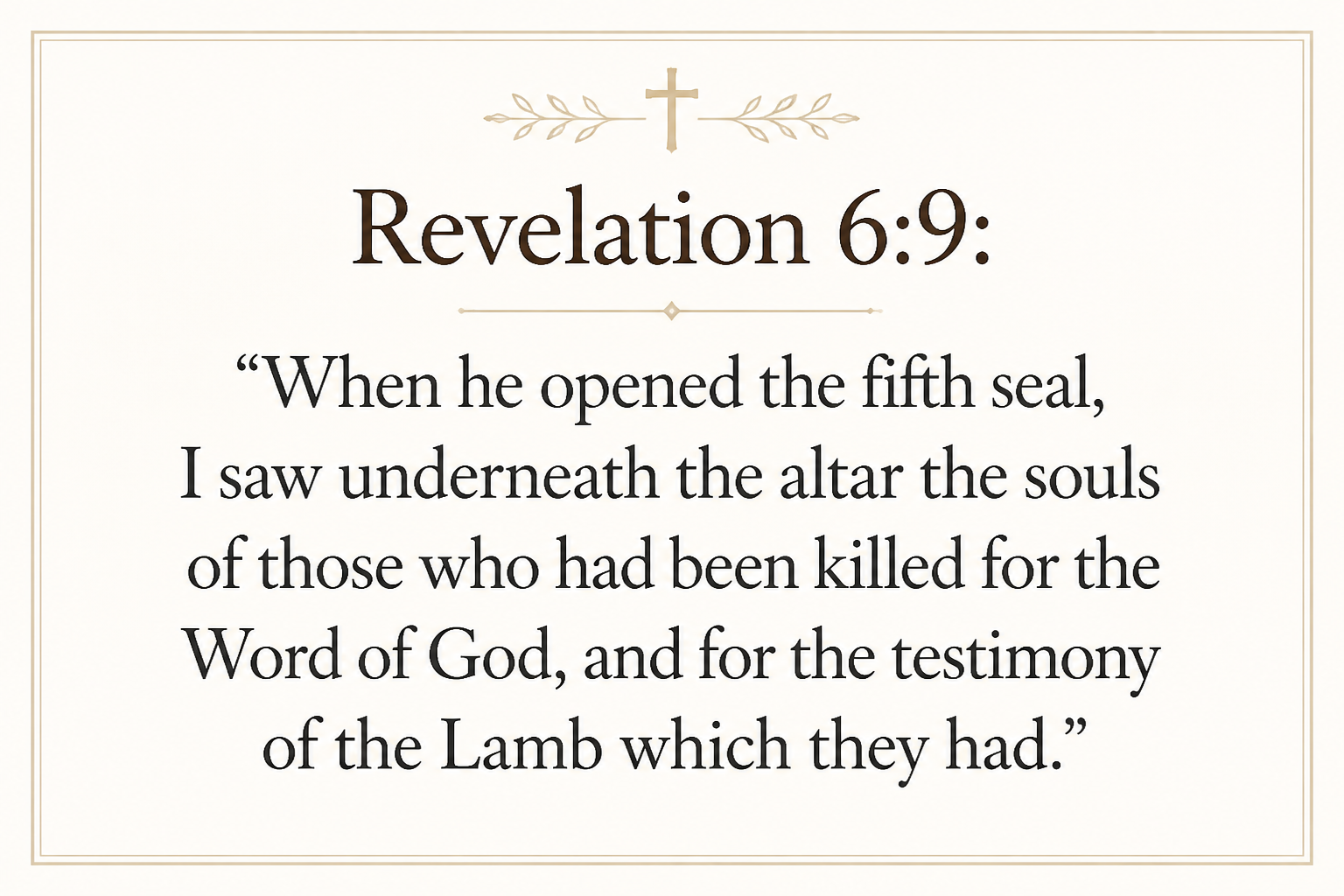
Revelation 6:9: “When he opened the fifth seal, I saw underneath the altar the souls of those who had been killed for the Word of God, and for the testimony of the Lamb which they had.”
Here πέμπτος identifies the seal being opened as the fifth within a series of seals. The ordinal does more than count; it places this vision at a defined stage in the unfolding sequence, so that what John sees (“underneath the altar the souls…”) is tied to that particular opening. The scene is not introduced as a general description of martyrdom but as the content associated with this numbered seal. By using a fixed position in the series, πέμπτος helps the reader track the progression and connect the appearance of “the souls of those who had been killed” with this specific moment in the opening of the seals.
Revelation 9:1: “The fifth angel sounded, and I saw a star from the sky which had fallen to the earth. The key to the pit of the abyss was given to him.”
In this verse πέμπτος qualifies “angel,” identifying which trumpet-blast is in view. The ordinal sets the action (“sounded”) within a structured order of angelic trumpet-soundings, and it frames what follows as the consequence or accompanying vision of that particular sounding: John sees “a star from the sky which had fallen to the earth,” and then the narrative turns to authority being granted (“The key to the pit of the abyss was given to him”). πέμπτος thus anchors this complex imagery to a definite place in the series, guiding the reader to hear this trumpet as one distinct step among others rather than a free-floating scene.
Revelation 16:10: “The fifth poured out his bowl on the throne of the beast, and his kingdom was darkened. They gnawed their tongues because of the pain,”
πέμπτος appears substantivally with the implied subject from context: “The fifth” functions as a shorthand for the fifth in the line of those who pour out bowls. The ordinal identifies which bowl-figure acts here and which bowl is being poured out, even though the noun “angel” is not restated in the quotation. The action is directed “on the throne of the beast,” and the effects are described in two connected results: “his kingdom was darkened” and the sufferers’ reaction (“They gnawed their tongues because of the pain”). By specifying “the fifth,” πέμπτος distinguishes this outpouring and its particular target and outcome from the other bowl actions in the sequence.
Revelation 21:20: “the fifth, sardonyx; the sixth, sardius; the seventh, chrysolite; the eighth, beryl; the ninth, topaz; the tenth, chrysoprase; the eleventh, jacinth; and the twelfth, amethyst.”
In the list of foundation stones, πέμπτος introduces the fifth item and pairs it with the stone assigned to that position: “the fifth, sardonyx.” The ordinal is part of a carefully ordered catalog (“the sixth… the seventh…”) that gives the reader a sense of arranged completeness and deliberate design. πέμπτος ensures that “sardonyx” is not merely one stone among many but the stone occupying the fifth slot in the sequence. The word therefore serves clarity and structure in a descriptive passage, allowing the list to be read as a patterned series rather than an unordered collection.
Sense and Usage
Across these four occurrences, πέμπτος consistently functions as an ordinal marker that assigns a person, act, or object to a particular position within an ordered set. In Revelation 6:9 it modifies a concrete element of the visionary framework (“seal”), placing the sight “underneath the altar” at a specific stage of the seal-openings. In Revelation 9:1 it modifies an agent (“angel”) whose sounding introduces a distinct development, with subsequent details (a fallen star and the giving of a key) narrated under that numbered heading. In Revelation 16:10 it is used as a standalone ordinal (“The fifth”), showing how the sequence is so established that the position itself can identify the acting figure and the bowl-event without repeating the full description. In Revelation 21:20 it operates in a list format, where the fifth position becomes a way to map a named item (“sardonyx”) onto a defined slot in a larger ordered arrangement.
In each setting, the force of πέμπτος is organizational and referential: it does not describe the nature of the seal, the angel, the bowl, or the stone, but it specifies which one is being referenced. That precision matters in apocalyptic writing, where multiple similar elements recur; numbering prevents confusion and supports cumulative reading. The word also contributes to pacing. By repeatedly locating events and objects at the fifth point in different series (seals, angels, bowls, stones), πέμπτος helps Revelation present its visions as structured sequences in which each step has its own content, target, and effect.
Imagery and Structure
The passages where πέμπτος occurs are rich in scene-setting—an opened seal revealing “the souls… underneath the altar” (Revelation 6:9), a trumpet sounding alongside a fallen star and a key to “the pit of the abyss” (Revelation 9:1), a bowl poured onto “the throne of the beast” resulting in darkness and agony (Revelation 16:10), and an ordered display of precious stones culminating in a complete sequence (Revelation 21:20). In each case, πέμπτος quietly undergirds the imagery by giving it a numbered place, turning vivid snapshots into parts of a coherent series that can be followed, compared, and remembered.
Sources: Lexical data from Strong’s Exhaustive Concordance and the Translators Brief Lexicon of Extended Strongs for Greek (STEPBible, CC BY). Occurrence data from the Translators Amalgamated Greek New Testament (STEPBible, CC BY). Scripture quotations from the World English Bible (public domain).