
Exploring the Meaning of Pegnumi in Greek
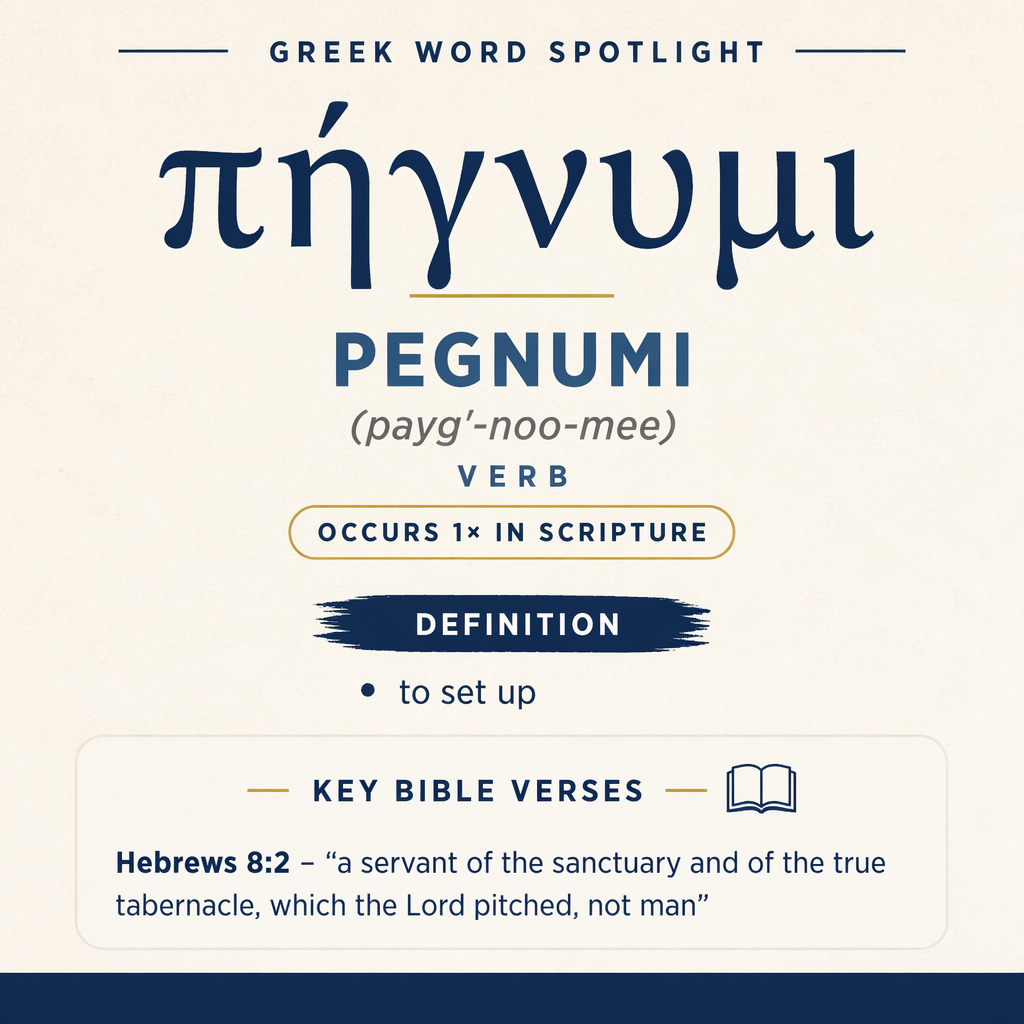
πήγνυμι means “to set up” and appears once in Scripture, in Hebrews 8:2.
Scripture Occurrence
It occurs 1 time in Scripture. Its single occurrence is in Hebrews 8:2.
Learn More →Hebrews 8:2 Use
In Hebrews 8:2, it describes the true tabernacle which the Lord pitched, not man.
Learn More →πήγνυμι expresses the act of setting something up. It appears in Hebrews 8:2 in the description of the “true tabernacle,” emphasizing who established it.
Occurrences
“a servant of the sanctuary and of the true tabernacle, which the Lord pitched, not man.” (Hebrews 8:2)
Here πήγνυμι stands behind the statement “which the Lord pitched,” locating the action of setting up the “true tabernacle” in the Lord’s initiative rather than in human agency: “not man.” The line is compact, but it is carefully balanced: the tabernacle is called “true,” and the contrast immediately clarifies what is meant by that claim in this sentence—its establishment is attributed to the Lord’s act of pitching it. The verb therefore carries the weight of origin and authorization: the sanctuary service described is connected to a tabernacle whose setup is presented as divine work, not a human construction project.

The immediate frame also matters. The verse speaks of “a servant of the sanctuary,” then adds “and of the true tabernacle.” The word “pitched” links the “true tabernacle” with the idea of an erected dwelling or tent-like structure (the sentence itself uses “tabernacle”), so πήγνυμι contributes a concrete, spatial action: the tabernacle is not merely spoken of as existing, but as having been set up. In this context, “pitched” makes the tabernacle sound like something established by decisive action—an act that results in a standing, functional place associated with “the sanctuary.”
The negation “not man” is not a side comment; it is the closing emphasis of the clause. Because πήγνυμι denotes setting up, the verse uses it to draw a firm line between two possible agents of such a setup. The verb therefore participates in the verse’s theological contrast by its very concreteness: a tabernacle can be pitched by someone, and Hebrews 8:2 names the Lord as the one who performed that act.

Sense and Usage
The sense “to set up” appears in Hebrews 8:2 in a form suited to the idiom of pitching a tabernacle. “To set up” is not presented as a vague planning or appointing, but as the establishment of a tabernacle as a set-up structure—something put in place so that it stands as the operative setting for sanctuary service. The verse’s wording makes the action foundational: before one can speak of service “of the sanctuary” and “of the true tabernacle,” that tabernacle must be set up, and the verb supplies exactly that anchoring action.
Because Hebrews 8:2 specifies the agent (“the Lord”) and denies the alternative (“not man”), the verb’s force is shaped by agency. The action of setting up becomes a marker of ownership and origin. The tabernacle is characterized by who pitched it. Thus, in this usage, “to set up” functions as more than a physical act described for color; it is a way of grounding the tabernacle’s identity as “true” within the sentence’s logic. The verb creates a direct connection between the tabernacle and the Lord as its establisher.
The setting-up idea also carries a subtle implication in the flow of the verse: a tabernacle that has been pitched stands as a ready place for service. The clause does not describe ongoing construction; it presents a completed establishment—something that has been pitched so that it is there as the arena of sanctuary ministry. The verb therefore supports the portrayal of a stable, prepared setting associated with “the sanctuary,” and it does so in a way that keeps the focus on divine action rather than human craftsmanship.
In terms of imagery, “pitched” evokes the straightforward act of erecting a tent. Hebrews 8:2 uses that imagery to speak of the “true tabernacle,” and πήγνυμι supplies the simple, concrete motion of raising and setting a dwelling into position. That concreteness helps the verse communicate that the tabernacle is not a mere concept but something established—set up by the Lord himself.
Imagery
Hebrews 8:2 places a tabernacle in view and chooses the language of pitching it. The verb frames the “true tabernacle” as something set up with purpose and authority, and the closing contrast—“not man”—presses the imagery toward its central point: the tabernacle’s standing presence is traced to the Lord’s own act of establishing it.
Sources: Lexical data from Strong’s Exhaustive Concordance and the Translators Brief Lexicon of Extended Strongs for Greek (STEPBible, CC BY). Occurrence data from the Translators Amalgamated Greek New Testament (STEPBible, CC BY). Scripture quotations from the World English Bible (public domain).




