Exploring the Meaning of Patris in Greek
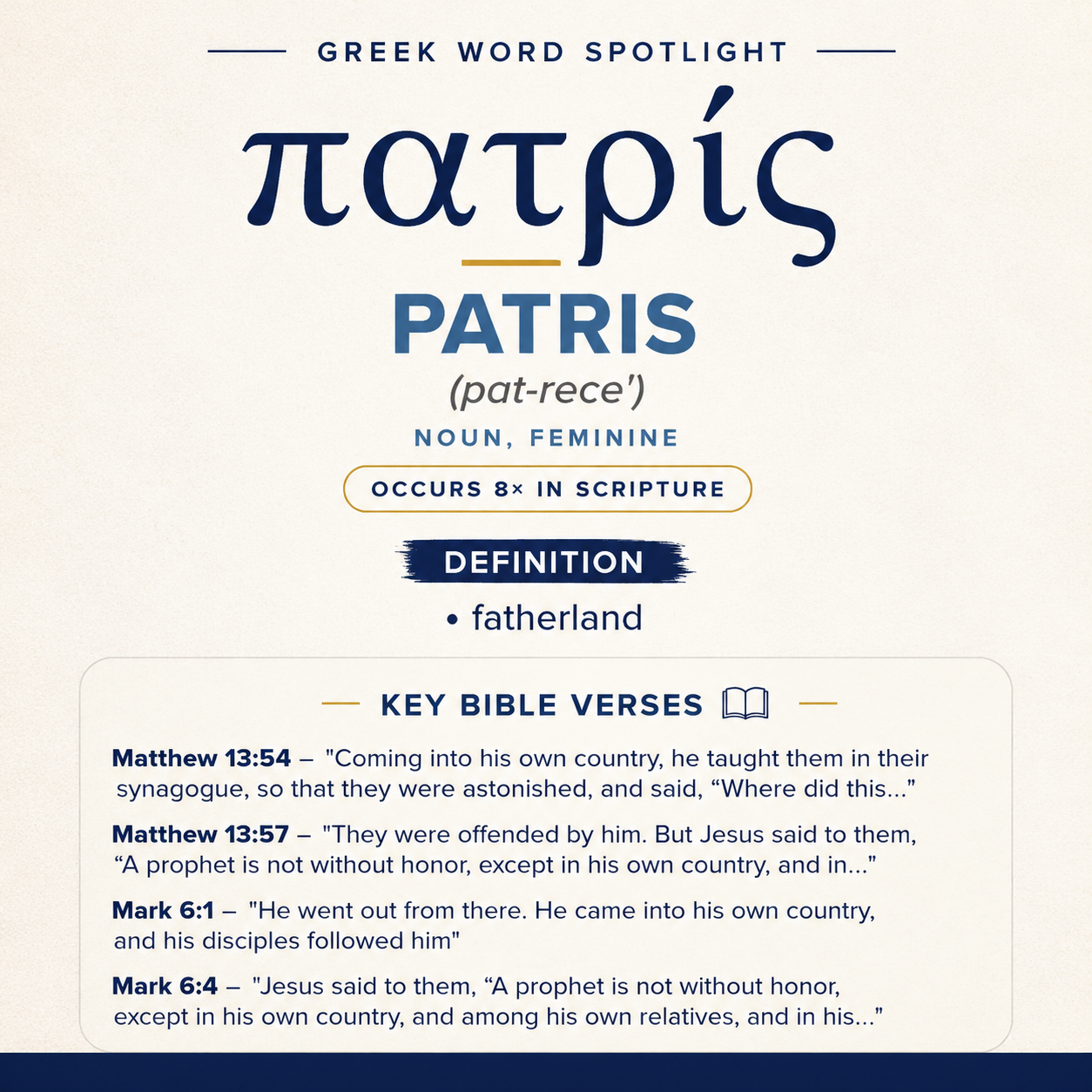
πατρίς means “fatherland” and occurs 8 times in Scripture, including Matthew 13, Mark 6, Luke 4, John 4, and Hebrews 11.
Gospel Context
In Matthew 13, Mark 6, Luke 4, and John 4, it appears in statements about one’s “own country” or “hometown.”
Learn More →πατρίς refers to one’s “fatherland,” the place recognized as one’s own country or hometown. In the New Testament it appears in narratives about Jesus’ reception among those who know him best, and in Hebrews as part of a confession about seeking a country of one’s own.
Occurrences
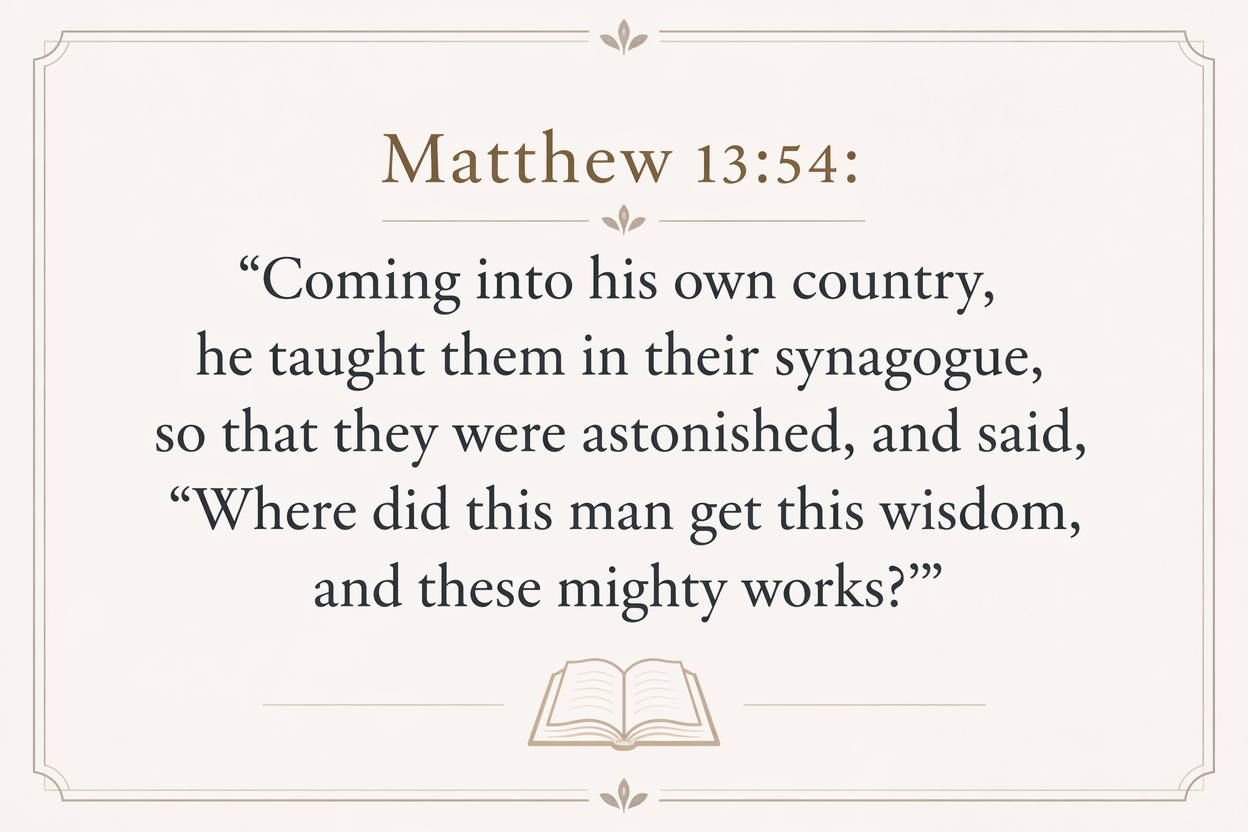
Matthew 13:54: “Coming into his own country, he taught them in their synagogue, so that they were astonished, and said, “Where did this man get this wisdom, and these mighty works?”
Here πατρίς sets the scene as Jesus’ “own country,” the social space where people have prior familiarity with him. The astonishment described in the verse is sharpened by that setting: the question, “Where did this man get this wisdom, and these mighty works?” comes from those who regard him as belonging to their locality. The word frames the teaching not as a distant public appearance but as instruction delivered on home ground, within the ordinary communal setting of “their synagogue.”
Matthew 13:57: “They were offended by him. But Jesus said to them, “A prophet is not without honor, except in his own country, and in his own house.”
In this saying, πατρίς names the “own country” where honor is withheld. The verse pairs “his own country” with “his own house,” placing the fatherland alongside the nearest circle of familiarity. The force of the proverb depends on the contrast between a prophet’s recognition elsewhere and the resistance he meets where he is most socially known; πατρίς marks the wider home environment that can breed contempt rather than honor.
Mark 6:1: “He went out from there. He came into his own country, and his disciples followed him.”
Mark uses πατρίς to describe the destination of Jesus’ movement: he “came into his own country.” The mention that “his disciples followed him” draws attention to the public character of this return; the fatherland is not merely private origin but a place entered with witnesses. The word contributes a geographic and relational tension: Jesus is re-entering the community that can claim him as one of their own.
Mark 6:4: “Jesus said to them, “A prophet is not without honor, except in his own country, and among his own relatives, and in his own house.”
Mark expands the same proverb with a threefold circle: “his own country,” “his own relatives,” and “his own house.” πατρίς names the broadest of these rings, the fatherland as the local public sphere in which a person’s reputation is formed and contested. By placing it alongside kin and household, the verse presents the fatherland as part of a layered network of belonging that can become the setting of rejection.
Luke 4:23: “He said to them, “Doubtless you will tell me this parable, ‘Physician, heal yourself! Whatever we have heard done at Capernaum, do also here in your hometown.’ ”
Luke uses πατρίς in the form “your hometown,” putting the word into a demand for local demonstration: “do also here.” The fatherland is the place that expects privileged access—what has been “heard done at Capernaum” should, in their view, be reproduced at home. In this setting, πατρίς carries the pressure of hometown entitlement: those in the fatherland imagine that proximity should secure benefits.
Luke 4:24: “He said, “Most certainly I tell you, no prophet is acceptable in his hometown.”
This statement makes πατρίς the location of non-acceptance: “no prophet is acceptable” there. The fatherland is not simply where one comes from; it is a testing ground for reception. Luke’s wording tightens the point from honor to acceptability—within the hometown, the prophet meets a particular barrier grounded in familiarity and local expectations.
John 4:44: “For Jesus himself testified that a prophet has no honor in his own country.”
John presents the idea as Jesus’ own “testified” judgment, again using πατρίς for “his own country.” The word highlights a paradox: the place that should naturally confer honor on one of its own is precisely where honor is lacking. In John’s phrasing, πατρίς marks a homeland defined not by affection but by the refusal of recognition.
Hebrews 11:14: “For those who say such things make it clear that they are seeking a country of their own.”
In Hebrews, πατρίς appears without reference to Jesus’ hometown and instead describes an object of desire: “seeking a country of their own.” The fatherland here is not merely inherited or remembered; it is something searched for and claimed as “their own.” The verse uses the word to express a settled orientation of the speakers—what they “say” makes their quest for a true country plain.

Sense and Usage
Across the Gospel passages, πατρίς functions as the homeland in which personal history and communal memory exert pressure on present claims. The repeated phrasing “his own country” (Matthew 13:54, 13:57; Mark 6:1, 6:4; John 4:44) makes the fatherland a defined sphere of belonging: it is “own,” and therefore populated by people who feel entitled to an explanation of what they see. That sense of possession cuts both ways. In Matthew 13:54 the “own country” becomes the setting for astonishment and scrutiny—wisdom and “mighty works” are evaluated against what locals think they know. In Matthew 13:57 and John 4:44 the homeland becomes the arena where honor is withheld, a reversal of what might be expected from one’s native place.
Mark’s pairing of πατρίς with relatives and house (Mark 6:4) further shows how the fatherland can overlap with the most intimate circles without collapsing into them. The word does not mean “house”; it can stand alongside “house” as a wider social field, a public space of reputation. This is why the proverb about a prophet’s honor can move from the broad (“country”) to the particular (“relatives,” “house”) without redundancy: each term identifies a different layer of belonging in which familiarity becomes a barrier.
Luke’s “hometown” emphasis (Luke 4:23–24) highlights another feature of the fatherland: it is the place where expectation demands proof. “Do also here in your hometown” (Luke 4:23) implies that the homeland claims priority over other places; what is done elsewhere ought to be done at home. Yet Luke 4:24 answers that expectation with a general principle—“no prophet is acceptable in his hometown”—so the fatherland becomes a place where the prophetic role meets resistance precisely because it is close to home.
Hebrews 11:14 uses πατρίς in a different key, not as the inherited homeland that refuses honor but as the homeland sought. The phrase “seeking a country of their own” presents fatherland as an object of longing and pursuit. Within this verse, πατρίς does not describe a settled civic identity so much as a clear direction of life: the speakers’ words reveal that their true belonging is oriented toward a country that matches them, a fatherland that can rightly be called “their own.”
Taken together, these uses show that πατρίς can name both a given place of origin (“his own country,” “your hometown”) and a desired place of belonging (“seeking a country of their own”). In the Gospels, the fatherland is socially charged: it is where honor, acceptance, and expectations are negotiated in the presence of those who claim to know the person. In Hebrews, the fatherland language is turned toward aspiration: the word supplies the vocabulary of belonging for those whose speech discloses an ongoing search for a proper country.
Imagery
The passages create a consistent picture of the fatherland as a locality with a strong memory and a strong claim. It is the setting of a synagogue gathering where astonishment turns into questioning (Matthew 13:54), the place where offense can eclipse honor (Matthew 13:57; John 4:44), and the hometown that demands familiar benefits (“do also here,” Luke 4:23) while withholding acceptance (Luke 4:24). Alongside this, Hebrews evokes the image of people whose words point beyond any immediate homeland toward a fatherland they still seek (Hebrews 11:14).
Sources: Lexical data from Strong’s Exhaustive Concordance and the Translators Brief Lexicon of Extended Strongs for Greek (STEPBible, CC BY). Occurrence data from the Translators Amalgamated Greek New Testament (STEPBible, CC BY). Scripture quotations from the World English Bible (public domain).