
Exploring the Meaning of Pathos in Greek
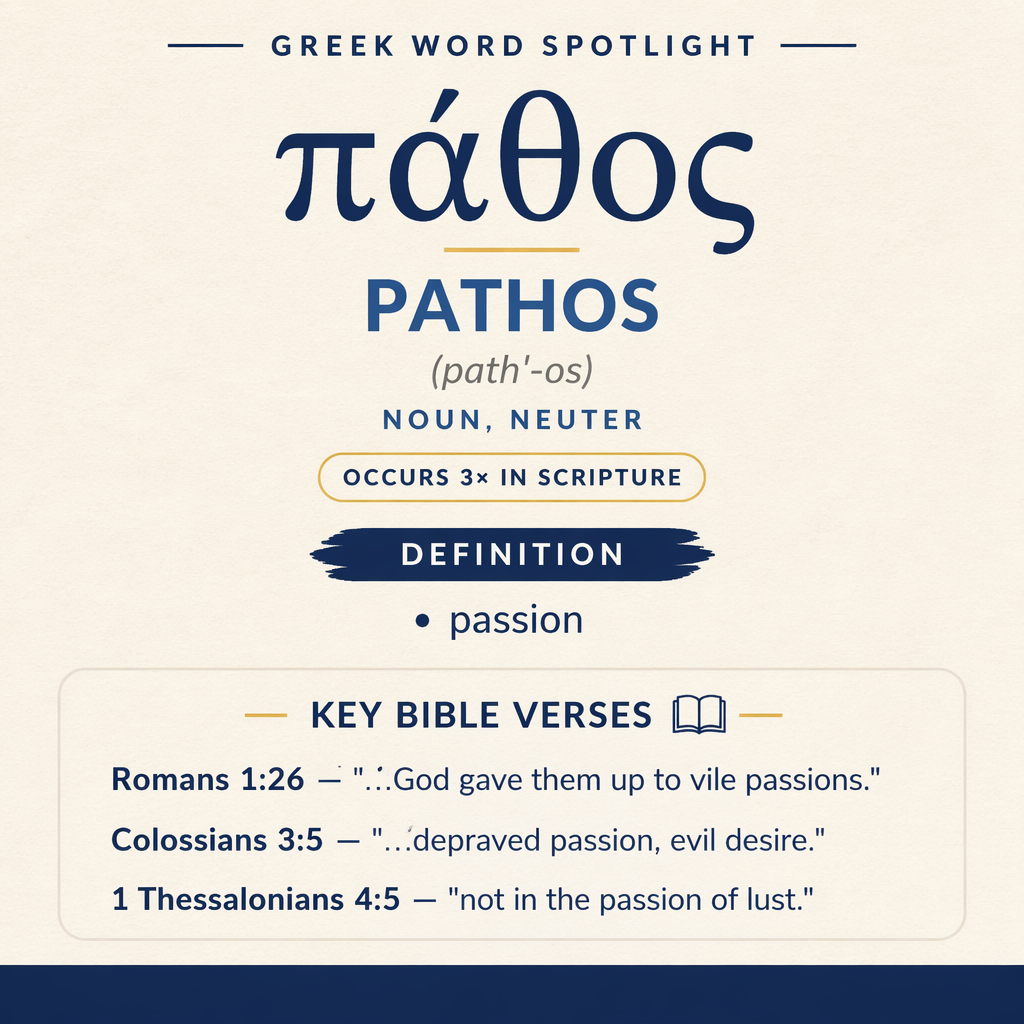
πάθος means “passion” and appears three times in Scripture: Romans 1:26, Colossians 3:5, and 1 Thessalonians 4:5.
Where It Appears
It occurs 3 times in Scripture: Romans 1:26; Colossians 3:5; 1 Thessalonians 4:5.
Learn More →How It’s Used
In these verses, it is used in phrases such as “vile passions,” “depraved passion,” and “the passion of lust.”
Learn More →πάθος denotes “passion” and appears in three Pauline contexts where it is treated as a powerful inward drive that shapes bodily conduct and moral direction. In each passage it stands in proximity to sexual behavior and desire, and it is either condemned or presented as a pattern to be rejected.
Root and Related Words
πάθος is connected with the verb paschō (πάσχω), “to suffer” (Strong’s G3958). This relationship places the noun in a family of words that can describe what a person undergoes or experiences with force, and it helps explain why the term can be depicted as something that seizes and carries a person rather than a calm preference.

Occurrences
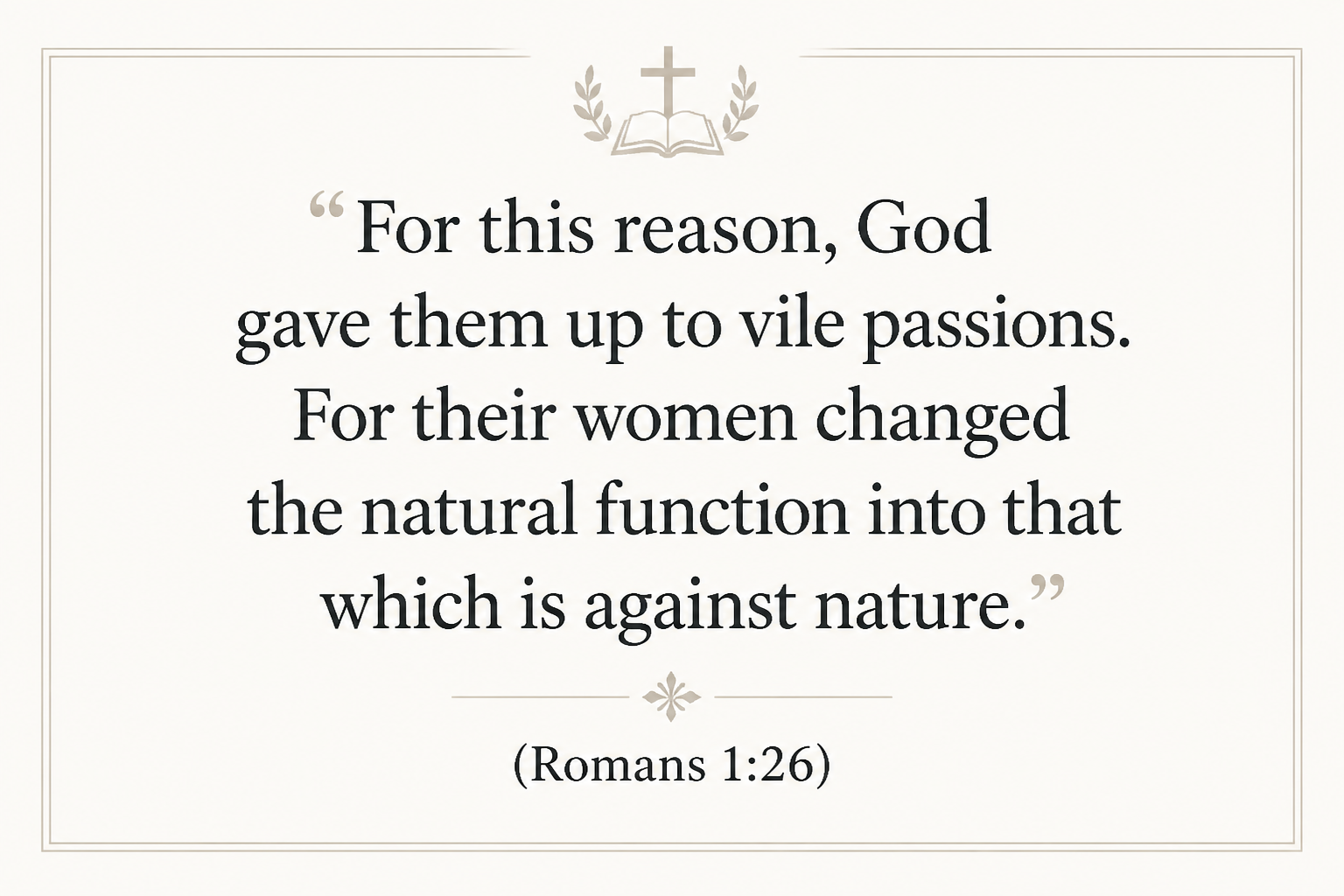
“For this reason, God gave them up to vile passions. For their women changed the natural function into that which is against nature.” (Romans 1:26)
Here πάθος appears as the object of divine handing over: “God gave them up to vile passions.” The wording frames passion not as a neutral feeling but as a dominating condition into which people are released. The verse immediately illustrates the outworking of that condition in embodied terms—“their women changed the natural function into that which is against nature.” In this scene, passion is portrayed as driving a “changed” practice, pushing behavior away from what the text calls “natural function.” The adjective “vile” intensifies the moral evaluation: the passions are not merely strong but are treated as degraded, fitting the logic of “for this reason” and the consequential “gave them up.”
“Put to death therefore your members which are on the earth: sexual immorality, uncleanness, depraved passion, evil desire, and covetousness, which is idolatry.” (Colossians 3:5)
In Colossians, πάθος is listed among concrete vices under a striking command: “Put to death therefore your members which are on the earth.” The phrase “your members” anchors the exhortation in bodily life and the practical outworking of inner impulses. Within the list—“sexual immorality, uncleanness, depraved passion, evil desire, and covetousness”—πάθος occupies a middle position, closely aligned with sexual immorality and with “evil desire.” The modifier “depraved” marks the passion as distorted, and the overall structure presents these items as targets of decisive action, not habits to be managed. The concluding clause, “and covetousness, which is idolatry,” shows how the list moves from bodily sins to an ultimate loyalty problem; in that moral chain, passion belongs among dispositions that compete with proper devotion and therefore must be treated as lethal to faithful living.
“not in the passion of lust, even as the Gentiles who don’t know God,” (1 Thessalonians 4:5)
In 1 Thessalonians, πάθος is bounded by a governing preposition and clarified by a qualifying phrase: “not in the passion of lust.” Passion here is characterized as belonging to “lust,” and the clause sets it up as a manner of living to be avoided. The verse draws a contrast in terms of knowledge of God: this “passion of lust” is associated with “the Gentiles who don’t know God.” Passion thus functions as a marker of a life-pattern; it is not merely an internal sensation but a definable way of acting and being, bound up with the absence of true knowledge of God. The construction also implies that passion can be a controlling atmosphere (“in the passion…”) that surrounds conduct, which is why the instruction is framed as a refusal to live within that realm.
Sense and Usage
Across these three passages, “passion” consistently denotes a forceful inner drive that issues in outward conduct. The term is not presented as an occasional flare-up but as something with enough momentum to define patterns: in Romans it accompanies a “changed” bodily practice; in Colossians it is a vice to be “put to death” along with other earthbound expressions; in 1 Thessalonians it is a sphere of life (“in the passion…”) characteristic of those “who don’t know God.”
Two features stand out in the way πάθος is deployed. First, it is repeatedly morally qualified rather than left bare. Romans calls these passions “vile,” Colossians labels them “depraved,” and Thessalonians ties passion to “lust.” The consistent qualification narrows the term’s rhetorical role: it is invoked not to celebrate intensity but to diagnose a disordered intensity. Second, πάθος is placed in close proximity to sexual wrongdoing and to desire-language, which grounds it in the realm of embodied appetite. The passion in view is not abstract enthusiasm; it is linked to “sexual immorality,” “uncleanness,” and a “changed” “natural function,” showing that the passions addressed are those that take hold of the body and redirect its use.
The three contexts also show different angles on how passion operates. Romans presents passion under the theme of divine judicial action (“God gave them up”), emphasizing its punitive or consequential dimension: passion becomes a condition into which people are released. Colossians presents passion under the theme of deliberate moral killing (“Put to death”), emphasizing the believer’s responsibility to treat such impulses as incompatible with the new life implied by the exhortation. Thessalonians presents passion under the theme of identity and knowledge (“who don’t know God”), emphasizing that such passion belongs to a way of life marked by estrangement from God. Taken together, πάθος is portrayed as a powerful engine of conduct—strong enough to be described as something people are given over to, something that must be executed, and something that characterizes a particular kind of life.
Imagery
Each passage frames passion with vivid action-words that give the term concrete moral imagery. Romans pictures people being “gave…up” to passions, as though handed over to a dominating power. Colossians pictures passion among deeds that must be “put to death,” treating it as an enemy within one’s “members.” Thessalonians pictures passion as an enclosing environment—life conducted “in the passion of lust”—contrasted with the knowledge of God. Together these images present passion as more than a feeling: it is portrayed as a ruling influence that must be rejected, resisted, and removed.
Sources: Lexical data from Strong’s Exhaustive Concordance and the Translators Brief Lexicon of Extended Strongs for Greek (STEPBible, CC BY). Occurrence data from the Translators Amalgamated Greek New Testament (STEPBible, CC BY). Scripture quotations from the World English Bible (public domain).




