Exploring the Meaning of Paroimia in Greek
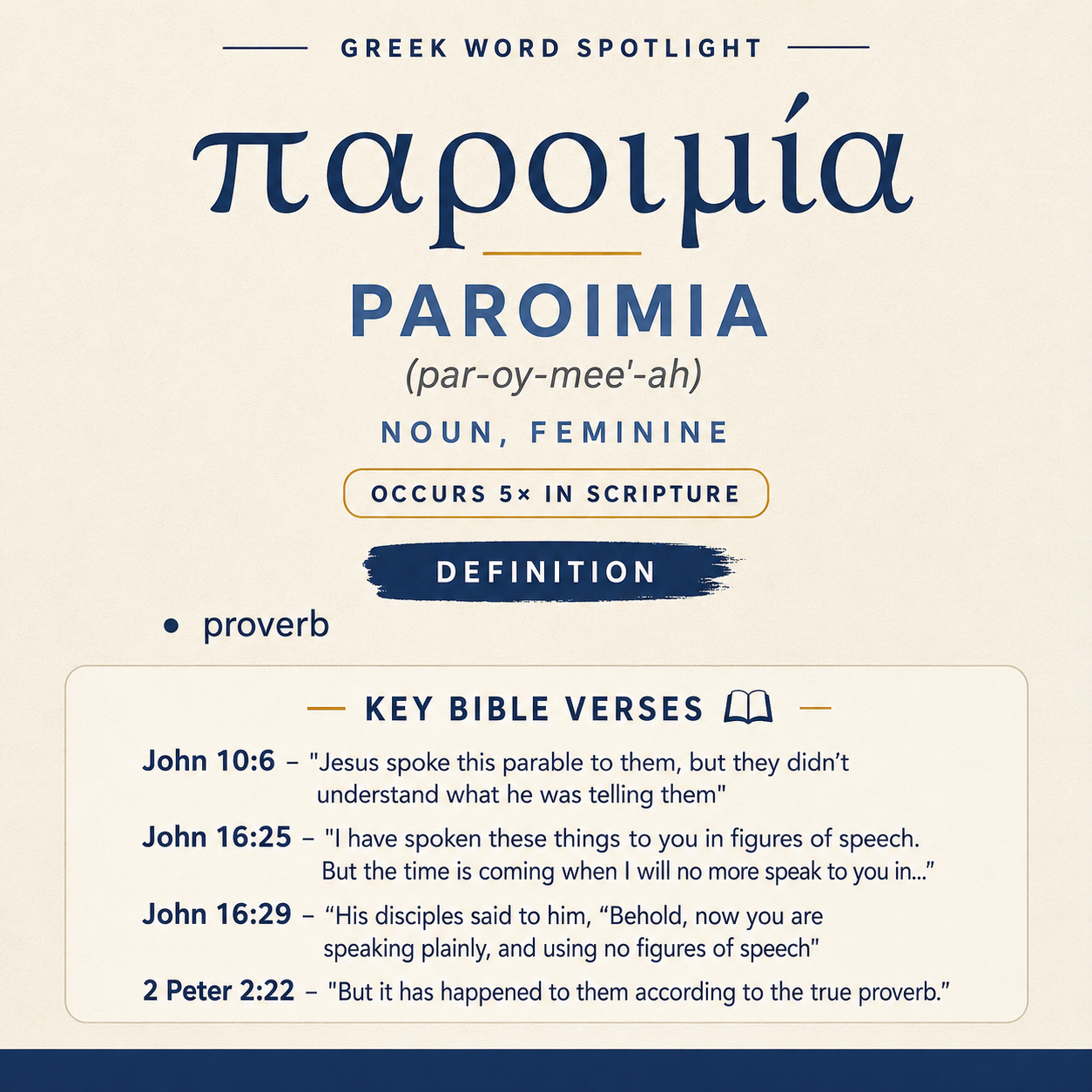
παροιμία means “proverb” and occurs five times in Scripture, including John 10:6; John 16:25, 16:29; and 2 Peter 2:22.
Gospel Usage
In John, παροιμία appears in contexts of figures of speech and plain speaking (John 16:25, 16:29). John 10:6 notes they did not understand what Jesus was telling them.
Learn More →Proverb Quoted
In 2 Peter 2:22, παροιμία introduces “the true proverb,” including “The dog turns to his own vomit again.”
Learn More →παροιμία denotes a “proverb,” a compact saying that conveys its point indirectly or in a memorable form. In the New Testament it appears in contexts where Jesus’ speech is received as figurative and where a moral warning is expressed as a pointed maxim.
Root and Related Words
παροιμία is connected with παρά (para), “from/with/beside” (Strong’s G3844), and οἴομαι (oiomai), “to suppose” (Strong’s G3633).

Occurrences
“Jesus spoke this parable to them, but they didn’t understand what he was telling them.” (John 10:6)
Here παροιμία frames Jesus’ communication as a proverb-like utterance: something spoken with a layer that requires discernment, rather than immediate comprehension. The verse itself highlights the typical effect of a proverb—its meaning can be real and intended, yet still opaque to hearers: “they didn’t understand what he was telling them.” In this scene the word marks the gap between the spoken image and the audience’s grasp of it, stressing that the form of speech calls for interpretation.
“I have spoken these things to you in figures of speech. But the time is coming when I will no more speak to you in figures of speech, but will tell you plainly about the Father.” (John 16:25)
In this saying, παροιμία belongs to a contrast between indirect expression and direct explanation. Jesus characterizes his earlier instruction as “figures of speech,” then sets a future moment when that mode will give way to plainness: “I will no more speak to you in figures of speech, but will tell you plainly about the Father.” The word therefore signals a teaching style that can carry truth in a veiled, image-driven form, suitable for instruction but also capable of leaving hearers with unresolved questions until fuller clarity is given.
“His disciples said to him, “Behold, now you are speaking plainly, and using no figures of speech.” (John 16:29)
This verse echoes the earlier contrast, but now from the disciples’ perspective. They identify a shift in Jesus’ manner: “now you are speaking plainly,” and therefore “using no figures of speech.” The presence of παροιμία here shows that the disciples recognized proverb-like speech as a distinct register—language that can be true yet not straightforward. Their comment implies that when such speech is absent, the message feels settled and accessible, as though the hearers are no longer required to infer the point from a compressed or indirect form.
“But it has happened to them according to the true proverb, “The dog turns to his own vomit again,” and “the sow that has washed to wallowing in the mire.”” (2 Peter 2:22)
In this warning, παροιμία introduces a moral diagnosis expressed through vivid animal imagery. The writer appeals to “the true proverb” and then gives two parallel lines: “The dog turns to his own vomit again,” and “the sow that has washed to wallowing in the mire.” The word marks these sayings as proverbial—memorable, concrete, and sharpened to a point—so that the lesson is carried by the scene pictured. The proverb-form is used to name an outcome (“it has happened to them”) as something recognizable and repeatable, the kind of pattern that proverbs are designed to capture.
Sense and Usage
Across these passages, “proverb” describes speech that teaches by indirection and by striking imagery. In John’s scenes, the word sits alongside the idea of “figures of speech” and functions in contrast with “plainly,” showing that proverb-like communication can be an intentional mode of instruction: it can reveal while also withholding full immediacy. John 10:6 underscores the interpretive demand that a proverb can place on hearers: the speech is delivered, but understanding is not automatic. John 16:25–29 then sets up a movement from proverbial speech toward directness, so that the proverb is not treated as false or empty, but as a form that can be surpassed by plain disclosure when the moment calls for it.
In 2 Peter 2:22, the same word is used not for teaching that awaits clarification, but for a settled maxim applied as a verdict. By calling it “the true proverb,” the writer treats proverbial speech as a carrier of recognized moral reality: the saying is not merely clever, but fitting to what “has happened.” The two images—returning to what is repulsive and returning to filth after washing—show how proverb-form can compress evaluation into a single, unforgettable picture. In this use, the proverb is not an open riddle but a sharp description of behavior and its tragic consistency.
Taken together, these texts show that παροιμία can name both (1) figurative, image-shaped instruction that listeners may struggle to grasp and (2) a concise maxim whose imagery supplies a moral conclusion. In both directions, the proverb operates by making a point memorable: either by inviting reflection until plain speech arrives, or by stamping a pattern of conduct with a picture that is hard to forget.
Imagery
The word’s imagery comes into focus most strongly in the explicit proverb quoted in 2 Peter 2:22: the dog returning “to his own vomit again” and the washed sow returning “to wallowing in the mire.” These are deliberately physical scenes, not abstract statements, and they show how a proverb can communicate through disgust and contrast—washing versus mire, turning away versus turning back. In John 16:25–29, the imagery is less concrete but still present in the contrast between “figures of speech” and speaking “plainly,” where the proverb-like form is pictured as a veil that can be lifted when fuller understanding is given.
Sources: Lexical data from Strong’s Exhaustive Concordance and the Translators Brief Lexicon of Extended Strongs for Greek (STEPBible, CC BY). Occurrence data from the Translators Amalgamated Greek New Testament (STEPBible, CC BY). Scripture quotations from the World English Bible (public domain).