
Exploring the Meaning of Pareisphero in Greek
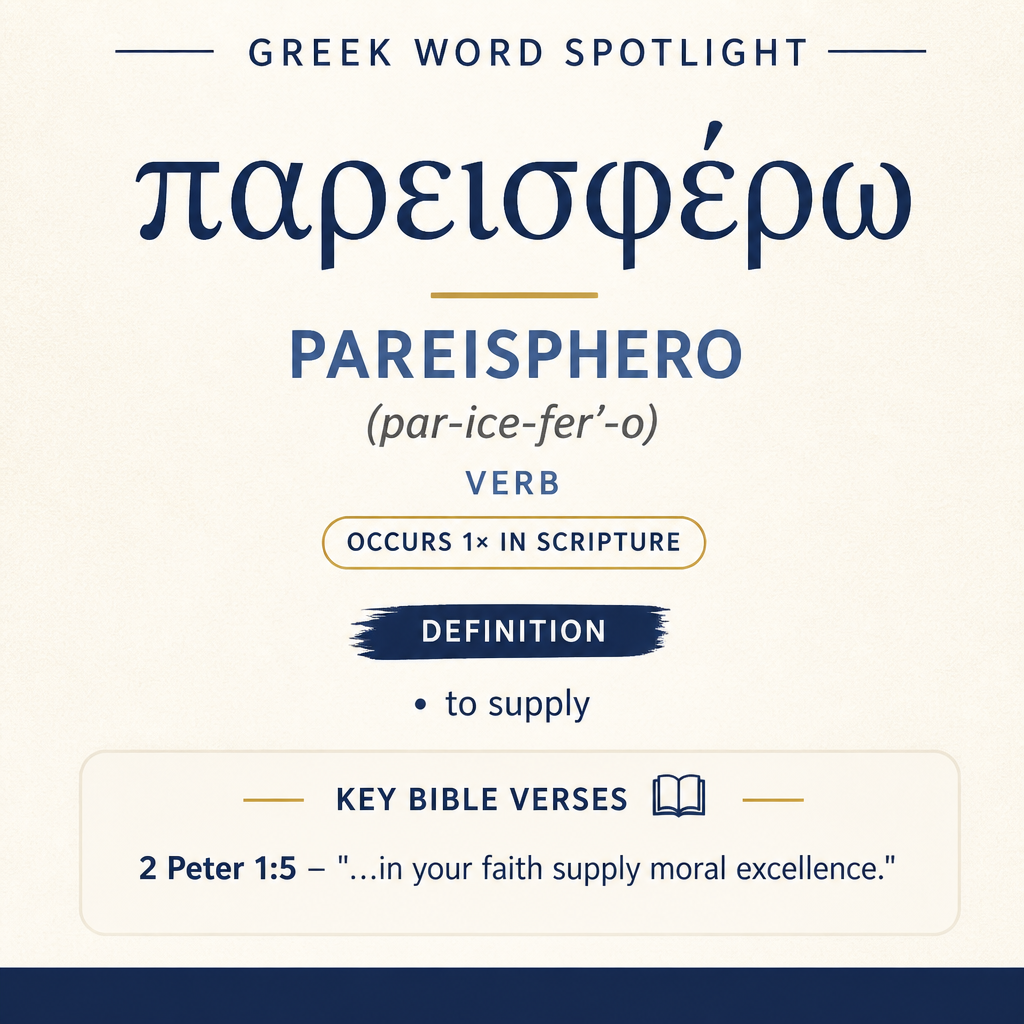
παρεισφέρω means “to supply” and appears once in Scripture, in 2 Peter 1:5.
Scripture Occurrence
It occurs 1 time in Scripture. Its single occurrence is in 2 Peter 1:5.
Learn More →Verse Context
In 2 Peter 1:5 it appears in the exhortation, “in your faith supply moral excellence.”
Learn More →παρεισφέρω means “to supply,” and it appears in the exhortation of 2 Peter 1:5, where it is used to describe what should be furnished within faith.
Root and Related Words
παρεισφέρω (Pareisphero) is related to εἰσφέρω (eisphero), “to bring in” (Strong’s G1533), and to παρά (para), “from/with/beside” (Strong’s G3844). These related forms frame the verb as an act expressed with a directional or relational nuance, with the action conceived in terms of bringing or providing in connection with something already present.

Occurrences
“Yes, and for this very cause adding on your part all diligence, in your faith supply moral excellence; and in moral excellence, knowledge;” (2 Peter 1:5)
Here the verb is set inside a tightly linked series of phrases that describe what is to be added “in” one sphere and then “in” the next: “in your faith supply moral excellence; and in moral excellence, knowledge.” The word marks a deliberate act of furnishing something to faith, not as a detached extra but as an element that belongs within faith’s working life. The verse has already called for “adding on your part all diligence,” and the supplying described by παρεισφέρω is presented as an intentional contribution that corresponds to that diligence: the reader is to take initiative, investing effort so that faith is not left alone but is furnished with what follows.

The immediate construction also places the supplying into a sequence. The supplied item (“moral excellence”) becomes, in turn, the setting in which the next item (“knowledge”) is addressed: “and in moral excellence, knowledge.” Within the verse’s logic, supplying is not merely providing one isolated ingredient; it functions as the mechanism by which one quality is furnished in relation to another, forming a structured progression. The verb thus carries the force of an enabling act—something that makes the next step possible within the ordered chain given in the sentence.
Sense and Usage
The sense “to supply” in 2 Peter 1:5 is practical and concrete in its effects: it governs what is to be furnished (“moral excellence”) and specifies where it is to be furnished (“in your faith”). The verse does not depict a passive receipt but an active provision aligned with “adding on your part all diligence.” Supply, in this context, is the action by which diligence expresses itself—by deliberately furnishing faith with what the instruction names.
Because the command is phrased “in your faith supply…,” the supplying is portrayed as occurring within an existing reality. Faith is already present as the sphere addressed (“in your faith”), and the instruction calls for a further furnishing inside that sphere. The verb therefore sits naturally alongside the earlier participial idea of “adding,” reinforcing the picture of supplementing: faith is not treated as the terminus of the exhortation but as the context in which further provision is made.
The verse’s paired clauses (“in your faith…; and in moral excellence…”) show how supplying functions within a patterned buildup. The word helps communicate that the qualities mentioned are not listed as disconnected virtues; they are to be furnished in relation to one another. Supply is the verbal hinge between what is already possessed (“your faith”) and what is to be furnished next (“moral excellence”), and it implicitly prepares for the subsequent furnishing (“knowledge”) by establishing that each step becomes the setting for the next (“in moral excellence, knowledge”).
Within this single attested use, “to supply” also bears a communal or cooperative tone in its wording: “adding on your part all diligence.” The act of supplying is described as something done “on your part,” highlighting personal agency and responsibility. The supplying called for is neither accidental nor automatic; it is a purposeful provision that corresponds to sustained effort. Thus, the verb’s contribution to the passage is to cast the moral instruction in terms of furnishing—providing what is needed in the appropriate place—rather than merely naming ideals.
Imagery
The imagery suggested by “supply” in 2 Peter 1:5 is that of provision added where it belongs: something furnished within faith as a deliberate act of diligence. The verse’s step-by-step phrasing evokes the picture of supplying one thing into another in an ordered way—faith furnished with moral excellence, and moral excellence furnished with knowledge—like successive additions placed into their proper setting.
Sources: Lexical data from Strong’s Exhaustive Concordance and the Translators Brief Lexicon of Extended Strongs for Greek (STEPBible, CC BY). Occurrence data from the Translators Amalgamated Greek New Testament (STEPBible, CC BY). Scripture quotations from the World English Bible (public domain).




