
Exploring the Meaning of Parathalassios in Greek
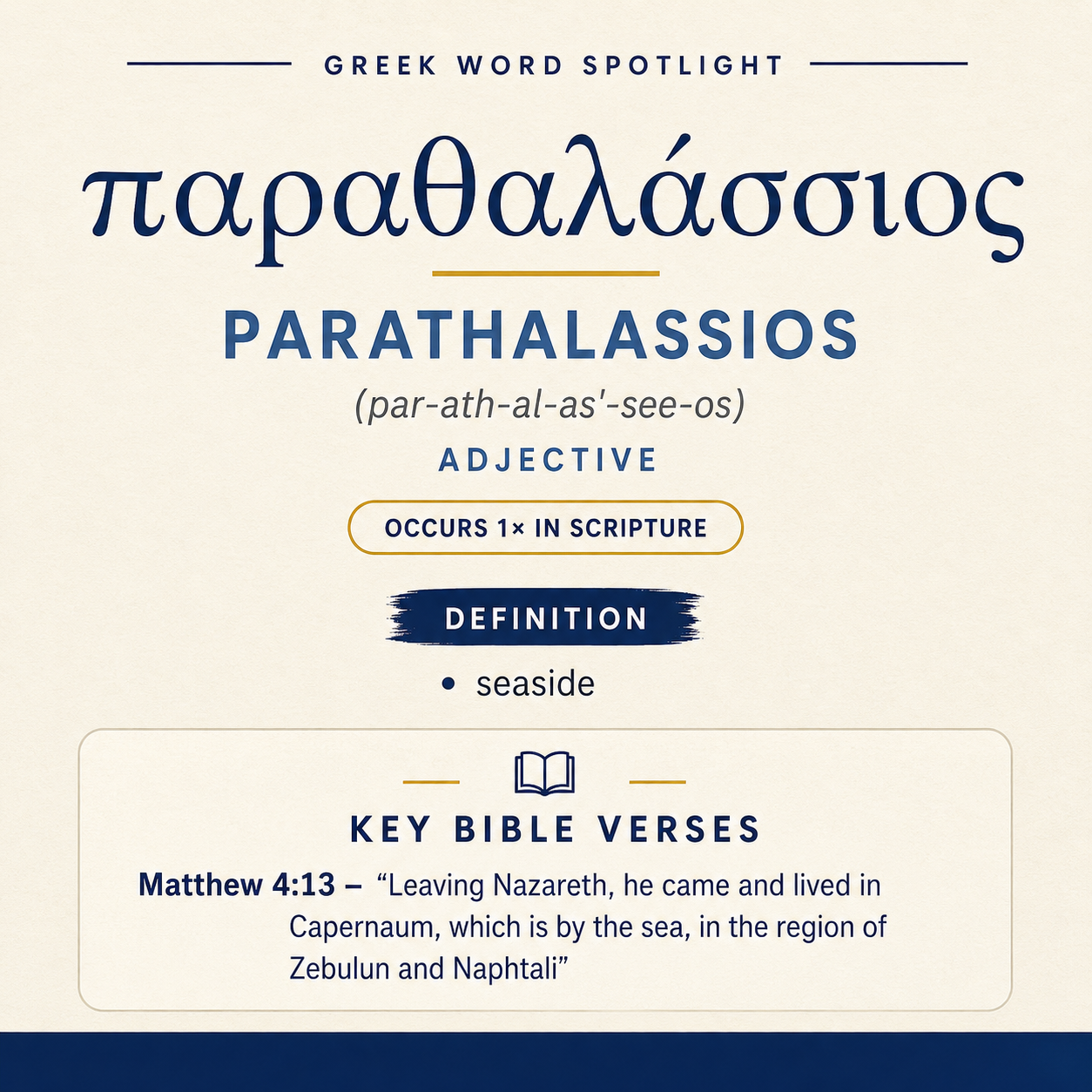
παραθαλάσσιος means “seaside” and appears once in Scripture, in Matthew 4:13.
Biblical Occurrence
It occurs 1 time in Scripture. Its single occurrence is in Matthew 4:13.
Learn More →Verse Context
In Matthew 4:13, it describes Capernaum as being by the sea, in the region of Zebulun and Naphtali.
Learn More →παραθαλάσσιος means “seaside,” and it appears in the description of where Jesus settled in relation to the sea in Matthew. The word frames a place by its immediate setting, locating it along the shoreline.
Root and Related Words
παραθαλάσσιος is formed from para (παρά), “from/with/beside” (Strong’s G3844), and thalassa (θάλασσα), “sea” (Strong’s G2281). The combination yields an adjective that characterizes something by its proximity to the sea.

Occurrences
“Leaving Nazareth, he came and lived in Capernaum, which is by the sea, in the region of Zebulun and Naphtali,” (Matthew 4:13)
Here the word functions as a geographic qualifier: Capernaum is identified not only as a destination but as a particular kind of location—one defined by nearness to the sea. In the flow of the sentence, the movement (“Leaving Nazareth”) culminates in a settled residence (“he came and lived”), and the seaside setting helps specify what sort of place this new home is. The line also places Capernaum within a wider territorial frame (“in the region of Zebulun and Naphtali”), so the seaside descriptor works alongside regional markers: the town is situated within named districts and, at the same time, is characterized by its coastal adjacency.
Because the verse’s wording describes Capernaum as “by the sea,” the adjective’s contribution is concrete and spatial. It points the reader to the shoreline as a defining feature of the locale. The statement is not about the sea as a theme or symbol in this verse; it is about where the town sits. The seaside descriptor therefore does the work of anchoring the narrative in a recognizable physical environment, making Jesus’ relocation an identifiable move to a maritime-adjacent town rather than simply a move to a different name on a map.
Sense and Usage
The sense “seaside” operates as a setting word: it characterizes a place by its relation to the sea. In Matthew 4:13 it modifies the understanding of Capernaum by foregrounding the town’s position at the water’s edge, which is a straightforward way of describing location. The word’s force is adjectival and local: it does not name the sea itself, but it assigns a coastal quality to what it describes, marking the place as belonging to a shoreline environment.
In this verse the seaside description is paired with other location cues (“Leaving Nazareth,” “came and lived,” “in the region of Zebulun and Naphtali”). This clustering shows how παραθαλάσσιος naturally fits within travel and settlement narration: it answers the question “what kind of place is this?” by giving a single, compact environmental feature. The word’s meaning does not require elaboration within the sentence; it is immediately intelligible as a descriptor of proximity, and it sharpens the reader’s mental picture of where the action is now located.
Imagery
In Matthew 4:13 the imagery carried by παραθαλάσσιος is that of a town set along the shoreline—life and dwelling placed next to open water. The verse presents this as an ordinary geographic fact, but the adjective still paints the scene: a residence established at a place defined by the sea’s presence nearby.
Sources: Lexical data from Strong’s Exhaustive Concordance and the Translators Brief Lexicon of Extended Strongs for Greek (STEPBible, CC BY). Occurrence data from the Translators Amalgamated Greek New Testament (STEPBible, CC BY). Scripture quotations from the World English Bible (public domain).





