
Exploring the Meaning of Parapikrasmos in Greek
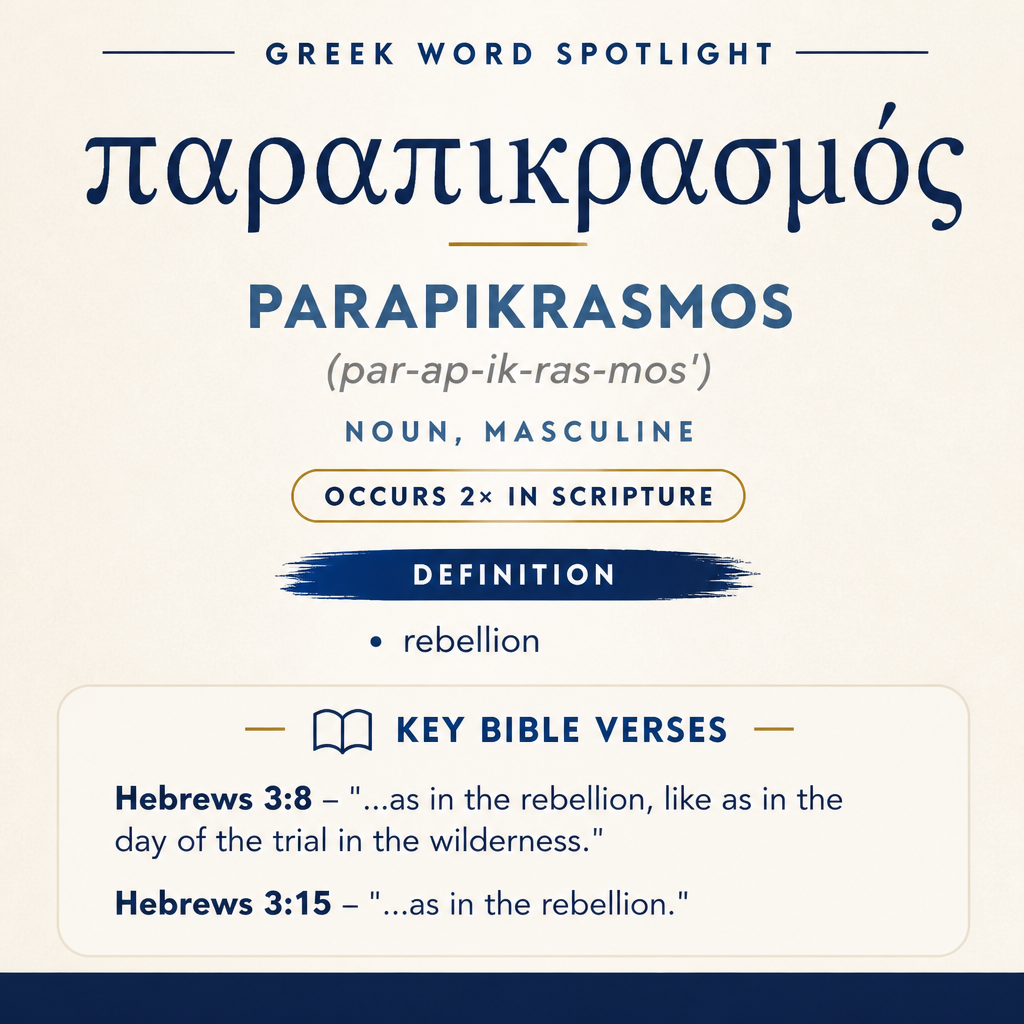
παραπικρασμός means “rebellion” and appears twice in Scripture, both in Hebrews 3:8 and 3:15.
Scripture Occurrences
It occurs two times in Scripture. Both occurrences are in Hebrews 3.
Learn More →Hebrews Context
In Hebrews 3:8 and 3:15, it is linked with the warning, “don’t harden your hearts.”
Learn More →παραπικρασμός means “rebellion” and appears in Hebrews 3 in an exhortation against hardening the heart. In both places it functions as a warning example tied to hearing God’s voice and responding rightly.
Root and Related Words
παραπικρασμός is related to the verb parapikraino (παραπικραίνω), “to rebel” (Strong’s G3893), from which this noun derives.

Occurrences
“don’t harden your hearts, as in the rebellion, like as in the day of the trial in the wilderness,” (Hebrews 3:8)
Here παραπικρασμός is set inside a direct appeal: “don’t harden your hearts.” The noun names a concrete historical pattern used as a cautionary comparison—“as in the rebellion”—and it is paired with a second comparison, “like as in the day of the trial in the wilderness.” In the logic of the sentence, “rebellion” is not merely a label for a bad moment; it is an interpretive name for the heart-posture the readers are warned against. The command addresses the interior (“your hearts”), while the example (“the rebellion”) provides the outward, remembered shape of what hardened hearts look like when put under pressure. By linking “the rebellion” with “the day of the trial,” the verse treats rebellion as something that surfaces in testing: a response that manifests when God’s people face a demanding situation and are confronted with the need to trust and obey.

The wording also shows that παραπικρασμός functions as a shared reference point between writer and audience. The phrase “as in the rebellion” assumes a story already known well enough to serve as a moral analogy. Within this one line, rebellion becomes a kind of benchmark: a named event or episode to which later hearers can be compared. That is why the prohibition is framed negatively (“don’t harden”), and the comparison is framed as a past instance to avoid (“as in…”). The noun thus carries the force of a warning sign: it gathers up the memory of a communal failure and places it alongside the readers’ present choice.
“while it is said, “Today if you will hear his voice, don’t harden your hearts, as in the rebellion.”” (Hebrews 3:15)
In Hebrews 3:15 the noun appears inside a quotation introduced by “while it is said,” and it is anchored to a temporal summons: “Today.” The structure is urgent and conditional: “Today if you will hear his voice.” The exhortation that follows matches Hebrews 3:8—“don’t harden your hearts”—and again the warning is sharpened by the comparison “as in the rebellion.” In this setting, παραπικρασμός functions as the negative counterpart to “hear his voice.” The verse sets two trajectories in opposition: hearing in the present (“Today… hear”) versus repeating a prior pattern (“as in the rebellion”). Rebellion is presented as the kind of response that can be reenacted, not simply remembered; the readers can still fall into the same posture if they refuse to hear and become hardened.
The placement of παραπικρασμός at the end of the quotation gives it rhetorical weight. The clause closes with the cautionary comparison, leaving the sound of “rebellion” as the final note of the warning. The effect is that “rebellion” names the outcome of a hardened heart when confronted with God’s speaking. The noun does not stand alone as a topic; it is integrated into a direct appeal about responsiveness. The scene is not described in narrative detail here, but the moral picture is clear from the words on the page: there is a voice to be heard “Today,” and there is a way of refusing that voice that deserves the name “rebellion.”
Sense and Usage
Across its two uses in Hebrews 3, παραπικρασμός serves as a fixed label for a decisive, cautionary example. The word is not used to describe a minor fault or a vague attitude; it is invoked as an identifiable episode with enough clarity to function as a comparison point (“as in…”). That comparative construction is central to how the noun works in these verses. It turns rebellion into an instructive pattern: the readers’ present heart-condition can be measured against it, and their response to God’s voice can be assessed in light of it.
The immediate collocations also show how Hebrews frames the phenomenon. Rebellion is connected with “hardening” and with a situation called “the day of the trial in the wilderness.” Those links situate rebellion in the realm of covenant response rather than mere emotion. The issue is not simply that people felt doubt or fear; the writer’s chosen descriptor for the remembered moment is “rebellion,” and that descriptor is applied precisely where the text speaks of resisting God’s speaking (“hear his voice”) and where it warns against inward stubbornness (“harden your hearts”). In this way, παραπικρασμός names a settled opposition that expresses itself through refusal to listen and a hardened interior posture.
Because παραπικρασμός derives from parapikraino (παραπικραίνω), “to rebel,” the noun naturally carries an event-like sense: it points to rebellion as something enacted, not only felt. Hebrews draws on that event-character by using the definite article (“the rebellion”), treating it as a known episode. Yet the application is forward-looking: both occurrences address a present audience with commands and conditions. The remembered rebellion is therefore more than background; it is a moral analogue meant to prevent repetition. The noun becomes a bridge between past and present—an established name for a prior failure, used to press the urgency of “Today” and the seriousness of hardening the heart.
Within these verses, the semantic profile of παραπικρασμός is also shaped by its contrastive role. The positive alternative is implicit in the text itself: hearing God’s voice and not hardening the heart. Rebellion, then, is portrayed as the opposite of receptive hearing. The word’s force in Hebrews 3 is pedagogical and pastoral: it compresses a complex failure into a single, weighty term that warns the community against repeating the same kind of response under trial.
Imagery in Hebrews 3
The passages surround παραπικρασμός with vivid moral imagery: a “heart” that can “harden,” a “voice” that can be “hear[d],” and a remembered “day of the trial in the wilderness.” In that setting, rebellion is pictured less as a sudden outburst than as a hardening process—an interior stiffening that results in the refusal to heed what is being spoken “Today.”
Sources: Lexical data from Strong’s Exhaustive Concordance and the Translators Brief Lexicon of Extended Strongs for Greek (STEPBible, CC BY). Occurrence data from the Translators Amalgamated Greek New Testament (STEPBible, CC BY). Scripture quotations from the World English Bible (public domain).




