
Exploring the Meaning of Parabouleuomai in Greek
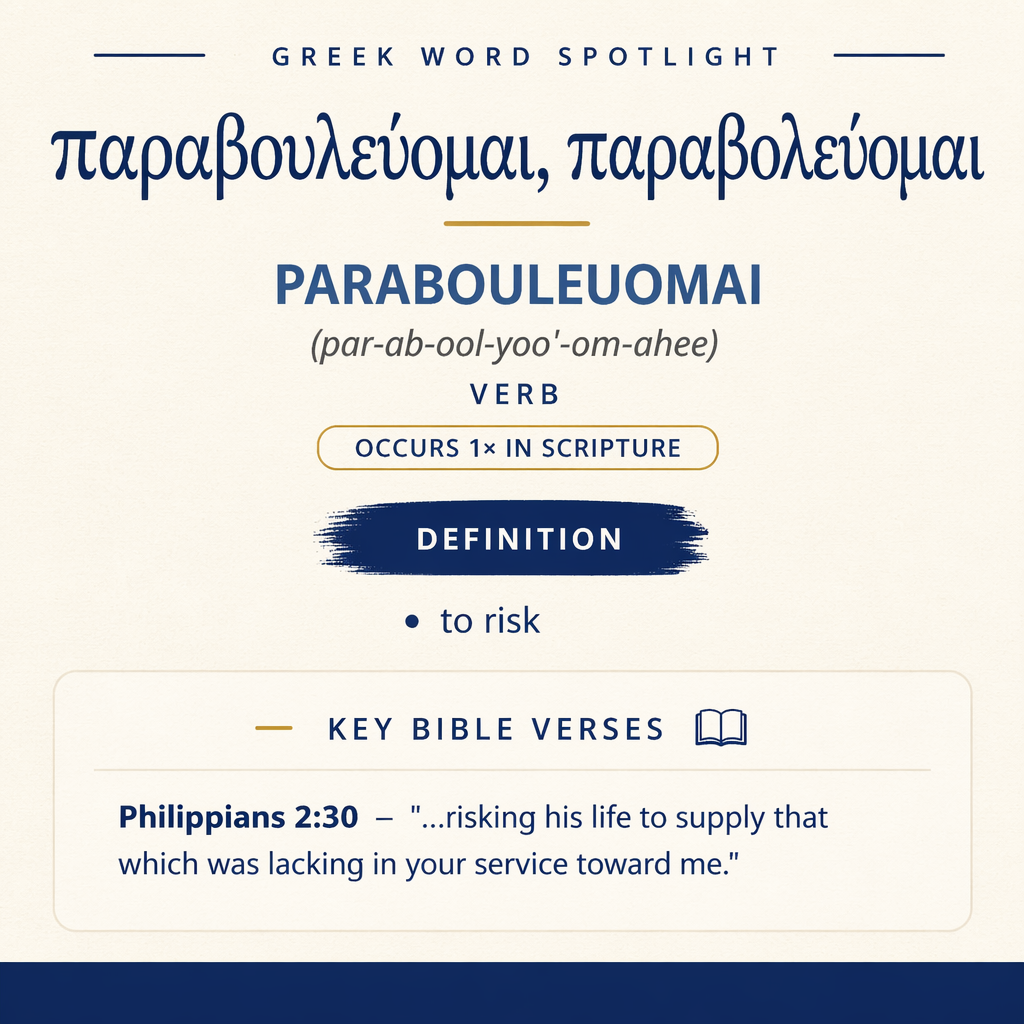
παραβουλεύομαι (παραβολεύομαι) means “to risk” and appears once in Scripture, in Philippians 2:30.
Verse Context
In Philippians 2:30, it describes risking his life for the work of Christ to supply what was lacking in their service.
Learn More →Parabouleuomai means “to risk” and is used once in the New Testament, in Paul’s description of another believer’s near-fatal service for Christ in Philippians.
Root and Related Words
Parabouleuomai is connected with two Greek elements reflected in related forms: bouleuō (βουλεύω), “to plan” (Strong’s G1011), and para (παρά), “from/with/beside” (Strong’s G3844). Together these components frame the verb’s shape and help locate it within a family of words associated with counsel or deliberation (bouleuō) and proximity or association (para).

Occurrences
“because for the work of Christ he came near to death, risking his life to supply that which was lacking in your service toward me.” (Philippians 2:30)
In this line Paul sets the verb inside a tightly packed account of devotion under pressure. The clause begins with motive: “because for the work of Christ,” identifying the cause that drove the action. It then states the cost in stark terms: “he came near to death.” The participial phrase “risking his life” explains how that nearness to death occurred—not as an accident of travel or an unavoidable misfortune, but as exposure willingly accepted while carrying out a task tied to “the work of Christ.”
The immediate purpose of that risk is also made explicit: “to supply that which was lacking in your service toward me.” The verb therefore functions as a bridge between two realities in the verse: the tangible danger (“near to death”) and the concrete aim (“to supply” what was missing). The “risking” is not narrated for its own drama; it is the manner in which the supply was accomplished. Paul’s wording places the risk on the level of personal life itself (“his life”), emphasizing that what was put in jeopardy was not comfort, reputation, or convenience, but continued existence.
Within the sentence, the verb also sharpens the moral and emotional texture of the scene. Paul is not merely reporting that someone “served” or “worked,” but that he accepted a serious hazard so that a gap could be filled. The reference to what was “lacking” does not diminish the Philippians; rather, the sentence treats their “service toward me” as real and meaningful, while acknowledging that something remained incomplete until this act brought it to fulfillment. In this way, the word “risking” marks the point where concern becomes embodied action—action costly enough to be measured against death.
Sense and Usage
The sense “to risk” in Philippians 2:30 is not abstract or hypothetical. It is anchored to a clearly stated outcome: the person “came near to death.” The verb therefore operates in a domain where “risk” is validated by a real, severe threat rather than a minor possibility. The verse does not treat the danger as inevitable fate; it presents it as something approached in the course of purposeful work. “Risking” names the posture taken toward danger: a willingness to proceed with the work even when the work exposes one’s life to loss.
Because the “risking” is paired with “to supply,” the word also carries a practical direction. It is not risk as spectacle, nor risk as recklessness described for shock value. The sentence ties risk to an act of provision: something needed to be supplied to Paul that was connected to the Philippians’ “service,” and that supply required someone’s costly involvement. The verse thus situates the verb at the intersection of mission (“for the work of Christ”), relational responsibility (“your service toward me”), and embodied vulnerability (“his life”).
The construction in English (“came near to death, risking his life”) also helps the reader feel the movement of the thought: nearness to death is explained by the risking of life. In other words, the word frames the peril as entered rather than merely encountered. The outcome is not a generalized “hardship,” but the extremity of death’s proximity; the action is not merely “going,” but going in a way that places life in jeopardy for the sake of a defined good.
Even in its single appearance, the verb’s placement gives it rhetorical weight. It is the pivot between the cause (“for the work of Christ”) and the benefit (“to supply that which was lacking”). The word therefore highlights a kind of service that is measurable by what it costs, and it presses the reader to interpret the supply given to Paul as something purchased at great personal hazard.
Imagery
Philippians 2:30 gives “risking” concrete edges: a worker “came near to death” while pursuing “the work of Christ.” The imagery is of a life brought to the brink, not because the goal is death, but because the task is carried through when danger is close. The verse leaves the danger unspecified, but it paints the scene in stark contrast—death near at hand, and service still being rendered so that what is “lacking” may be supplied.
Sources: Lexical data from Strong’s Exhaustive Concordance and the Translators Brief Lexicon of Extended Strongs for Greek (STEPBible, CC BY). Occurrence data from the Translators Amalgamated Greek New Testament (STEPBible, CC BY). Scripture quotations from the World English Bible (public domain).





